Volunteer with us Today!! We have various dates to choose from Jan 31st | Feb 1st | Feb 27th | Feb 28th | Mar 1st | Sign Up Today!

YG State Conference

Live, Love, Leg: The Importance of the Legislative Branch

By Delia Rune,

Liberal Arts and Science Academy


The legislative section of Youth and Government (YAG) is one of the organization’s
most popular sections. In the legislative section, students propose bills and try to get them
passed.

One of this year’s legislative students, Prabath Girish, explained his bill about Texan
education standards. “My bill is about re-examining the TEK standard for learning in the state of Texas,” Girish said, “and readjusting the scheduling of them in such a way that makes it less stressful for students, and allows them to learn better.” According to Girish, doing the legislative section has taught him a lot about different
perspectives and encouraged him to be more open-minded. He thinks YAG helps students speak
their minds. “I’ve definitely learned about lots of different viewpoints in the world on different
issues,” Girish said. “All of us have a voice, and we all are very different people and can learn to
speak our own opinion and our own minds.”

Fabiana Urrego Diaz, another legislative student, describes her experience in the
legislative branch as being really fun. This is her second year at YAG, and she already feels like
she has gained a lot of valuable skills. “I’ve learned to be more confident when talking.” Diaz said, “Because, I mean, you have to be out there answering questions while people question the way you think. So I definitely have learned to be more confident when I speak in public.” Diaz agrees that YAG and the legislative branch have taught her the value of other perspectives. She says she definitely plans to keep coming back. “I think YAG is an important thing because we learn about different issues,” Diaz said. “And we kind of learn to take into account different people’s perspectives, and be like, more open-minded and more understanding.”

Girish agrees that YAG is important, and he hopes that it gives students skills they can apply to their lives as adults. He thinks the main skill the legislative section can teach students is the value of sharing their opinions. “YAG is really important because it gives people a voice.” Girish said, “It’s super important to allow people to get their voices out there. A lot of people are reluctant to speak out, but everyone has an opinion that should be heard.


YAG is the now. YAG is the future!

By Zuly Noriega,
Duncanville High School 


As the Renaissance Hotel becomes flooded at State with eager delegates from Youth and Government (YAG), we can’t help but notice District 5’s theme and attire. A navy long-sleeve blue shirt with big bold red letters spelling out, “THE NOW GENERATION.” Delegates also can’t help but stop and read the messages being plastered on posters and balloons displayed all throughout the lobby saying “FUTURE CHANGE MAKERS”.

These phrases echoing around this week’s conference raise our curiosity and invite big questions: How do both these topics tie together and apply to YAG students; and why is it so significant to acknowledge delegates’ roles in them?

The Now Generation has high ambiguity, many meanings, and is uniquely defined by every delegate. Two conference delegates asked what the Now Generation means to them gave different definitions, although both had a similar idea of how the Now Generation contributes to the theme of “Future Change Makers.”

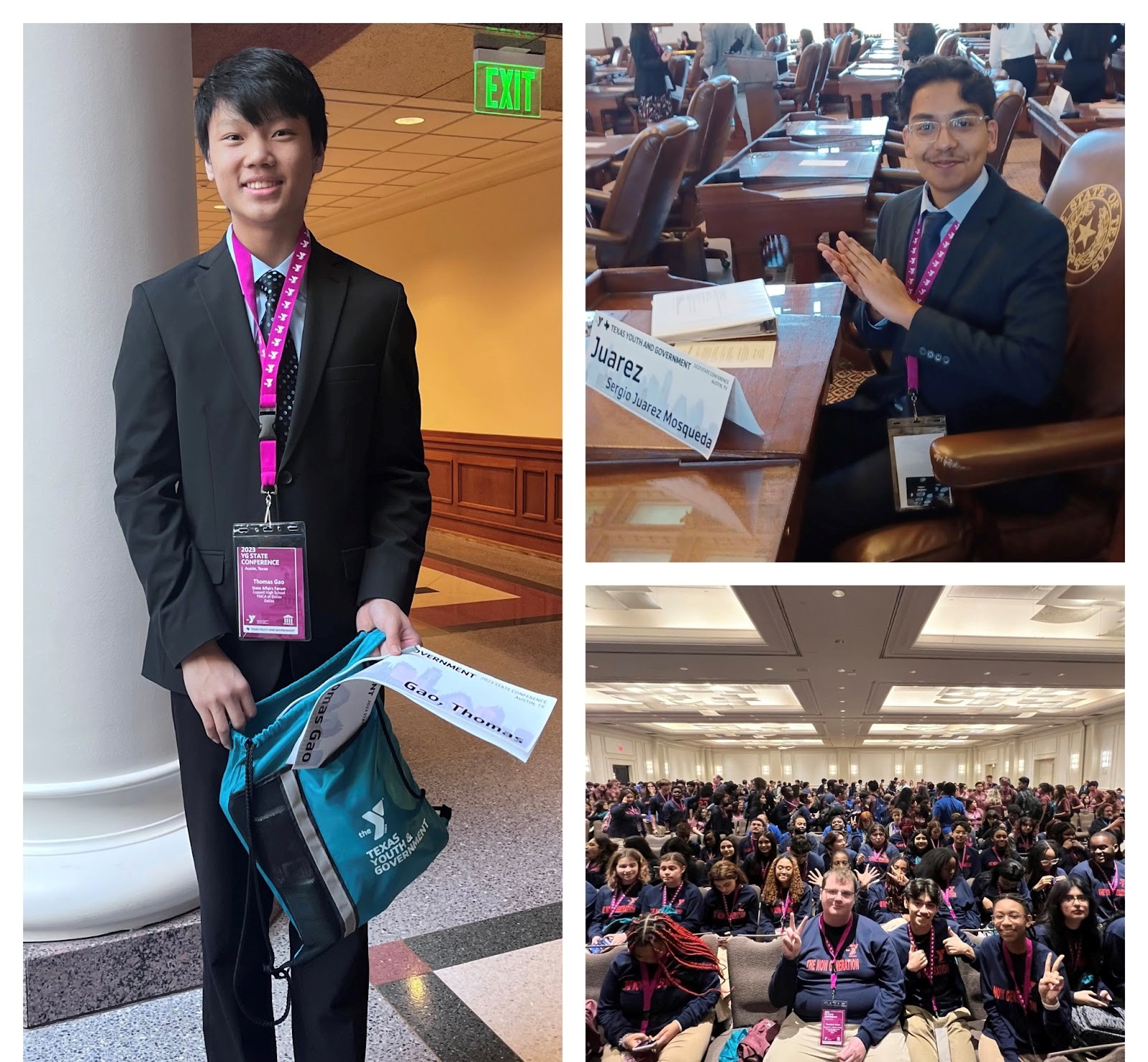
State Affairs Forum (SAF) delegate Thomas Goa defines the Now Generation as, “The Now Generation is how our generation doesn’t recognize the role they have, which is why a lot of youth does not vote.”

Legislative delegate Sergio Juarez says, “The Now Generation is a unique group who have gone through lots of physical, social, and emotional challenges.” Both delegates have unique meanings of the Now Generation and both mention change.

Goa adds, “We need to realize that it is up to the youth to make changes, speak out when we have the chance, and be aware of our situations and our society.”

Juares says, “Delegates have built the determination to be able to make a change if they want to make a change.”

Overall, these two delegates help shine a light on how the youth are the drivers of this change. In other words, the “Future Change Makers.”

Since the Now Generation is believed to be the future change makers, which includes the YAG delegates, it is significant for these individuals to understand their impact on the world. YAG delegates’ awareness of their influence on the future is significant and represented in YAG because it helps demand change now and fast. For YAG, a lot of members want to make a change and know they can do it now, so they create these proposals and bills to have a future of getting passed in the National Congress.

The next time you delegates come across a Now Generation t-shirt, or when you are taking pictures with friends with the words “Future Change Makers” in the background, remember and understand that you all are the “NOW” and you all are the “FUTURE.” It is up to YOU as a delegate to take responsibility for the torch, maintain the flame and strongly pass it onto the next. 

  Delegates Thomas Gao and Sergio- Juarez, The Now Generations shirts worn.

A Game of Cards

By Saron Elias

Garland High School


Youth and Government collects students from all around the state, allowing them to come together as a group to compete, learn from each other, and show their skills. However, delegates tend to hesitate when it comes to meeting others, despite this rare opportunity to meet fellow delegates from across the state who have a similar interest in government. One group of students, however, traveled outside of their bubble to create new connections.

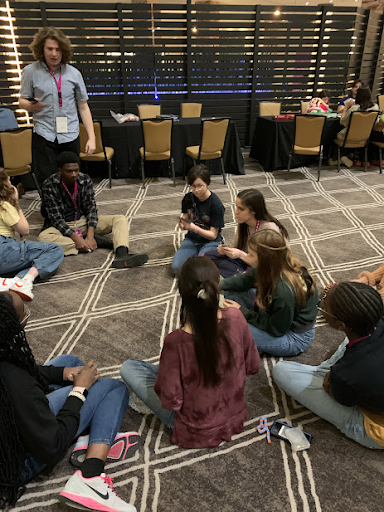
As game night commenced on Friday night, students set off, ready to explore the different activities. While some students rushed to the karaoke station, others flocked to the board game section. Seated on the floor amongst the chaos was a group of about 10 playing with a deck of cards. When asked what game the group was playing, delegate Lizzie Bobzien stated that the group was playing “B.S”. The group had formed spontaneously through delegates inviting others to join the game. Bobzien stated that she’s “never met [these] people before” and that they had simply gone around the board game section, asking if others wanted to play. Bobzien claimed that this game night was “a lot more fun” in comparison to her previous 2 years. As Bobzien was completing an interview about the group, students around the circle were laughing and having an enjoyable time meeting and conversing with others as they bonded over a card game they all loved.

This group of students playing a simple card game exemplifies the unity that Youth and Government has the potential to create. Although reaching out to others to construct a group for a game of cards may seem insignificant, it signals the start of connections that can continue to blossom over time. This group of students made some new friends that night and formed connections that may continue to grow with every conference they attend. By making small steps to connect with fellow delegates, Youth and Government participants can work towards creating a sense of community across the next generation of government workers in Texas. 

Fellow delegates, step outside of your comfort zone and make connections with those around you. You never know who you’ll find!


Delegates circle up to play B.S

Youth and Government Women Delegates Explain the Unspoken Sexism

By Spandana Palyam,
Liberal Arts and Science Academy

Though respect rules are withheld, some sexist opinions do not waver. Despite women working in the government for nearly 100 years now, people still do not treat them with the same regard as they do with men; unfortunately, sometimes even in Youth and Government, which is a program that actively encourages all adolescents to join. “Even if it’s not overt, every single woman here can attest to the fact that she’s walked into a room and gotten a look that made her feel less than.” Catherine Masey expressed. 

Catherine Masey has been part of the Youth and Government program for three years and loves it because she wants to make the world a better place. While YAG has rewarding aspects such as collaborating with new people and exploring different aspects of authority, equality is not always given. Last year, Macey judged during district and asked a male evaluator for constructive criticism after the event. “He looked at me and he was like, not for you. And then turned around and gave feedback to the teams who had boy attorneys,” Masey claimed. The evaluator also did not give feedback to any girl witnesses at all. She expressed her exasperation with people respecting her. “There are quite a few people, women, and men, who think they can talk over me. And I’ve seen them not do that to a male judge and evaluators too,” Masey said. Masey acknowledges that even though these actions can be unintentional, it is still something that should not happen.

Other female delegates have also had a similar experience. One claimed that a lot of times, male judges tended to not encourage receiving feedback for themselves and that sometimes the feedback given is not accurate. “They’ll tell you that your witnesses were boring. And then it’s very strange feedback. They also won’t really take any feedback,” the delegate claimed. 

Additionally, male delegates have been unnecessarily blunt towards female representatives. Lucy Murphy experienced this firsthand while participating in the Legislative section on March 3. “When I was doing leg[islative] yesterday, I noticed that the boys in the room would object to girls’ bills a lot more than guys and would try to make it seem as if they were better than us.” Murphy also mentioned that the girl legislators were not taken seriously by boy legislators. 

Thankfully, Youth and Government is always open to improvement and deals with issues relating to disrespect. Rules and regulations are just the start to changing the opinions and experiences of women youth and government participants.


Delegate Feature: Fatimah Sajid

By LeeAnn Partin,

Hays High School


Out of the 1300 delegates this weekend, many get lost in translation- and more often than not, our newest delegates here are forgotten about! Despite this, one rookie has stood out amongst the crowd: Fatimah Sajid.

Her journey starts in Vista Ridge High School, combined with Austin’s District 2, with many of her peers choosing the legislative route. Delegate Sajid is one of the newest recruits to the legislative section, starting her first year as a freshman in this State Conference. Sajid is 14 years old, making her a part of some of the youngest Youth and Government members. For the first time, Sajid creates her bill for legislation: House Bill 124, an act to provide free healthcare to legal residents of Texas who make household incomes less than or equal to $59,999 per year. While Sajid’s bill was posted for unfavorable recommendation, she’s quickly learning from the experience on how to improve. With the goal to be a politician in mind, she’s taking this chance to grow her writing and learn more about the position she wants to take on through her experiences in Youth and Government, and her other extracurriculars.

While chatting with Sajid, she tells me a bit about herself. “I go to Vista Ridge High School. Everyone says it’s in Austin, but it’s technically in Cedar Park,” Sajid clears up. “I’m in the legislative section- everyone else in my school is in that too!” Because of this, Sajid explains it’s a difficult learning curve to go into any different section without help.

Jumping to Sajid’s assignments for her section, she details her thought process behind them. “My bill is made to help lower income and kind of middle-class families to afford basic healthcare, an unalienable right that we all have.” Sajid’s bill not being passed surprised her, but motivates her to try a different route for next year.

Despite spending her free time participating in Debate she also participates in the Health Occupations Students of America (HOSA) and enjoys spending time at the Mosque to help tutor refugees. Sajid explains how she also loves to dance; no dancing experience, just enjoys it!

So far, she’s loving her first experience at state and is coming back with fire next year. Watch out delegates, Fatimah Sajid is ready to shine.


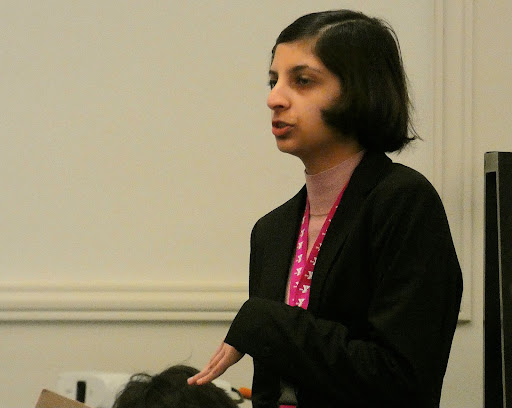
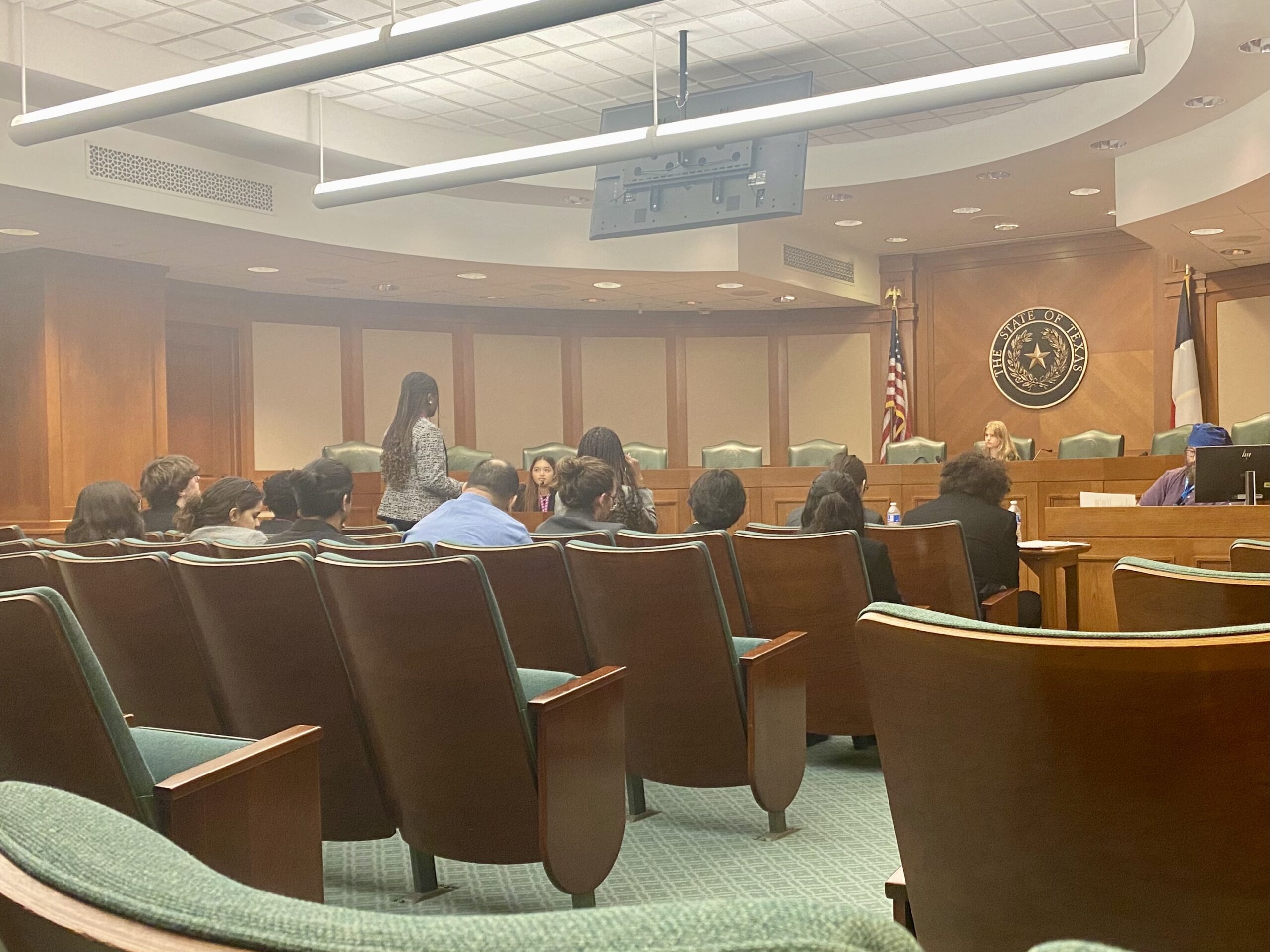
Fatimah Sajid during Question and Answer time in Committee B for delegate Theodore Nguyen’s bill

In Defense of the Windshield Murderer

By Alanis Rodriguez,
Chisholm Trail High School

In late October 2021, Jefferson Doyle was hit by a car that was driven by Arlo Key. Before this, Key had taken an Ether pill, distorting his perception of time and the senses. He then went to the club PB&J after an eight-hour shift as a nurse aide. In the club, he drank alcohol and smoked marijuana, further distorting his senses. As he drove home, Key hit Doyle, causing Doyle to get stuck on his windshield. Key then drove home and kept his car in the garage. An anonymous tip led the police to Key’s home, where Key broke down in tears and admitted to killing Doyle in a written statement.

When deciding who is guilty in trial case, there are two groups diligently fighting to prove their point. The prosecution proves that the person accused of the crime is guilty. Meanwhile, the defense proves that the person accused of the crime is innocent. Ultimately, the judge must determine the defendant’s guilt.
Throughout the rounds, the defense claimed that since Key had taken in drugs, alcohol and was sleep deprived because of his shift, that he did not knowingly intend to cause the death of Doyle. The defense used teamwork and a catchphrase to diminish the prosecutor’s argument.
“Out of sight, out of mind, and out of time,” said Eva Wesley as she started her opening statement. This phrase was used in court to catch the court’s attention in a concise catchphrase and prove Key’s unstable state while inebriated. Wesley and her co-council, Ibenehita Eguakhide, made sure to emphasize the drugs Key took and the serious, debilitating affect it had on him, along with the sleep deprivation.
“I was using Google, and [it told me to] repeat three things, like in a sequence,” Wesley explained. “And then she [Eguakhide] came up with ideas on how to plug everything in and connect the entire trial to those three elements.” The two worked together to create a strong and effective argument that eventually paid off, as the judge determined that Key was not guilty in just their first round of the day.
Key found not guilty in murder trial.

Prosecution, Defense Strategies Vary in Arlo Key Trial

By Joelle Henry,
Chisholm Trail High School

As people say “there are two sides to every story.” In court, this statement applies in the same way. For cases in court, the prosecution presents facts to the jurors and judges to incline the result that the prosecutors want.

In the mock trial “the windshield murderer”, Arlo Key, a nurse aide, killed a homeless man named Jefferson Doyle while under the influence on October 6th, 2021. As the story goes, the defendant, Arlo Key, went out to a bar with family and friends, but before arriving to the bar Arlo went to their friend’s house and took a narcotic and was not in the right state of mind. After many drinks at the bar that night, Arlo was driven home by a friend but got back into his car highly intoxicated to take a drive. During that drive Arlo, in an inebriated state of mind, and as an occurrence of their reckless driving, they hit and killed a homeless man, Jefferson Doyle.  

In a state of panic, the defendant took the body, which is tampering with evidence, and hid the body in the garage until they dumped the body in a nearby park. The case went cold for a couple of months until an anonymous tip was given to the police saying that Arlo Key was the murderer. A prosecutor’s job is to find the defendant, which in this case, Arlo Key, guilty of murder and tampering with evidence. After seeing different versions of the case, it can be concluded that every prosecutor has a different way to approach witnesses and the defense.

Regardless of the outcome of the case, it’s interesting to hear what prosecutors do to prepare themselves, and what type of strategies they use. Charles VanScoy, from YMCA of Greater Williamson County, was one prosecutor interviewed about strategies for words and comments that they might have been using during the trial.

“We really tried to base everything factually. We wanted everything to be like based in the affidavit, so it is less objectionable,” VanScoy said, who also acknowledged areas for improvement. “We were pretty disorganized,” VanScoy said, “so we probably lost some points on decorum. I think my opening was pretty good. And his closing work was good, but I think we can improve the directs by adding more evidence.”

Arnav Koppala was another prosecutor, from NorthPark YMCA, who shared ideas and strategies that were used on trial. “On the prosecution side, we truly believe that the substance abuse did not affect her decision making, because it’s integral for the prosecution,” Koppala said,” that we meet the burden of proof and for failure to stop and render aid that goes under the felony for felony murder. Whereas, on the defense, we’re trying to show there’s doubt in the prosecution’s case.” 

“Prosecution is proving their point of to the court, and they use multiple strategies to do so. I take time and practice to polish statements and evidence, for every case prosecution may have.”

Arlo Key is tried after killing a homeless man while driving under the influence of narcotics.

Do First-Time Drug Users Deserve Leniency?

By Syrah Omar,
Chisholm Trail High School

Exposure to drugs could lead a victim down a shadow-casted path. The less fortunate never escape this path, leading to a life controlled by their addiction. In the trial case “The Windshield Murderer”, the defendant Arlo Key has taken the life of another while under the influence of intoxicants and drugs. Among the drugs consumed by Key is ether, a drug that can cause disorientation and hallucinations. As a first-time user of ether, the effects of this drug were new to Arlo. A question emerges: if a law were enacted that lightened the punishment for first-time users of a certain drug, how would this change the court verdict?

“I think that people always deserve second chances,” said Catherine Masey, a Judicial delegate who served as a judge. Individuals who consume a certain drug for the first time may underestimate the effects and potential development of addiction. The effects that result from the intake of these substances may also be heightened as a surprise factor is included within the experience. Delegate Masey emphasizes the difficulty of the case, especially when drugs and their influence must be considered when making a final decision.

From a defense attorney’s point of view, “leniency”, as described by the judicial delegate Eva Wesley, is what would have been given if the law was enacted. However, his innocence would not only stem from Key’s new experience with this drug, but also the environment surrounding him. Ibenehita, a Judicial delegate who also played the role of defense attorney in the same trial, stresses the unfairness of his situation from a personal perspective of what is morally correct. She elaborates, “Putting yourself in Arlo Key’s shoes, it almost wasn’t fair. His friends, Avery Beasley especially, was familiar with the effects of ether, and Arlo should never have been left alone.”

The dangers of drugs were shown in the trial case of “The Windshield Murderer” in the form of death. With cases that display similar outcomes that result from drug and substance intake, the question still remains: what justifications must be made to deem drugs as non-influential to a court’s verdict?


Court case considers leniency for first-time drug offender.

SAF Proposal Seeks to Expand Access to Thought-Provoking Literature

By Zuly Noriega,
Duncanville High School

Literature covers a wide variety of topics, and the reader is the keeper of the key to the knowledge literature provides. But this isn’t always true when discussing student readers. Rules and restrictions have always been meant to protect and benefit individuals, however shielding students from reading about life obstacles and knowledge in society such as racism, LGBTQ+ representation, gender inequality, religion, and sexual assault does the exact opposite.

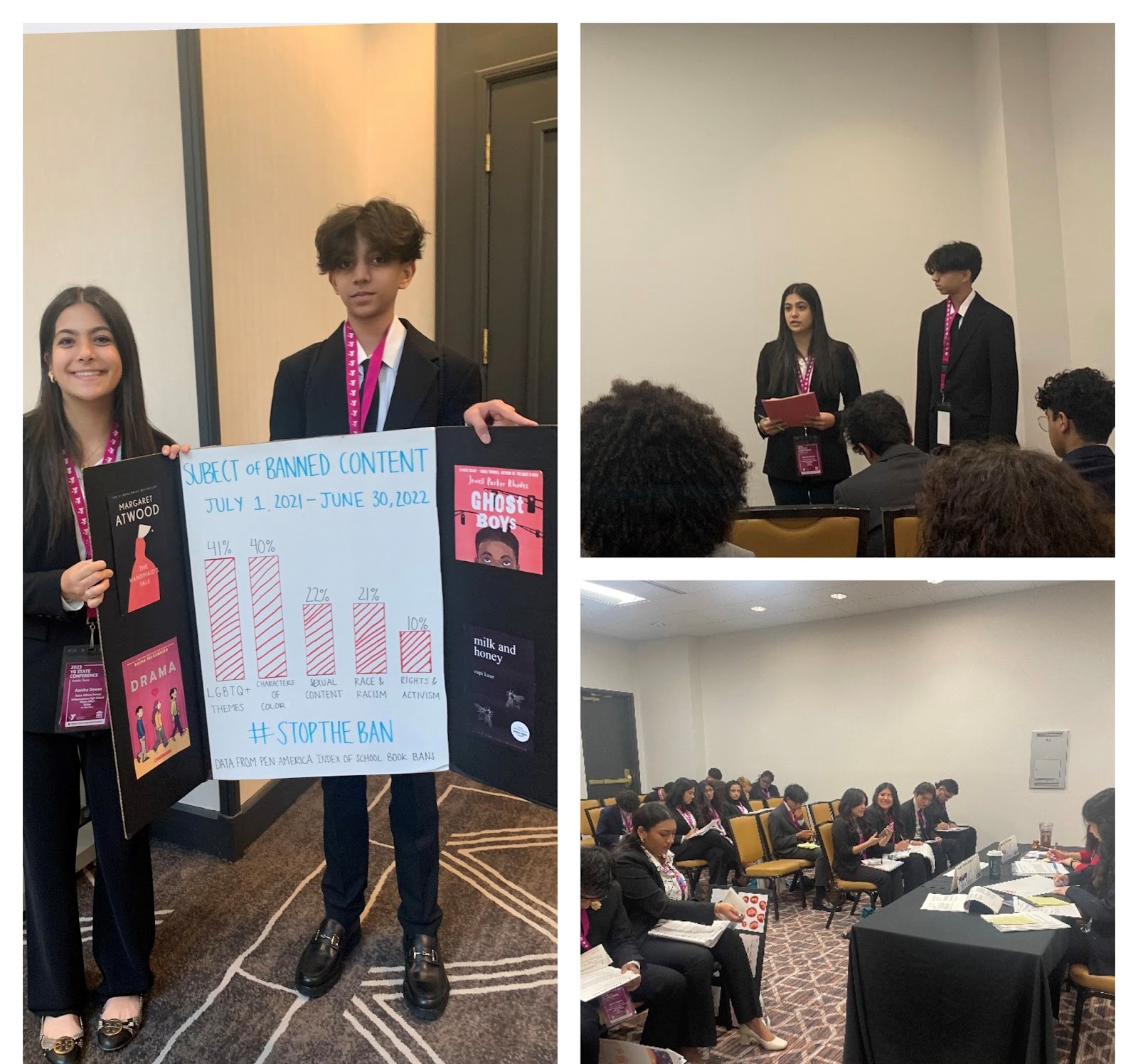
Books discussing these topics are often banned or highly restricted in Texas schools, thus stopping the expansion and the knowledge to prepare students for real-world situations. These limitations of literature enforced onto students are what have inspired the State Affairs Forum (SAF) delegates Aanika Dewan and Krrish Patel to propose an opportunity to lift restrictions on books that expose students to societal situations. For Example, “Drama” by Raina Telgemeier, which includes LGBTQ+ representation, and “The Perks of Being a Wallflower” by Stephan Chbosky discuss sexual assault. When interviewing delegate Aanika, she was asked what her motivation was and she responded, “I tutor kids who love to read, and I believe kids my age should be educated on the topics that are being banned.” Aankika intends to achieve this with her and her partners’ proposal. 

When observing SAF Committee Room 5, delegates Aanika and Krrish, who believe students should have access to all literature, presented their proposal (#104), which tackles this issue by suggesting the course of action of allowing the parents to grant permission regarding the literature content for their child through an online form that is given out every school semester. If permission is granted, students can access books of their choosing, gain freedom and expand their knowledge.

During the pros and cons section, some delegates appreciated the idea but opposed this proposal because they found it ineffective in situations where the parents don’t approve. During an interview with delegate Krish, he was asked what his response to the cons side opinion about the proposal, and he responded, “It is ultimately the parents’ decision, and the online form isn’t meant to be forced.” In addition, con delegates discussed their view that students can always access any book they would like on the internet. In response to this, delegates Aankia and Krrish state, “Not all students have internet access at home.” On the other hand, many delegates such as Crystal Zamora promoted this proposal because of the awareness it brings to serious issues like racism and sexual assault. 

Overall restrictions on topics seen as inappropriate have, for the longest time, taken away the freedom, diversity, and knowledge of students. The attempts of delegates Annika and Krrish’s proposal strives to break this ongoing cycle and give students the opportunity and inclusivity of everyday societal topics. Students can only wish that SAF delegates believe in this proposal and its potential for Texas students’ literature access in the future to come. 

Delegates propose expanding access to books on controversial subjects.

Judicial Witnesses Draw on Emotions to Win Their Case

By Maryfer Garcia,
Chisholm Trail High School

In the Judicial section, there are many things that go into being a witness. This ranges from the delegates’ interest in the character, the understanding of who they are playing, and the dedication put into their role as a witness. Witnesses all have different approaches to getting their point across and helping their teams.

Being a witness requires much thought about what to say in order to achieve your goal. In some cases, the witnesses try to convey emotions they are feeling, while in other cases, there is a need to be logical and well-versed in areas that need much learning and investigating.

“I think that because he’s a detective I had to get that he is a power of authority,” said Evelyn Choi, a first-year YG student. “I just had to find a way to answer the question without giving the response that they really needed. I think that took the most practice to get around that.” In a confident way, Choi was able to join her fellow delegates in joy as they won the round two trial case.

In the opposite case, there are witnesses that require more emotion to be able to truly get their point across. Some witnesses study the emotions and relay their message through their tone, facial expressions, and body language. “Because this is a sad case, sometimes the cross-examiners (CX) ask a lot of questions that have sad endings,” Nanda Acherya said. ”I just lower my voice a little. I change my expressions, and my strategy is to just go with the flow, go with the moments. If I’m starting off happy I might not end happy. I might be sad. And if I’m starting sad, I might end up happy. That’s my strategy, just to change my facial expressions and go with the flow,” Acherya said, after achieving the first win of the day in her round one trial.

While Choi was on the prosecution’s side and Acharya was on the defense side, they both came to the agreement that when portraying a witness “you can’t just read the affidavit” Choi said. ”You have to go into the evidence you have to analyze it just like your attorneys do.” At the end of the day, all of the witnesses used their understanding of the characters, along with the emotions and logic, to better portray their side of the story.

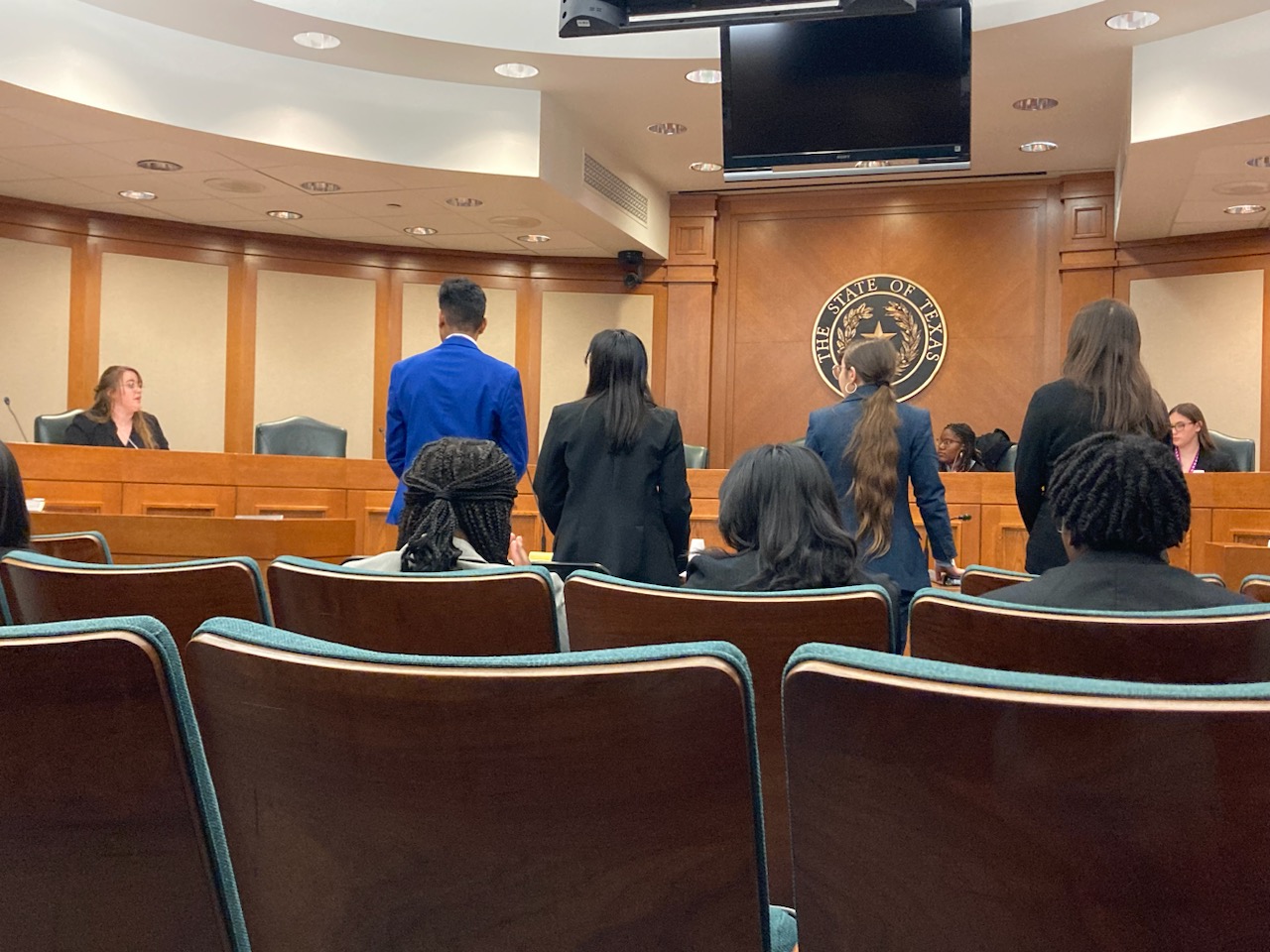
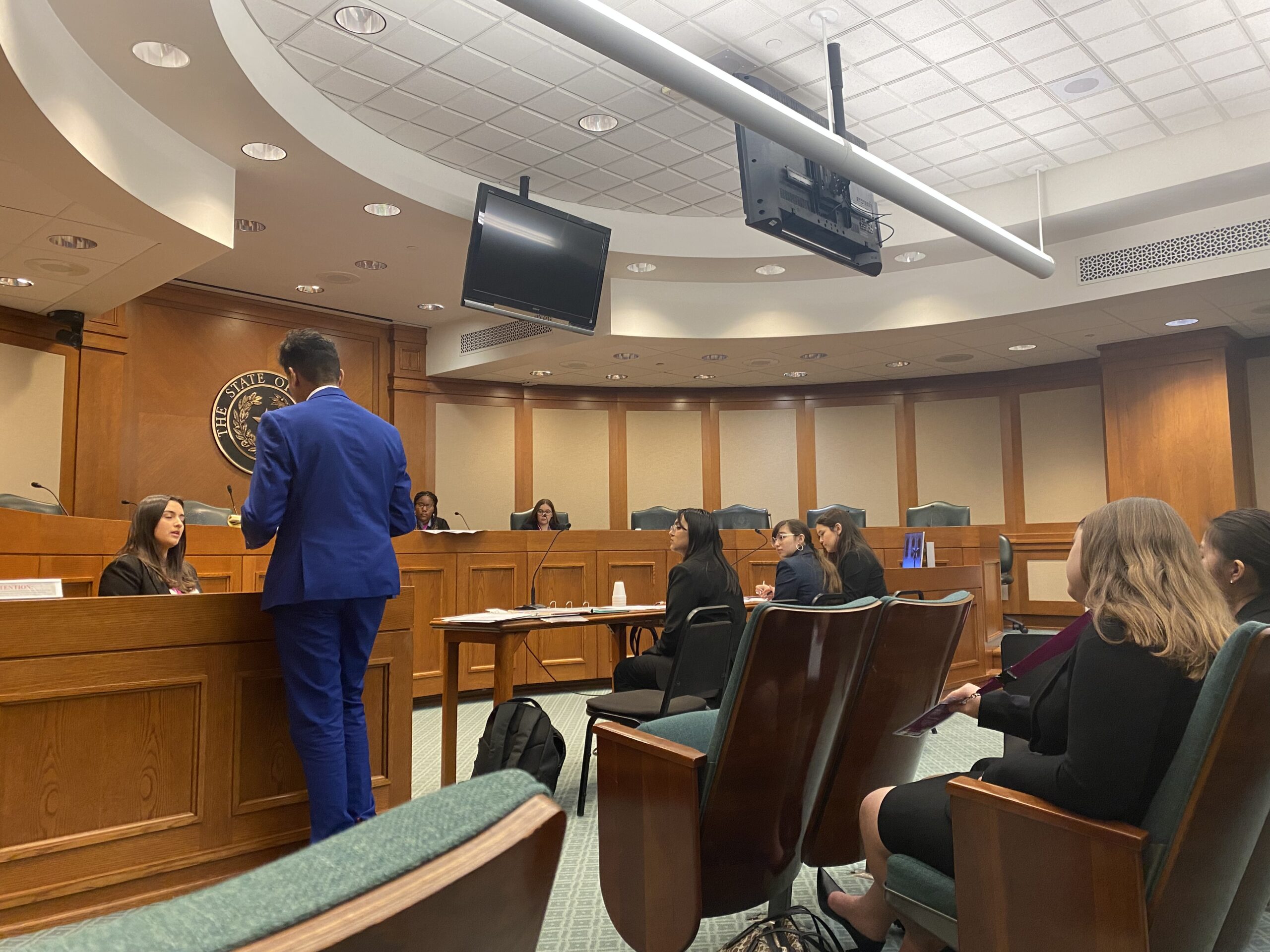
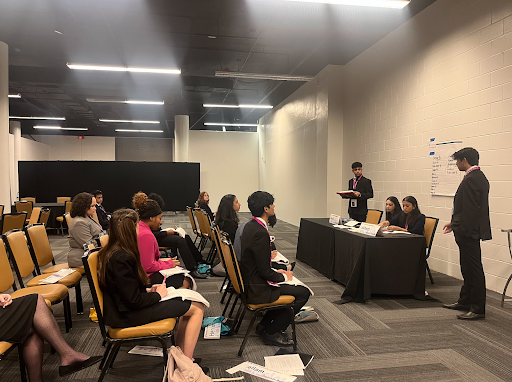
An attorney questions a witness in a court case
Go to Top