Volunteer with us Today!! We have various dates to choose from Jan 31st | Feb 1st | Feb 27th | Feb 28th | Mar 1st | Sign Up Today!

Uncategorized

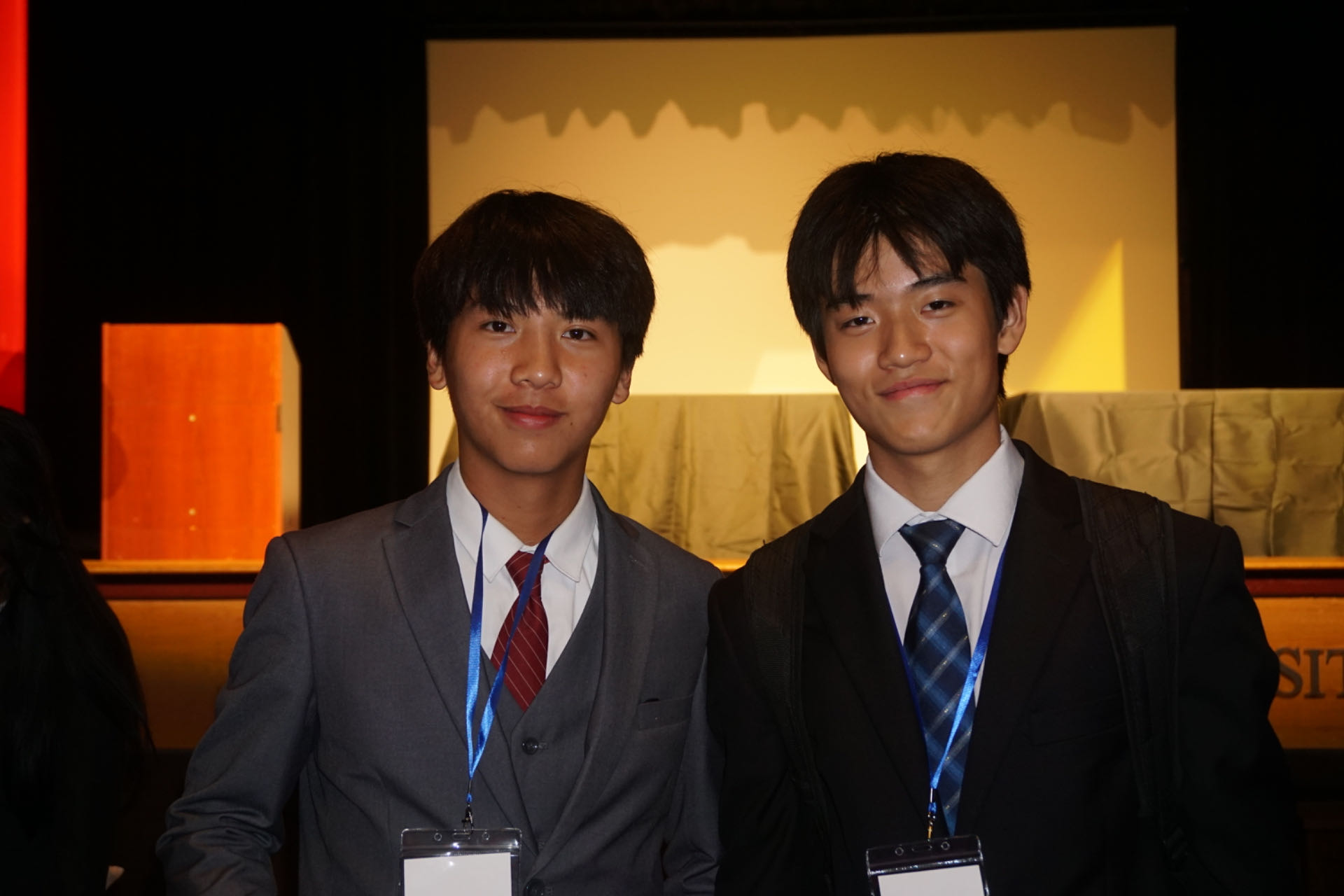
Youth Governor Candidate Daniel Ren Seeks to Strengthen Trust and Equity

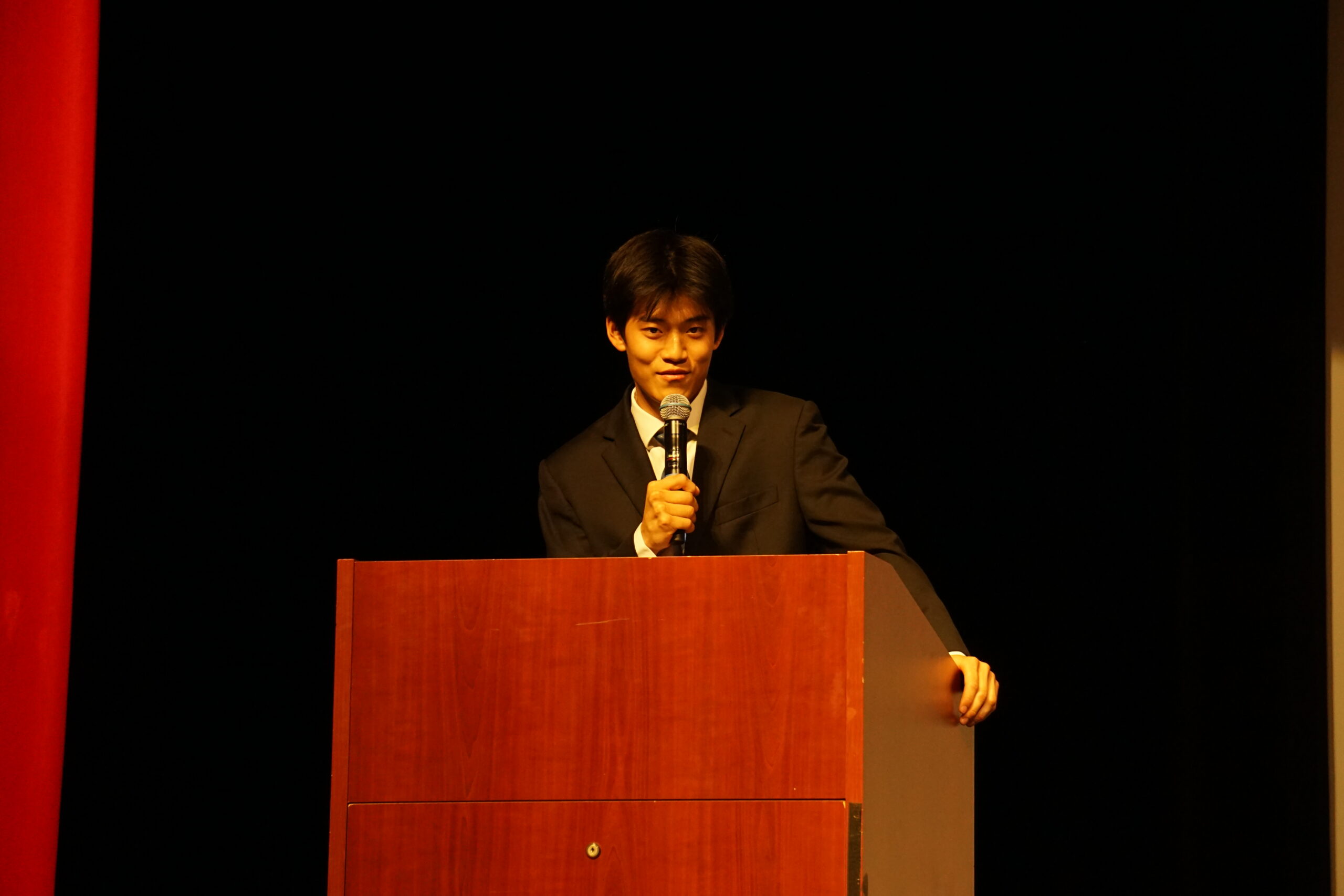
As delegates gather for the Texas Youth and Government State Conference, Daniel Ren, a candidate from Glenda Dawson High School in District 3, is campaigning for Youth Governor with a platform centered on equity, structural refinement and restoring trust in the system.

Ren said his candidacy is rooted in representation.

“I’m running because I come from District 3,” Ren said. “It’s smaller. We don’t have thousands of members behind us. We don’t always have the loudest presence in the room. And for a long time, leadership has consistently come from the largest districts.” While he acknowledged the work of larger delegations, Ren said representation across districts matters.

“I want students from smaller districts to look at the ballot and think, that could be me,” he said.

Rather than proposing sweeping change, Ren emphasized strengthening the program’s foundation. “Youth and Government has existed for nearly 80 years,” Ren said. “It does not need reinvention. It demands refinement.”

The central issue of his campaign is trust in the judging system. “When judging feels inconsistent, when rubrics aren’t clear, when outcomes feel emotional instead of
objective, students notice,” Ren said. “If we ask students to prepare for months, we owe them fairness.”

Ren proposes standardized judge training, greater rubric transparency and a more accessible appeal system. He also supports maintaining financial aid while exploring merit-based scholarships that recognize leadership, growth and commitment within clubs. Beyond structural reform, Ren hopes to strengthen YG’s culture through monthly “table topic” sessions designed to help students think critically and speak confidently under pressure.

“I lead quietly,” Ren said. “I rely on structure, follow-through and listening carefully before acting.” If elected, Ren said he would begin by gathering detailed feedback from members before implementing initiatives. “Winning would mean responsibility,” Ren said. “Youth in Government belongs to its members. If I am given the opportunity to serve, my role is simple: to listen carefully, act intentionally and leave the organization stronger than I found it.”

Blog By: Gavin Strong, Glenda Dawson HS
2026-02-27T12:45:58-06:00February 27th, 2026|Uncategorized|0 Comments

Why Young Voters Matter- and Why So Few Show Up

Most people can name the President. But fewer can name their cities’ mayor; and almost none can name their school board members. Yet, those local officials make many of the decisions that shape daily life. While National officials are in charge of the headline national issues, local decisions affect everything from schools, libraries, road maintenance, police departments, and trash collections. So the people we vote for as mayor or city councilmen should be a choice that we think about carefully- their decisions affect us every day.

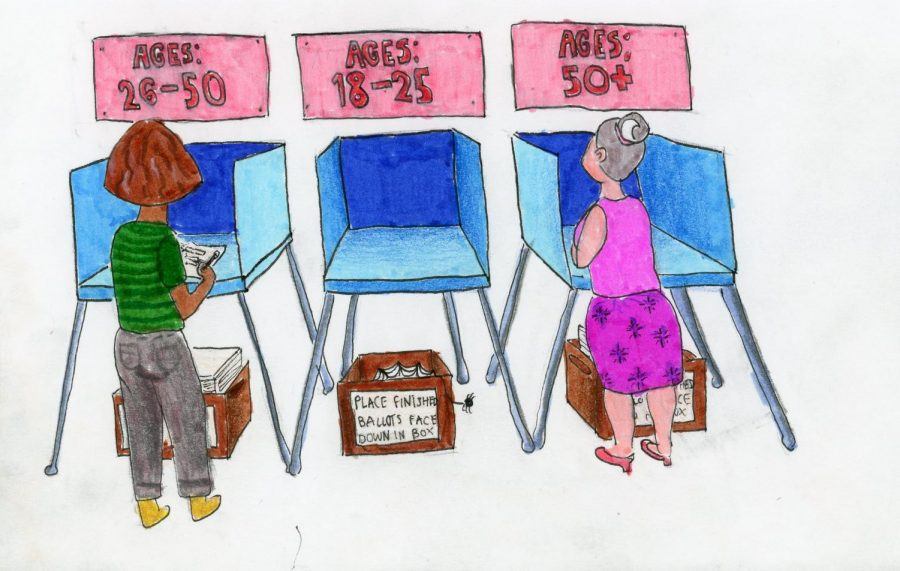
For such an important role, voter turnout remains low. In Texas, only 10-20% of registered voters participate in local elections. This is a sharp contrast to the 57.9% of voters who voted in the 2024 presidential election. This problem becomes more significant when looking at young voters. Voter turnout among 18-25 year olds is lower than any other age group, with about 14-16% of youth voting for local elections. Texas has one of the lowest youth turnout compared to the rest of the country.

Texas passed a law in 1986, stating that all high schools in Texas must provide voter registration applications to eligible students at least twice each school year. Even though this has been a requirement for the last 40 years, most schools in Texas don’t fully comply, and many students don’t know that this law exists. There’s no statewide enforcement or reporting system that ensures that schools follow this rule, and penalties for not offering voter registration applications are not strong enough.

Yet within Youth and Government, students demonstrate that apathy is not the problem. During the State Conference, delegates run for Governor and other positions of office. Their peers carefully decide who to vote for based on their campaign platform. Students who are statistically the least likely to vote in real elections approach this mock election with seriousness and enthusiasm.

The Youth Governor is more than a ceremonial title. Like a mayor, they set the tone for the conference, represent thousands of students across Texas, and influence the direction and decisions of the program. Delegates understand that who they vote for will impact their experience.

Texas Youth and Government proves that young people care about leadership. The challenge is translating that same care beyond the conference into real elections. Democracy is not strengthened by knowledge alone, but by participation. Texas Youth and Government shows students how the system works and how important voting is. The next step is ensuring that the lesson continues long after the conference ends- in city halls, school board meetings, and voting booths across Texas.

Laney Morgan

Graphic by Angelina Oliveira

2026-02-27T13:13:31-06:00February 27th, 2026|Uncategorized|0 Comments

The Charging Bull and The Death of Print; A Media Delegate’s Memoir of Journalism

12 / 12

Text

Photo Taken by David Lee, Corpus Christi Texas 
Aesthetic values are taken into consideration. The photo was taken in a fast moving automobile, allowing for motion blur to be incorporated into the photo. The motion blur contributes to themes of chaos, with the bull’s passion and defiance being emphasized.

A sleek bronze bull is haunched in attack, charging at its onlookers. With eyebrows furrowed, horns curved, and muscles tense, the bull is filled with ferocity and determination. In the heart of New York City, The Bull’s atmosphere is squirming with tourists and businessmen, swarming the bull close to suffocation, painting a scene of determination in the midst of chaos.

The Charging Bull of New York symbolizes the American dream and the confident enigma of American entrepreneurship that motivates so many. The movement of the bull symbolizes the deep ferocious passion that has inspired so many Americans to actualize their dreams.

As a media delegate for YAG YMCA, I discovered an instance of emotional resonance with this scene. The tense, yet grounded determination that The Bull carries aligned with my experience within Youth and Government. In my district conference, the race to submit media assignments on time and the scurry to interview new faces for new articles made me filled with energy. It was a high pressure environment that still allowed me to be interactive and creative through literature. Training myself as a journalist and media delegate allowed me to gain the quality of adaptability and versatility through fast changing events and trends.

Changing Tides

My experience through Youth and Government has also informed me on the history of journalism, further highlighting its fast-paced, energetic nature. However, within the history of journalism, these changes can have detrimental consequences.

Print is dead, and we have killed it.

According to data from the US News Deserts Project, An estimated 300,000 jobs since 2000 have been lost due to the eventual decline of print, local outlets have been entirely shut down due to lack of interest, and political polarization has increased as a reduction in local community cohesion becomes more apparent. It’s important to humanize these statistics, and to take these shifts into empathetic context. Each job lost is a human being losing their purpose, their livelihood, and their passion. From Carolina Titus, she shared her personal experience with these rapidly shifting cultural and market conditions, “We’re currently cleaning toilets at two Airbnbs at our newspaper office to keep the presses printing. If we decide to shut the doors after 141 years, it’ll take us a year to wind down, we figure. We have to run out people’s subscriptions: can’t afford to give refunds!” Stephen Kaye, another journalist, from Millbrook further explores the nihilistic devastation that this change has inflicted:

“I was the editor and publisher of The Millbrook Independent, which closed its print operation after an eight-year run. We started two weeks after the preceding paper closed, taking local news to a higher plane. We found circulation shrinking and tried migrating to the web, which worked for us but not for readers who didn’t regularly
go to our web pages.

School boards, town and village boards, county news, local news — it all disappeared. We were a check on governments, on endless environmental and zoning hearings, on budgets that we often published in detail, on misdoings and good doings.
There is now a void. No one took up the slack.”
(New York Times, Takenaga)

The devastation that the death of print has caused cannot be understated. Whether it’s submitting assignments on strict deadlines, interviewing candidates, or brainstorming ideas for articles, my experience with youth and government has led me to understand the nature of journalism to be fast paced and constantly evolving. Similar to
The Charging Bull, I found a ground of determination and ambition in the face of chaos.

The Rise of Social Media

With the decline of print came the advent of social media as the primary form of communication and information. News now comes through the lens of flashy thumbnails, 2.5 second hooks to capture the algorithm, and influencers pushing emotional narratives to connect to their audience.

My journey through youth and government has therefore allowed me to combine multiple passions into one field. On my Tiktok account, @davetoearth, I post lifestyle vlogs consistently and was able to cultivate an audience of over 1000 followers. At the State Conference, I continued to post and create vlogs and influencer-formatted content to record my experience at youth and government. The traditional style of influencer content allows for a creator to relate to the viewer on a personal level, speaking casually and cultivating trust with their audience. As a member of Generation Z, I understand that many of my peers consume content through social media, and that cultural atmospheres and public opinion is shaped by the relatable voices we find on our social media feed. The death of print led to the advent of social media, and my experience with Media through Youth and Government allowed me to experience this change firsthand.

The evolution of journalism from print to social media has allowed for the beauty of journalism and literature to continue. Through fast paced graphics, relatable vlogs, and editing, Youth and Government has blessed me to experience this cultural and historical shift through a first hand experience.


Works Cited
Metzger, Zach. “The State of Local News.” Local News Initiative, 23 Oct. 2024,
localnewsinitiative.northwestern.edu/projects/state-of-local-news/2024/report/.
“Vanishing Readers and Journalists -.” The Expanding News Desert, www.usnewsdeserts.com/reports/news-deserts-and-ghost-newspapers-will-local- news-survive/the-news-landscape-in-2020-transformed-and-diminished/vanishing-readers-and-journalists/.

Photo Taken by David Lee, Corpus Christi Texas 
Aesthetic values are taken into consideration. The photo was taken in a fast moving automobile, allowing for motion blur to be incorporated into the photo. The motion blur contributes to themes of chaos, with the bull’s passion and defiance being emphasized.

A sleek bronze bull is haunched in attack, charging at its onlookers. With eyebrows furrowed, horns curved, and muscles tense, the bull is filled with ferocity and determination. In the heart of New York City, The Bull’s atmosphere is squirming with tourists and businessmen, swarming the bull close to suffocation, painting a scene of determination in the midst of chaos.

The Charging Bull of New York symbolizes the American dream and the confident enigma of American entrepreneurship that motivates so many. The movement of the bull symbolizes the deep ferocious passion that has inspired so many Americans to actualize their dreams.

As a media delegate for YAG YMCA, I discovered an instance of emotional resonance with this scene. The tense, yet grounded determination that The Bull carries aligned with my experience within Youth and Government. In my district conference, the race to submit media assignments on time and the scurry to interview new faces for new articles made me filled with energy. It was a high pressure environment that still allowed me to be interactive and creative through literature. Training myself as a journalist and media delegate allowed me to gain the quality of adaptability and versatility through fast changing events and trends.

Changing Tides

My experience through Youth and Government has also informed me on the history of journalism, further highlighting its fast-paced, energetic nature. However, within the history of journalism, these changes can have detrimental consequences.

Print is dead, and we have killed it.

According to data from the US News Deserts Project, An estimated 300,000 jobs since 2000 have been lost due to the eventual decline of print, local outlets have been entirely shut down due to lack of interest, and political polarization has increased as a reduction in local community cohesion becomes more apparent. It’s important to humanize these statistics, and to take these shifts into empathetic context. Each job lost is a human being losing their purpose, their livelihood, and their passion. From Carolina Titus, she shared her personal experience with these rapidly shifting cultural and market conditions, “We’re currently cleaning toilets at two Airbnbs at our newspaper office to keep the presses printing. If we decide to shut the doors after 141 years, it’ll take us a year to wind down, we figure. We have to run out people’s subscriptions: can’t afford to give refunds!” Stephen Kaye, another journalist, from Millbrook further explores the nihilistic devastation that this change has inflicted:

“I was the editor and publisher of The Millbrook Independent, which closed its print operation after an eight-year run. We started two weeks after the preceding paper closed, taking local news to a higher plane. We found circulation shrinking and tried migrating to the web, which worked for us but not for readers who didn’t regularly
go to our web pages.

School boards, town and village boards, county news, local news — it all disappeared. We were a check on governments, on endless environmental and zoning hearings, on budgets that we often published in detail, on misdoings and good doings.
There is now a void. No one took up the slack.”
(New York Times, Takenaga)

The devastation that the death of print has caused cannot be understated. Whether it’s submitting assignments on strict deadlines, interviewing candidates, or brainstorming ideas for articles, my experience with youth and government has led me to understand the nature of journalism to be fast paced and constantly evolving. Similar to
The Charging Bull, I found a ground of determination and ambition in the face of chaos.

The Rise of Social Media

With the decline of print came the advent of social media as the primary form of communication and information. News now comes through the lens of flashy thumbnails, 2.5 second hooks to capture the algorithm, and influencers pushing emotional narratives to connect to their audience.

My journey through youth and government has therefore allowed me to combine multiple passions into one field. On my Tiktok account, @davetoearth, I post lifestyle vlogs consistently and was able to cultivate an audience of over 1000 followers. At the State Conference, I continued to post and create vlogs and influencer-formatted content to record my experience at youth and government. The traditional style of influencer content allows for a creator to relate to the viewer on a personal level, speaking casually and cultivating trust with their audience. As a member of Generation Z, I understand that many of my peers consume content through social media, and that cultural atmospheres and public opinion is shaped by the relatable voices we find on our social media feed. The death of print led to the advent of social media, and my experience with Media through Youth and Government allowed me to experience this change firsthand.

The evolution of journalism from print to social media has allowed for the beauty of journalism and literature to continue. Through fast paced graphics, relatable vlogs, and editing, Youth and Government has blessed me to experience this cultural and historical shift through a first hand experience.


Works Cited
Metzger, Zach. “The State of Local News.” Local News Initiative, 23 Oct. 2024,
localnewsinitiative.northwestern.edu/projects/state-of-local-news/2024/report/.
“Vanishing Readers and Journalists -.” The Expanding News Desert, www.usnewsdeserts.com/reports/news-deserts-and-ghost-newspapers-will-local- news-survive/the-news-landscape-in-2020-transformed-and-diminished/vanishing-readers-and-journalists/.

2026-02-28T11:25:13-06:00February 27th, 2026|Uncategorized|0 Comments

Three years. One section. One mission: Strengthen the judicial branch from within.

By Alana Dixon,
Duncanville High School

After three consecutive years in Youth and Government’s judicial section, Jordyn Woodruff is seeking the role of Attorney General at the 2026 State Conference. Her campaign is centered on accessibility, organization, and improving the overall structure of the trial courts for delegates across Texas.

Unlike candidates who rotate between sections, Woodruff has remained committed to judicial throughout her entire high school YAG career. That consistency has allowed her to experience the courtroom from multiple perspectives: as a competitor, a teammate, and a returning delegate. Each year, she returned with a deeper understanding of how preparation, mentorship, and communication impact delegate performance.

Her platform, she said, is rooted in that personal experience. Reflecting on her first year, Woodruff recalls entering the trial court feeling unprepared compared to more established delegations. “I wanted to make the trial court and YAG as a whole more accessible,” Woodruff said. “I don’t want anyone to be discouraged because they don’t have the same resources as more experienced delegations.”

Accessibility, however, is only one component of her campaign. Woodruff also emphasizes the need for stronger organization within the judicial branch, particularly in the scoring process. Clearer structure and more consistent communication, she believes, would reduce confusion and allow delegates to focus more on preparation, growth, and performance rather than uncertainty.

Leadership, in her view, requires both empathy and resilience, especially when overseeing an entire section composed of hundreds of participants. “In high-pressure situations, I slow down and reassess,” she said. “You always need to be able to pivot.” At the core of her campaign is visibility. Woodruff hopes to ensure that quieter or newer delegates feel supported and recognized within the courtroom environment.

“A vote for Jordyn is a vote for justice.” With three years of judicial experience and a platform focused on fairness, structure, and inclusion, Woodruff is seeking to strengthen the foundation of the trial court in the State.

2026-02-27T12:29:57-06:00February 27th, 2026|Uncategorized|0 Comments

Two Roles, One Courtroom

How Naila Amol Navigates Justice from Opposite Ends of the Courtroom

In District Court, judicial delegates usually commit to one role. Naila Amol has chosen two.This conference, she is playing both a prosecution lawyer and a defendant in Mock Trial. “I’m a prosecution lawyer,” Naila explained, “which is like the people accusing the other person. And then on the defense side, I’m the one being accused. I’m the defendant.” Being able to balance these opposite perspectives requires lots of preparation, adaptability, and a deep understanding of the case.

Playing both sides, she says, is “definitely complicated.” Earlier in the season at district, she portrayed Harper Lynn, the defendant. To prepare for her role, she read the affidavit repeatedly, carefully studying her character’s statement and practicing responses to possible cross-examination questions. Now, as a prosecution attorney, that preparation gives her an advantage. Because she also embodies the defendant, she knows the character, Harper Lynn, very and has a good understanding of the testimony.

“I know the characters so well,” she said. “It feels easier because I feel prepared.” That familiarity allows her to ask impromptu questions confidently, anticipating how the other side might respond. Her experience highlights one of the most valuable skills Mock Trial develops: the ability to think from multiple perspectives.

Beyond the courtroom intensity, Naila has also embraced the community aspect of the program. From long bus rides with teammates to meeting new delegates at state, she describes the experience as fun and is excited to continue connecting with others.

By stepping into two drastically different roles, Naila demonstrates that understanding justice requires seeing both sides of the story.

Story By Lola Sagoe, Greenhill School

2026-02-27T12:24:53-06:00February 27th, 2026|Uncategorized|0 Comments

Building Democratic Muscles

Inside Greenhill’s TX YG Delegation and the advisor guiding Its growth.

At Greenhill, students involved in Youth and Government don’t just learn about our government, but they actively practice it. Now in her second year as the delegation advisor, Mrs. Hensen stepped into the role after being encouraged by one of her own students. “This is my second year as the advisor,” she explained. After arriving at Greenhill mid-year and beginning to teach AP Government, one of her students approached her about sponsoring the club. The program had already been established at Greenhill, but they were looking for a new advisor.

Mrs.Hensen’s decision to lead Youth and Government reflects her broader philosophy about civic participation. She believes that living in a democracy comes with responsibility. “If you live in a democracy, you should participate in it,” she shared. “That’s one of the reasons why people choose democratic countries.”  For her, Youth and Government is more than a competition. It is a training ground for active citizenship. Students gain “an understanding of civics” and begin to see “how exciting, but challenging the democratic process can be.” Through drafting bills, debating legislation, campaigning for office, and writing articles, delegates experience the realities of governance firsthand.

She describes the program as a way for students to strengthen what she calls their “democratic muscles.” Youth and Government provides opportunities for students to practice leadership, collaboration, and civic engagement before entering adulthood. Delegates even experience simulated elections long before they are eligible to votethemselves.

By guiding students through this process, Greenhill’s delegation continues to grow as a space where young people do not simply learn about democracy but actively engage in it. Under Mrs.Hensen’s leadership, the program encourages students to understand their role in shaping the systems they are part of and prepares them to participate thoughtfully in the world beyond the classroom.

Story By: Lola Sagoe, Greenhill School

2026-02-27T12:17:36-06:00February 27th, 2026|Uncategorized|0 Comments

What do the YAG shirts represent?

By Benedicte Djontu
North Central Texas Academy

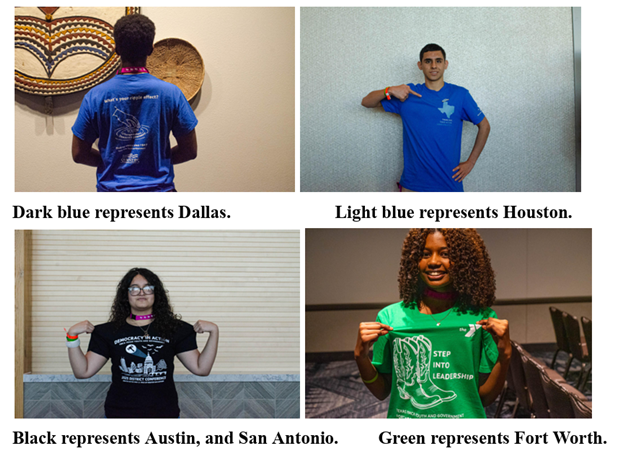
The 2026 YMCA Texas Youth and Government State Conference kicked off Thursday, February 26, at the Kalahari Resort & Convention Center. Though the hotel looks intriguing and beautiful, one thing in particular caught my eye. As I walked in, I noticed different color shirts passing by me. To my surprise, the State Conference includes not only Fort Worth and Dallas but Houston, Austin, and San Antonio as well. I figure that we underestimated the substantial size of the student body that attends State. As I made that discovery, I wondered if the different colors had a meaning behind them.

  • Dark blue represents Dallas.
  • Light blue represents Houston.
  • Black represents Austin, and San Antonio.
  • Green represents Fort Worth.

While capturing all the different shirt colors, I asked all the participants if they knew the meaning behind their shirt colors. To my surprise, most of the participants had no idea of the meaning behind their shirt designs. Dallas and Houston, having the most simplistic designs, while sharing the same color, didn’t have much to base off on. Austin and San Antonio, on the other hand, having more design patterns, still did not have an idea of the meaning behind their shirts.

Finally, when the same question was asked to Fort Worth, they mentioned that on their shirts, there are cowboy boots. Why might that be? Well, their guess was that the boots represent Fort Worth’s love for Line dancing! Now, it’s your turn to guess.

What do you think the shirts represent? Apart from the fact that all those areas of Texas are wearing different-colored shirts, there is a bigger picture to grasp here. I imagine how challenging it might be for people from diverse backgrounds to come together for a good cause. All parties have to commit to the end goal for the outcome to come to life. The Youth and Government program showcases the power of unity. Something that this country needs desperately at this moment.

With the times our Country is going through right now, the club is a great example of what we should each be doing. Getting informed about our country and using our voice to make a change. Now is when we make the change.

2026-02-27T12:07:38-06:00February 27th, 2026|Uncategorized|0 Comments

Difference In the Districts: How Corpus Christi and Austin Prepare for a Mock Trial Against One Another

By: Caydenn Angeles
W.B. Ray High School

Austin, TX – When hosting the District Conference for Texas Youth and Government, the districts of Texas are divided into four separate conferences. In Texas’s state capital, Austin, one of these conferences is held between Austin itself and Corpus Christi, along with other cities.

The verdict of Harper Lin, a 31-year-old woman accused of murder, criminal conspiracy, and criminal solicitation against Cody Maddox, depended on Veterans Memorial High School from Corpus Christi, Texas, which stood as the prosecution, and Liberal Arts and Science Academy High School from Austin, Texas, which defended the accused woman. Through the observation of this specific mock trial, a question arose: Do different districts of Texas prepare and perform using different strategies?

The final verdict for this court trial was decided by the judge as not guilty. There  were many factors that contributed to the verdict of this woman, but Liberal Arts and Science Academy High School stood out to me when defending their client. During the trial, the defense provided objections to the judge a significant amount more than the prosecution. Veterans Memorial made a great attempt to prosecute Lin but was unable to ask sufficient questions to witnesses in this trial overall. This is because, while the prosecution would try to ask a question towards the witnesses in this trial, the defense would continuously state, “Objection!” which would typically later be sustained by the judge.

After the verdict was announced, I proposed an interview with Diya Darshan, the lead attorney of this court case who has participated in this event for three years, with the intention to discover if these consecutive objections were a planned tactic or if it was a a happy coincidence that contributed to their success. “That wasn’t specifically planned, as there were many instances of a foundation not being laid properly for the witness to be questioned about that topic. This gave us an upper hand as they weren’t able to enter evidence for specific witnesses and receive crucial feedback,” Darshan responds. It was interesting to view the mindset lawyers must have when performing in a trial, as it seems like a nerve-racking job to possess. Darshan helped me formulate a clearer understanding of her process, as her “biggest strategy was to look at the judge and solely convince them only as it is their courtroom despite the pressure,” ignoring any sort of self- consciousness that would impact her performance.

Despite Harper Lin being found not guilty, Veterans Memorial High School still provided an exceptional performance that impressed me. Keane Wood, a witness for the prosecution, stated that it was Veterans Memorial High School’s “first time attending a conference of Youth and Government.” This was a factor of the trial I was unaware of during the observation oftheir mock trial, so discovering this unknown fact contributed to my curiosity within their methods of preparation. “Understanding the trial and making questions that would defend our accusations was our main focus in preparation,” Wood stated, “but we weren’t able to fully defend our points because the defense’s objections to our questions kept getting sustained.” Because the defense seemed very relaxed with their case, I then asked Wood if their confidence intimidated him to the point of affecting his performance. “Their confidence, along with their constant objections, was definitely intimidating for me, and it was hard to stay collected when I was under pressure as a witness.”

The differences between each school from the towns of Corpus Christi, Texas, and Austin, Texas within their level of preparation, expertise, and performance was profound. Liberal Arts and Science Academy High School maintained preparation, as they were experienced and knew how to format and defend their evidence. On the other hand, Veterans Memorial High School were not as confident within their abilities because of their low experience level and inability to ask questions that were necessary to succeed. Though, one thing schools had in common from both Corpus Christi, Texas, and Austin, Texas, was pressure. Acting as any member of a trial, whether you’re a lead attorney or witness, is required for your whole team to succeed. There is no doubt that even if certain districts have more expertise within mock trials, the pressure each Youth and Government member feels proves the care they have for this organization.

The Issue of Plasma Donation and Its Effects on Lower-Class Communities

By Naden Ramirez
B. Ray High School

We should prohibit the wearing of socks with sandals. This is HB005, written by Alexandra Harper, and an example of one of several “joke bills” that took place at Committee 6 at the district meet for Districts 2 & 7. A large variety of bills were proposed, some relating to issues involving schools, while others were about lighthearted issues where they took a strong stance on issues like whether or not we should allow for Texas schools to teach that the Earth is flat. One bill that showed a genuine compassion for the issue it was discussing was HB088, which argued for an act to regulate paid plasma donation practices. The bill author, Sofia Torres, spoke on the issue with such passion during a casual 10-minute recess, and her passion was highlighted even more when she officially proposed her bill. 

The main components of her bill included provisions such as “The Texas Department of State Health Services (DSHS) shall regulate plasma donation practices statewide. Individuals may donate plasma no more than once every fourteen days, with payments capped at sixty dollars per donation.” This bill is meant to address the real-world issue of the connection between blood plasma donation and poverty in the United States. Americans with low incomes use these donations as a way to “add a few hundred dollars a month to household income, an important source of economic support for low-income families” as stated in “The Interlinkage Between Blood Plasma Donation and Poverty in the United States” by Western Michigan University. Although this can add on several hundred bucks a month to a person’s income, the detrimental effects of this on a person’s body are too severe. This is why Torres capped plasma donation to “no more than once every fourteen days” to ensure those who are donating plasma, mainly those in the lower class, have time to recover as much as possible. The negative effects of donating too much plasma are extensive, as it can lead to things such as dehydration, fatigue, vein damage, iron deficiency, infection, and many more. 

Placing regulations on an issue as serious as this in a sort of mock legislation reflects the real-world actions we should be taking towards regulating health-related issues such as this. Torres’s bill not only shows an incredible amount of passion towards a real-world issue, but it also reflects the positive effects of organizations such as Youth and Government. These sorts of organizations allow students to participate in real issues even if it is in a “fake” setting, allowing them to share their voice and inform people on real-world issues. As stated on the Youth and Government website, “Democracy must be learned by each generation.”

Being Lieutenant Governor as a Woman of Color: The Good, Bad, and Ugly

By: David Lee
W.B. Ray High School

“A lot of guys and even evaluators won’t take you seriously as a woman, I’ve had sexist comments said to me, but to be honest, I just laughed at them”, Spandana Palyam expressed. 

Spandana Palyam is the 79th Lieutenant Governor of district two and seven, and has shared her experience as a leader in youth and government, the good, the bad, and the ugly. Spandana Palyam is a devoted leader of district two and seven, with the experience and determination to back it up. Spandana started her youth and government career as a freshman, winning Distinguished Delegate in media, and advancing to state. Palyam also became the youngest ever media co-editor of the state, attended the conference on national affairs, and the Youth Advocates Program in D.C. on National Advocacy day. However, her journey didn’t start with perfection. Spandana found that she struggled with insecurity and imposter syndrome. She struggled with the experience of being seen differently because of her identity, and found that she wasn’t taken as seriously because she was a woman. However, Megan Dern and Missy Garcia, female leaders of Austin pushed her to stay committed to her journey of civic duty. When asked how she responded when discriminated against, Palyam gave me a steadfast answer, “To be honest, I just laughed at them. My brain just translated that experience into, “It’s not about me, they’ve got their own things, and if they truly believe that, then that’s just because they haven’t seen anything differently”. As a queer person of color myself, I found that this answer was deeply inspiring. There are moments when I struggle with a marginalized identity, but it was heartwarming to see such a successful leader like Palyam devoted to civic duty. 

Palyam also expressed more advice for leaders that struggle with being treated differently. “focus on what matters to you, don’t ever try to abandon what you value, just to cater to other people just to make them like you more.” Palyam also found that these experiences were essential to her growth, allowing for her to mature into the leader that she is today. Palyam found that Youth and Government pushed her to be more confident, to assert herself no matter what challenged her. “No matter where you go, there will always be haters”, Palyam expressed. 

Spandana Palyam is a visionary leader and inspiring heroine for anyone that struggles with their journey in leadership, showing that anything is possible. Through the challenges she faced in YAG and YMCA, Palyam was able to build her confidence, self security, and above all else; her commitment to civic leadership.

79th Lieutenant Governor
Spandana Palyam

Go to Top