Volunteer with us Today!! We have various dates to choose from Jan 31st | Feb 1st | Feb 27th | Feb 28th | Mar 1st | Sign Up Today!

Uncategorized

AI Accumulating All the Energy

By Wangmin Estes
Liberal Arts Science Academy

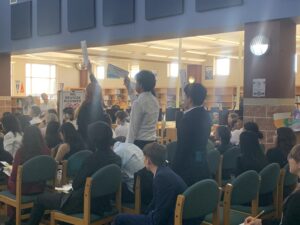
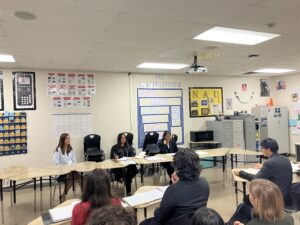
In the afternoon, session 3 of State of Affairs was going on. A proposal about limiting the energy usage of AI in the State of Affairs room. Delegates Wright and King started out by stating that AI data centers consumed so much energy that it was causing black outs for people in the state. To fix this problem Wright and King propose to limit the energy use for AI data systems to 8% for the entire state and 10% for the county. They say that these limitations will allow AI to grow without harming the people.

The idea is that when the state is using 8% of the energy for AI data centers, no more data centers can be built unless the state or country supplies their own energy. Another delegate asked about how the companies will know how much energy they have left, and the answer was that there would be a tracker to ensure that the state knows how much energy they have left.

In the closing statement made by delegates Wright and King, they made several more strong points. They mentioned that the “energy consumption will double by 2030” which would make the power outages and blackouts even morecommon (Wright). In the end the authors of the proposal defended their proposal so well that it passed unanimously.
The State of Texas Versus Harper Lynn

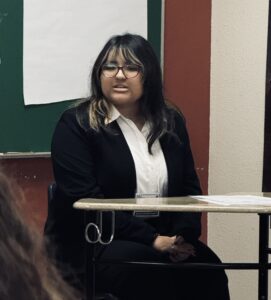
(Above) Zane Torres on the witness stand in the court room,
photo taken by Marin Patterson

By Marin Patterson
W.B. Ray High School

This is the case of, ‘Local politics, old enemies, and deadly explosion,’ as written by Hon. C. Tyler Atkinson and Judge Denton from the Municipal Court for this 2025-2026 court case. I was actually able to sit in on this court case, and get exclusive information and photographs that would not be made available to the public for a year. So without further ado, this article presents an overview of the case, what happened, who did what, and the outcome. 

The cas began like any other, the prosecution and the defendant teams decided how they wanted their time spent and witnesses proclaimed the oath and affirmation. And then the prosecution immediately went into their opening statement, which can be summarized by their final quote stating, “Cody Maddox was killed in a bomb explosion made by Harper Lyn. She committed the offense of murder, criminal solicitation, and criminal conspiracy. We intend to testify to the court so that the defendant is found guilty of all charges, your honor.” 

After these words, the defendant decided to remain silent, so the prosecution went ahead and called their first witness, Jordan Reeves. Jordan Reeves stated that he was a detective, who’d gone to Sam Houston University. He is also currently working on this case, proving to be an expert witness in criminal justice. The prosecution’s questions permitted around the first piece of evidence, lawn fertilizer. Jordan answered that the lawn fertilizer had a “key component” called ammonium nitrate, which was confirmed to have been used in the bomb device. This exact kind of fertilizer was also found in Harper’s garage. 

It was then the defense’s turn to cross-examine the witness, asking several short questions to make it known to the court that this is not evidence that can prove Harper to be 100 percent guilty. The defense managed to prove that this fertilizer was quite popular, and stated that, “This circumstantial evidence should not be the proof of all these crimes.” 

After Jordan Reeves left the witness stand, the prosecution wasted no time or words before calling up Jamie Ternian, their second witness. Jamie Ternian was a friend of mister Maddox and miss Lynn, and she was called to the stand to testify as to why Harper was acting suspicious towards Cody weeks before the explosion. The prosecution’s first question was about Harper’s behavior, how she was acting, and what words may have been said. Ms. Ternian’s answer to this was, “I remember Harper saying to Cody a few weeks ago at a party, that one day he will push somebody too far.” The defendant then went on to ask about personal interactions and words exchanged between Ms. Tiernan and Ms. Lynn. According to Mr. Reeves, about a week ago, Harper had asked him if he’d seen Cody’s car, to which he replied that he had not, and Harper was speculating if Cody was sleeping IN his car, which marked the point of the conversation where Ms. Tiernan grew confused. Harper then proceeded to laugh and end the conversation. 

The defense had little cross-examining to do it seemed, as many of their questions speculated why or how Harper might be innocent, before they sat back down. After a few more witnesses (Riley Knox, Harper Lynn, and Gloria Parker), all of which provided only substantial evidence to the court, with Harper stating that she is fully innocent of all charges, the defense called their last witness. 

The witness’s name is Zane Torres, an expert in digital forensics and cybersecurity analysis, who was involved in the investigation due to her personal and professional view on the evidence exhibited on Harper Lynn’s laptop and burner phone. Mr. Torres stated that his takes from the evidence consisted of, “geolocation pings and pings in the area of Cody’s house.” However, Mr. Torres also explained that the location pings were not the most accurate due to the triangulation on the pings, triangulation meaning that

it sets the phone’s location into a certain mile radius, not giving the precise location. The prosecution questioned the man first, asking about the time and precise location. Mr. Torres answered the best he could, which brought the prosecution to their final statement, stating, “I implore the court to find Harper Lynn guilty of murder, criminal solicitation, and criminal conspiracy.” The defense’s closing statement chose to be a response to this, as both had three minutes. The defense stated, “Why destroy something you already have? Witnesses stated that other witnesses only supplied shaky evidence, the court must take this into account.” After the words of the defense, the prosecution used their last minute to provide a rebuttal, their final statement being, “While certain pieces of the evidence may be shaky, the entire picture proves that Harper Lynn is guilty, without a doubt.” Now, with the defense only having a few more seconds left to speak on, the last few words they managed to get out was stating that Harper Lynn was not in town during the searches of her house and properties. 

Finally, the court went into recess, and everybody waited with baited breaths, silently looking around. I took note that the prosecution looked confident, while the defense was quiet, with downfallen expressions of someone who believed they would not succeed. When the judge returned, she announced that the defendant, Harper Lynn, was found guilty of all charges, the prosecution had won. 

In conclusion, this case was a series of ups and downs. Experts were brought in, friends were brought in, and ultimately all of it resulted in the prosecution of Harper Lynn. When everybody was exiting the court room, I managed to get ahold of the judge for just a few words, even though she clearly was not eager to talk to a journalist at the moment. I asked, “Do you truly believe that Harper Lynn is guilty, with the evidence presented to you by both sides?” I waited silently for an answer before the judge responded quietly and curtly, “Yes. Harper Lynn is truly guilty of all charges.”

Behind the Scenes: Unseen Aspects of the Youth And Government District Conference

By: Dorcas Owala
John Marshall Law and Medical Services

Austin, TX – Before any competition or important event, we all tend to become nervous and prepare endlessly for the moment. Dreading for the day to come, we become doubtful and stress out over the little things. The only thing we want is for the day to be perfect, just perfect. Well the same can be said for many youth and government delegates. Nerves flying through the building as delegates walk in. There’s lots of hard work and training put into it that most judges and evaluators don’t get to see. Behind the Scenes work is the most important factor to prepare them for the District Conference. All delegates hope the outcome is a spot for the State Conference.

Preparation can range from parent support/advice, school training, mental notes, repetition of information, etc. Jose Garza a youth teacher of DMS says, “Students were provided with Bill/Proposal templates and mandatory practices twice a week. We help them navigate through the law world and answer any questions when needed.” Preparation comes from guidance. When needed, delegates watch videos, ask questions, and learn more from their teachers in order to do and be the best.

Shelby Watson an Advisor says, “Humans crave community; community can of course look different for people, but its very important to give them that scene. It’s not fun to be alone to be that support.” In the 2025 District Conference, about 200+ visitors came to watch their fellow friend and or family member compete. As the conference reaches, delegates begin to feel nervous and stressed. Their family members support and team support, helps them calm down and motivate them to be the best and do their best no matter the outcome.

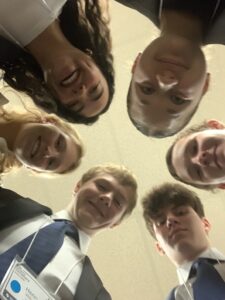
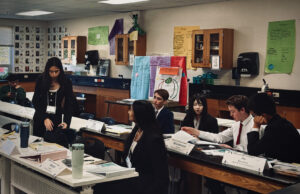
Trial Court Delegates in a group huddle before the start of the trial.
This is in order to calm down nerves and build confidence.

Mock Trial Mentality: What Mock Trial Members Do During Recess

By Caydenn Angeles
W.B. Ray Delegation

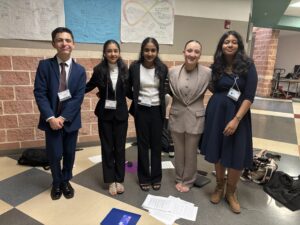
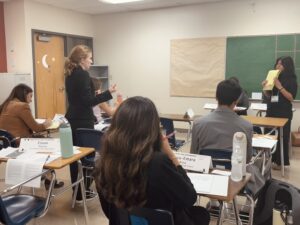
While walking in the hallways of Akins High School for the District 2 & 7 Conference, a group of students were seated in the hallway with paper and folders sprawled out everywhere. Confronting them, students Sebastian Oviedo, Aashna Kosher, Yuktha Gobburu, Catherine Willard, and Dhiya Sundar from both Cedar Park High School and Leander High School clarified that they were in a recess period.

For this District Conference, there are not enough judges available to conduct four mock trials, requiring each school to only achieve three. Because of this, each school is granted recess, which allows for the mock trial members to have a one-hour period of time to do whatever they prefer. I assumed that most members in Youth and Government would spend their time calming down from a suspenseful event, eating lunch, or having a talk with familiar friends, but these mock trial members proved me otherwise. “This is our first meeting, so we’re really nervous,” Kosher stated, “but working together in our mock trials has been more fun than scary.” In preparation for this conference, Kosher explained to me that their mixed mock trial team attended online meetings with each other once a week and in-person meetings every two weeks. 

Though, despite their consistent preparation, it still seemed like they were continuing to study for their upcoming trial. This surprised me, as I assumed they would have been confident in their abilities by now. “Going over the rules of evidence and the trial case itself is important to have our team succeed,” Yuktha Gobburu emphasized. Adding on to this, Catherine Willard expressed, “Reviewing our previous trials is really important for our next mock trial. That’s what we’re doing right now. It helps to see how other trial courts make arguments because we are able to predict and prepare for similar arguments coming up.” 

As a media journalist for this conference, it was surprising to see how members of different events spent their time. Each event has specific requirements in order to succeed, and this was demonstrated through my interview with this group of mock trial students. Realizing the dedication each member of Youth and Government has toward their event was and still is motivating to my overall perspective of the organization itself.


The Age of Student Debt; The Necessity of Financial Literacy

By: David Lee
Ray High School

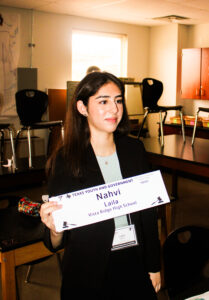
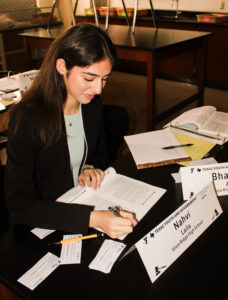
To be a Teenager in America means to collectively shoulder a total of $144.9 billion dollars in college debt. Financial literacy isn’t an additive to preparing high school students for the real world; it’s a necessity. This is why Delegate Laila Nahvi, a senior from Vista Ridge High School has proposed a bill to make financial literacy a course requirement for high school.

Nahvi, a high school senior, understands firsthand the importance of financial literacy. From a family of triplets, her household has to carry the immense financial burden of sending 3 children to college at the same time. Nahvi expresses her sentiments of a lack of financial awareness in her high school community, “most high school students aren’t aware of the intricacies of financial literacy”. Nahvi’s personal experience and numerous extracurricular activities related to financial literacy demonstrates her passion. These include meeting with members of the Bank of America, being a part of the Austin City Counsel, and an internship with the city of Austin.

The facts echo delegate Nahvi’s sentiment. According to the IFAC, Americans collectively lost a total of 330 billion dollars due to financial illiteracy. Another surprising statistic according to NEFE, only 1 in 5 high school students can answer basic financial literacy questions. In the age of predatory loaning, FASFA, scholarships, and the student debt crisis, this is a daunting issue. Nahvi urged her fellow delegates to pass her bill, and a unanimous vote erupted in her favor, showing the relevance of this pressing issue.

Delegate Galvan’s Artificial Intelligence Bill

By William Einhorn
Stephen F Austin High School

One of the sections offered by the YMCA Youth and Government program in Texas is the State Affairs section. In the state affairs section, delegates from certain schools within the conference debate solutions to real-world problems within Texas. They spend months preparing speeches and proposals for the District Conference. Delegates will present their proposal to a committee, then the delegates will question the proposal, and then take a pro or con side of the
debate.

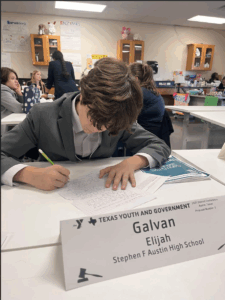
Elijah Galvan, from the Austin High School delegation, proposed his idea on the regulation of artificial intelligence in schools. He proposed to implement stronger punishments for AI usage to prevent it from happening again. Elijah strongly believes that the use of AI on school assignments greatly hinders learning for people in school, as well as lowers productivity and creativity. He said when asked about his personal viewpoint on AI, “I hate when I see my friends using it in school, because it makes me think they aren’t learning.” He also believes that making sure AI is not used in school helps prepare kids for the real world by giving them a
better education as well as a work ethic. He states, “Under these policies, students will grow to be more independent learners and stronger thinkers.” However, Elijah does believe that the use of AI can be helpful in some ways. He believes that using it as a brainstorming tool can be
useful, but it should never be used for an entire assignment.

Sadly, Elijah’s proposal failed to pass in the first meeting because he didn’t have a clear enough solution. However, he now has a second chance in his next meeting, and he plans to have his proposal pass. Elijah truly cares about his proposal and wants it to pass.

Texas Youth and Government, Shaping the Leaders of Tomorrow

By William Einhorn
Stephen F Austin High School

Before kids can even vote, some of them already know how to debate court cases, propose laws, and write articles. YMCA Youth and Government (YAG) is the place where these kids learn these skills. YAG is a club offered at many high schools across the country, one of which is in Texas. Students compete in conferences against other schools in their same district within their state. Students get to compete in mock trials, practice being journalists, propose bills, or propose solutions to current world problems. Students who participate in the conference get excellent experience participating in roles that simulate real-world situations. Some of the sections that are offered are: Legislative, State Affairs, Media, and Judicial. With all of the different sections offered at YAG, there’s room for everyone. Future lawyers may do the Judicial section to get courtroom experience through a mock trial, aspiring journalists would do the media section, and future lawmakers would want to do the Legislative section.

Some of the biggest benefits of YAG are that you get crucial experience for roles in government if that is what you want to pursue in life. YAG also gives you experience speaking in front of a small group of people. More shy people get to go out of their comfort zone and have a good experience publicly speaking. YAG is also very good when you are applying to college, specifically for people going into majors like political science. Doing YAG is what will separate you from the rest of the applicants.

Today, November 15th, 2025, the District 2 and 7 Conference is being held at Akins High School. Districts 2 and 7 represent high schools in Austin, San Antonio, and Corpus Cristi. Young leaders came from all of these places to debate their proposed bills, write articles, and participate in court cases. Excitement is in the air as young leaders from districts 2 and 7 have prepared for months just for today. They wrote their proposed bills, prepared to present solutions to real-world problems, and studied their court cases. I spoke with Gabriel Lara from the Austin High Judicial Delegation and asked him about the benefits of YAG. He said when asked about how he believed he was benefiting, “It’s helping my public speaking skills, and thinking on my feet as a lawyer.”

YAG is an excellent opportunity for the young leaders of the world. Kids get so much experience that is necessary to go into jobs related to politics when they are adults. They get a jump start on their education on the topic while also getting experience doing the tasks that they will be met with when working in the real field. If you are interested in going into politics in your future or you just want to have a good experience, then YAG is definitely the program for you.

Harper Lynn vs State of Texas

By Wangmin Estes
Liberal Arts Science Academy

City Council Member Harper Lynn is accused of murdering fellow council member Dakota “Kody” Maddox. Lynn is a City council member and immigration attorney. In the early morning hours of February 3, 2025 City Council Member Dakota “Kody” Maddox was killed when his car exploded. Harper Lynn, who is a fellow city council member, is charged with the murder.

The prosecution witnesses in the trial were Jamie Tierman (a part-time employee at a bookstore in Redwood Crossing), Riley Knox (the IT Systems Administrator), and Jordan Reeves (lead investigator for the Major Crimes Investigation). When I arrived Janie Tierman was testifying. She knew Lynn and Maddox in middle school and observed that they had a very continuous relationship. When asked what Lynn was like in June of 2024 Tierman replied that “I was present at a budget meeting where Harper had an outburst towards Kody and afterwards, I texted her that she went too far, and she simply responded with a shrugging emoji.”

Tierman ran into Lynn again when going to City Hall. Lynn asked if “Maddox still parked his driveway overnight in case someone needed to send him a message.” To sum that up, Lynn seemed to still deeply dislike Maddox when Tierman talked to her. Next was Riley Knox. She is the City IT Systems Administrator. She was asked by the Chief of Staff for the City Manager to get all information about Maddox and Lynn. What she found was similar to what Tierman described, which was that Lynn seemed to deeply dislike Maddox. When collecting information about Lynn and Maddox, Knox found a deleted post from Lynn saying “You’ll get what’s coming to you, 86KM @KodyM.”

After that Knox found several strange searches including, “how to spoof a number in Texas,” “untraceable phone carriers,” 3 and “do police check library IP addresses.” The witnesses for the prosecution were Witnesses for the defense were Zane Torres (a digital forensics consultant), Gloria “Gigi” Parker (a retired middle art teacher). Gloria Parker was former Council member Maddox’s neighbor. In the early morning hours of February 3, 2025 Parker was sitting in her kitchen when she heard an explosion. Earlier in the morning Parker saw a figure go to Maddox’s car, but the figure wasn’t Lynn because the person was tall and broad. Parker describes Lynn as short. Zane Torres is a digital forensics consultant and cybersecurity analyst. Lynn independently asked Torres to review the digital evidence that the prosecution links her to the death of former Council Member Maddox.

There was a burner phone that was previously assigned to Lynn for her 2023 city council campaign. This phone pinged a cell tower near Maddox’s house, but because of triangulation doesn’t put the phone at Maddox’s house, but somewhere near it. Also it’s possible to clone a phone. After the recess the Judge ruled that Harper Lynn was innocent. The judge made this decision because Zane Torres, who is an expert in digital forensics and cybersecurity, stated that he didn’t think that the digital evidence left behind wasn’t enough to incriminate Lynn, while the prosecution expert didn’t seem to know his field very well.

Texas Delegate Introduces Bill to Limit Religious Influence in Public Schools

Texas Delegate Pitches Bill to Prohibit the Promotion of Religion onto Children in Texas Public Schools 

By Marin Patterson 

W.B Ray High School 

On the morning of November 15th, 2025, a Texas Delegate by the name of Srishti Attelli decided to put a foot forward into the world of religion in schools. She prepared and presented the Bill HB095, an act that would prohibit any and all forceful promotions of any religion towards children in Texas public schools. 

In her opening statement, Delegate Attelli stated, ‘I’m talking about stopping children from feeling pressured into endorsing one single belief, and stopping where students are made to feel excluded for not practicing a certain religious belief.’ She portrayed that she is an avid believer of either all religions get represented and taught about, or none of them do, ultimately leaving it up to the children who would be learning about it. She then went on to state that any school staff members who violated this bill would receive a warning for the first offense, a suspension for the second, and complete termination for the third. Schools who violate this bill, on the other hand, would receive budget cuts, and a reduction of funds as a form of punishment. 

After her opening statement the process then accelerated to the questions portion. Delegate Dye, another member present, proceeded to ask, “Where I’m from, there is a school where it is all about religion,and students go there because they choose to learn about Christianity. Would your bill put a stop to religious schools teaching their beliefs?” Delegate Attelli then answered with this statement, “According to my bill, if the school’s funds come from the state, then it is up to the state if they decide this school adheres to this act or not.” According to this question and answer, and another question that was asked later on, Delegate Attelli’s bill only affects public schools in the state of Texas. So if the school is a private school, for example, or the school’s money does NOT come from the state, then it is ultimately up to that school if they want to continue teaching religion or not. It is only the public schools that would have to stop their religious teachings and stop forcing it onto their students. 

After the questions had been asked, of which there were very few as Delegate Attelli proved to be very thorough with her first answer and her opening statement, the session moved on to the pros and cons section. There were actually no delegates who chose to speak up about any pros and/or cons, when asked why, Delegate Dye simply stated, “[Delegate Attelli] was very thorough and final, I simply did not feel the need to speak up any more as everything that needed to be said had already been put out.” 

So Delegate Attelli quickly progressed into her closing statement, which can be summarized in this quote from her, “Imagine being a child in the classroom whose beliefs are called ‘wrong,’ and you must conform to following the beliefs of others just so you can belong. No child should feel that pressure, and my bill will put a full stop to that. 

In conclusion, Delegate Attelli and several others in the room were sure that her bill would provide substantial, beneficial changes to public schools all across Texas, as the bill received favorable recommendation and was a success in being formed. 

To officially end this article, here is an exclusive interview between me, and Srishti Attelli.

YG Media: Did you go to a public school? 

Delegate Attelli: Yes. 

YG Media: What was your thought process coming up with this bill?

Delegate Attelli: I was looking into current day issues and studying the Ten Commandments that were recently passed in the Senate, and I decided to write something to combat that, so it wouldn’t be about one religion specifically, and that all are equally important. 

YG Media: And have you personally encountered any religious indigents at your past schools and/or current life? 

Delegate Attelli: No I have not but I know that at many schools there have been several reported incidents proving religion to be a center issue, so I thought it was important to enforce something. 

YG Media: Do you know anybody from your past schools and/or in your current life that has encountered this issue? 

Delegate Attelli: At my school there were many kids who definitely did, and while I don’t know everyone personally I believe there are kids like that everywhere. There are a lot of dominant religions all over Texas so minorities often feel inferior and out of place, which is not okay. 

YG Media: At the high school you went to, would you say it was very pressured and centered around one specific belief? 

Delegate Attelli: Not at my school specifically, there were people promoting religions but nothing was ever forced onto us. 

YG Media: So you would say your high school was very diverse? 

Delegate Attelli: Yes. 

YG Media: So you would admire other schools to be like your school? 

Delegate Attelli: Yes, it was one of my inspirations for writing this bill. 

YG Media: Great! So as my final question, what was the most memorable question that you had been asked? 

Delegate Attelli: I think that every question that regarded private schools was very important as that was something I hadn’t really looked into, and then we opened to revising. 

YG Media: Okay, thank you!

The “Joke Bill” – A Bill Proposing the Earth is Flat

By: Naden Ramirez
W. B. Ray High School

Babylonians, Egyptians, the ancient Greeks, and many other ancient societies believed that the earth was flat for centuries. In the modern world, we no longer believe in this idea, as the concept that the Earth is round and spherical is taught in schools worldwide. However, HB042 seeks to change this in Texas, as it requires the state of Texas and all Texas public institutions to recognize the Earth as flat, as written by Grace Ford, a senior at Liberal Arts Science Academy.

The bill includes provisions such as Section II. a. The TEA will work to update the curriculum to align with the fact that the Earth is flat. It also includes Section II c. All public institutions other than educational institutions must ensure they do not propagate false information that the Earth is anything other than flat. A penalty of the bill includes Section III. a. Failure of the public institutions to recognize the Earth as flat and adhere to relevant teaching will cause the revocation of all its state funds.

At a glance, this bill seems incredibly intriguing and very strange to some, but when you find out the backstory of the bill, it becomes a lot more lighthearted. Grace Ford lacked an idea for her bill and so she left it up to the choice of her friend Connor, stating that “I couldn’t think of an idea for a bill, so [Connor] was like, ‘Hey, I have an idea,’ and I was like, ‘Great, I’ll do that, no matter what the topic may be and that’s how I ended up here.’” The lighthearted beginnings of the bill don’t detract from the fact that when it was time, she was a strong proponent of her bill.

During the actual proposal of her bill, she truly immersed herself in the character, stating that the origins of her bill came from her “Extensive research into the Illuminati and the medieval ages and how, in fact, the Earth is flat and how we’ve been taught this lie for so long that so many people believe it’s propaganda and false.” She also argued for the proposal of her bill as “We’re at a very pivotal time in our history where if we don’t stand up to the illuminati now, we’re going to get taken over.”

Although the actual concept of a bill that proposes teaching the earth is flat in schools is a rather incomprehensible idea, the fact that we should “ensure that we are a state of free thinkers” and allow for open and honest discussion is very important and relevant to our current political climate. Despite the fact that the bill wasn’t passed, Grace Ford demonstrated incredible commitment to her bill and her backstory behind it, allowing for a compelling story inside and outside of her bill.

Go to Top