Volunteer with us Today!! We have various dates to choose from Jan 31st | Feb 1st | Feb 27th | Feb 28th | Mar 1st | Sign Up Today!

YGMedia

About YG Media

This author has not yet filled in any details.
So far YG Media has created 122 blog entries.

All Roads Lead to Texas

By: Faith Pawley

First-year Delegate Ashish Dave has big plans for Texas. Changing road quality in cities and near airports to improve driving conditions and first impressions. He wanted to invest $10 billion dollars in road improvement through the use of funds and bonds. The bill was passed by a majority vote.

“Every Sunday during football season, my family and I go to the Texans’ games at Reliant Stadium,” Dave said. “We always have so much fun, but the one thing we all complain about are the roads.”

Dave used his own experience in Houston to support his argument of his bill. He brought up the fact of the numerous potholes, bumps and on-going construction in the city. He felt like the poorly-shaped roads of Houston was in great need. Thus, he began his research and presented his idea to the Hyde House.

“For the one time investments, it’s going to need some repairs. This will transform Texas,” Dave said. “We will get new roads again. Our roads will be safe again. This will benefit all involved and the drivers too. “

This bill created a great amount of debate in the Hyde House. He answered their questions clearly, supported by his resources of The National Highway Administration.

Many delegates supported his proposal, but one delegate was adamantly against it. He believed that it was un-economical and not supported well due to the few facts presented. He believed it should be tabled for he felt like it could not work with the current economical structure.

However, many of the delegates believed that many great changes would be in affect if the bill passed. Sebastian Callet supported the bill fully. He thought that the bill would improve street-front businesses and also believed that it would increase tourism in the city of Houston.  

“I really feel like it was a risk worth taking, there was really very little risk involved and we would get three-fold the profit,” Callet said. “Also it’s great for targeting Texas as a whole, it’s not going after one person or one place.”


2018-05-31T07:22:51-05:00January 27th, 2017|Uncategorized|0 Comments

Sister Follows in Older Brothers’ Footsteps by Running for Attorney General

Passing the Torch

By: Sophia North

Jeanmarie Kmetz has been passed the torch as she now runs for attorney general to try to continue her two older brothers’ legacies. They were both attorney generals for Youth and Government and helped motivate her to follow in their footsteps.

“I really looked up to them as individuals and they helped me become a leader,” Kmetz said.

Not only did they inspire her to run, but they inspired her ideas as well.

Kmetz seeks to continue the platform her brother ran for by “carrying on the idea of making instructional videos.”

She finds the videos to be helpful for others because they prepare them for cross questions as well as expose viewers to the perspective of both the attorney and the witness. This idea was originally presented by her older brother, but she wants to continue on that aspect of Youth and Government.

Additionally, she pushes for originality in court cases.

She has observed that details in the court case “are the same every single year” so she is pushing for using “brand new names and brand new locations,” since Joshua Sapp and Amelie Hodges have been used repeatedly, as well as the street Penny Park Place in Brookbend, Texas.

Her ideas and opinions were encouraged to be heard by her family as well.

“I have an awesome family and I gained a lot of respect for them,” said Kmetz. “They encouraged me to voice my opinion and have my voice be heard, especially since I’m a woman.”

She also received encouragement and guidance from her close friend, and previous attorney general candidate, Cole Lehman.

He helped her with the position of attorney general by teaching her to be more “personable” through his own “kind and friendly personality.”

Also, as she addresses ideas previously presented by her brothers’, Lehman sees her as effectively carrying on her brothers’ legacy.

“I think she’s a very good candidate, and I like her policies because they are still good,” Lehman said.

Cole’s sister, Landis Lehman, feels that Kmetz will be efficient if she wins.

“She’s so nice and friendly, and I feel like she will actually follow through with the things she’s proposing,” Landis said.

Saturday Youth and Government delegates will vote to determine if Kmetz will take on the position that has been passed down from sibling to sibling.


2018-05-31T07:22:51-05:00January 27th, 2017|Uncategorized|0 Comments

Does YG Prepare for Real World Politics?

By: Kathryn Horton

The Youth and Government state conference grants two days of simulating life working in government, but does it truly entail the daily life of a politician? Many students have been inspired by Youth and Government to continue their life in politics and make it their career, but some wonder if it adequately prepares them for real political life.

Bryan Shufelt, Chief of Staff at the capital and former YMCA staff person, revealed that in terms of preparation Youth and Government “gives you a taste. I’m not sure how much anyone can be completely prepared for the legislature, but going through that definitely gives you a leg up over someone who hasn’t.” Shufelt believes the legislature includes long and complicated processes that are very hard to simulate in student organizations due to the time commitment and the amount of people involved. However, a leg-up on others in politics could mean the difference between being elected or not.

Striving to make Youth and Government as similar to real government as possible is a constant goal, and Shufelt believes that adding more lobbyist and constituents could aid in this process. The constituents, those who could not attend the state conference, could stay home and express their ideas from there. A large part of government daily life for Shefult is taking what the constituents at home (Fort Worth) say and proposing that in Austin.

Hays High School delegate Mackenzie Smith, believes that in terms of preparing for a political career, Youth and Government “gives you the foundation… I think it gives you a baseline that not necessarily everyone has.” Smith believes that political science and law classes are the most important in terms of preparation.

Overall, Shufelt said that Youth and Government does a good job of representing real political life with such a short time. Shufelt said, “from what I’ve seen, it’s pretty realistic. The only problem is you only have three days so you can’t do the entire process which takes 100 days. I think you guys scale it pretty well.”

The advice Shefult has for aspiring politicians is this, “Watch what you post on social media; whatever you put online will come back to bite you. Make sure you don’t stay in an echo chamber, by this I mean engage with people that you don’t agree with to understand their thought process.”

2018-05-31T07:22:51-05:00January 27th, 2017|Uncategorized|0 Comments

The Inner Working of District Court


By: Briana Taylor

District Courts within the state of Texas are responsible for handling criminal cases and felonies presented in the court system. Round One of the Texas Youth and Government State conference judicial district courts commenced around 9 a.m. Friday morning, with hundreds of delegates from five districts in attendance throughout the Texas State Capitol. Prior to the conference, delegates in the judicial branch were responsible for grouping themselves in teams of up to six from their delegation and selecting roles which include witness, attorney, and bailiff. Delegates then prepare their case by reviewing the details of their position and practicing for months before the conference. These delegates must think on their feet in the courtroom and be able to work well under pressure. As the proceedings of Round One unfolded, delegates from group 9 and group 13 proved to be prime examples of these attributes. As Valeria Salinas from attending team 13 stated prior to the trial, “My biggest goal for this round would be to learn from it; learn how to tackle the attorneys’ questions, and also have fun.”

In this year’s Mock Trial case, “The Stone Cold Teenage Killer: The State of Texas v. Jenny Smith,” we see the prosecution and defense of 15 year old Jenny Smith, who has been convicted of murdering seven year old Benjamin Netlo. The trial sought to dispute if Jenny Smith, considered clinically depressed, was within her right mind while committing the murder, due to the fact that she was, at the time, prescribed a debatable dosage of the antidepressant Prozac. Team nine (District five) served as the prosecution, claiming that the prescription of Prozac did not cloud Miss Smith’s judgement, while team 13 (District three) served as the defense, claiming that Miss Smith was not mentally stable and had no control over her actions.

The trial began with the entrance of Judge Schramm, who then proceeded to swear in all witnesses in attendance. The prosecution was then allowed to present their opening statement, to which the defense passed. The first witness called to the stand by the prosecution, Detective Amelie Hodges, served to outline the details of the murder itself. The prosecution then called up Dr. Joshua Sapp, a medical examiner, whose purpose was to report the findings of his autopsy of Benjamin Netlo. Finally, the prosecution introduced Dr. Austin Myles, a psychopharmacologist, in order to testify as to the mental state of Jenny Smith and the effect of Prozac on her mental state. Throughout this presentation of witnesses, defense attorneys could, and did, rebuttal many of the statements made by prosecution attorneys and witnesses in order to build their argument against their opponents.

The defense was then allowed to present their opening statement and called up their first witness, Dr. Kathryn O’Reilly,  who was brought to the stand due to the fact that she was Jenny Smith’s psychologist. Next, the defense brought Jenny Smith’s High School counselor, Joanna Stemblay, to the stand. Lastly, the defense called Jenny Smith’s best friend and neighbor, Jamie Manning, to the stand, who knew Miss Smith better than anyone else. The prosecution was able to cross examine these witnesses as well, and built their case through the use of opposing questions.

After both the prosecution and defense had presented their witnesses and evidence, each side was allowed to deliver their closing statements. Closing statements provide counter arguments to statements made by the witnesses of the opposing team and make a lasting impression on the judge.

This lengthy and intricate trial is evidence of the hard work that each delegate puts in to ensure that their team emerges victorious. According to Grace Coleson (Team 9), “We practice as much as we can during the week, and we also go in after school and practice until 5 p.m.”  Despite all of the effort each team contributed, only one team can win the trial, and this round that victor was team 13. Their quick wit, presentation of evidence, and perseverance all came together to earn them the victory in the first round of a very long day ahead of them.


2018-05-31T07:22:51-05:00January 27th, 2017|Uncategorized|0 Comments

OPINION COLUMN: Lunch Options for those with a Different Diet

By Briana Taylor

In our ever-changing society, it’s hard to know everything about a person just by looking at them. Are they into heavy metal or Mozart? Are they a dog person or a cat person? Many questions similar to these are no longer answered at a single glance. One pressing topic seen this year at our State conference is a question that’s similar to these in nature, yet doesn’t seem to get enough recognition. Supplying students with food allergies or other dietary restraints, such as vegans or vegetarians, with suitable meals during the state conference is an issue that can easily be fixed. But what if the food these students are being provided is less than satisfactory?

Being a vegetarian myself, I am no stranger to the lunch options debate. Sometimes it’s either ham or turkey or you get nothing at all, and other times people assume that because vegetarians don’t eat meat that they want a loaded lettuce sandwich instead. However, this assumption is the farthest thing from the truth. Chloe Opelt (District 2), a non-vegetarian, says that she’s, “never had the fear that there wouldn’t be something for me to eat when I go to lunch. It’s just never been an issue.” Unfortunately, many students including myself have had that fear cross our minds.

Thankfully, the Youth and Government program has been gracious enough to provide meals for those who cannot or choose not to eat the standard issued meal. When entering the lunchroom, you’re immediately greeted with walls filled with delicious looking options from sandwiches to ice cream and even barbecue. The island in the middle of the room is a coffee station and a salad bar, equip with everything a person could need to make the lunch of their dreams, if not more.

Much to our dismay, the main lunch area isn’t meant for Youth and Government Delegates. Our station is right around the corner, and it is a hub where we can pick up one of many sacked lunches filled with a ham or turkey sandwich, chips, cookies, an apple, and a water bottle. However, if you look to the left of the table you’ll find a small box with the word “Veggies” scribbled on in Sharpie. Even more disheartening is the fact that gluten free and vegan students have to inquire about their “specialized” meals and cannot just simply grab one off the rack.

The vegetarian meals are a pretty good spread; they feature the same items as the regular meals, but instead of ham or turkey on their sandwiches they are stuffed with vegetables – onions, mushrooms, lettuce, and tomato. “I think it’s a good alternative for the kids who don’t eat meat, but it doesn’t seem fair that they don’t get a second option like everyone else,” says Keely Smith (District 2). Keely says she has many friends who are vegetarians, and that they were satisfied with the lunch provided to them. Hopefully, Youth and Government will be able to expand upon the options they provide to students in years to come, and will continue to make the State conference one that everyone can enjoy.

“I think it’s a good alternative for the kids who don’t eat meat, but it doesn’t seem fair that they don’t get a second option like everyone else,” says Keely Smith (District 2).

Keely says she has many friends who are vegetarians, and that they were satisfied with the lunch provided to them.

Hopefully, Youth and Government will be able to expand upon the options they provide to students in years to come, and will continue to make the State conference one that everyone can enjoy.


2018-05-31T07:22:51-05:00January 27th, 2017|Uncategorized|0 Comments

Coming Full Circle: YG Alum Speaks About Impact

By: Nettie Comerford

January 26th, 2017 marked the 70th anniversary of the Youth and Government State Competition. Fayruz Benyousef was one of this year’s keynote speakers. Benyousef is a professional fundraiser that works for non profit organizations such as helping schools, art programs, healthcare facilities and the YMCA raise funding necessary for their prosperity.

Benyousef has been close to the YMCA family since she was in high school. “At age 16, I had the opportunity to participate in our Youth and Government in Pennsylvania and starting out as a pager,” Benyousef said. From there, Benyousef worked her way up to running for the Governor’s position.

“At age 16, I had the opportunity to participate in our Youth and Government in Pennsylvania and starting out as a pager,” Benyousef said. From there, Benyousef worked her way up to running for the Governor’s position.

From there, Benyousef worked her way up to running for the Governor’s position.(how did she do this? how long did it take? what were other offices she held?)  As Benyousef was getting ready for the North Carolina competition, (please be more specific about the North Carolina conference for readers that are not familiar with it)  she was diagnosed with Hodgkin’s disease.

“I had tumors

in

my neck, one in behind my left lung. The one thing that was there for me were my Youth and Government friends,” Benyousef said.

Benyousef later spoke about the impact of the YMCA on the community.

“The YMCA is going to be in every community you may end up living in. They are serving tens of thousands of families and people who can’t afford a YMCA membership and that philanthropy of people giving…that’s what keeps the culture and life of the YMCA,” Benyousef said.

Delegate Julie Apagya-Bonney, has been a part of Youth and Government now for two years but has been a part of the YMCA ever since she was little. “The YMCA to me has always been something, whether or not it was Youth and Government or it was taking swimming lessons, it has always been an organization that has impacted the community and has continued to do that even now,” Bonney said. Bonney’s thoughts remained true after hearing Benyousef speak, “to me [the speech] resonated with the sense that if you’re in Youth and Government you just have to enjoy it and if you don’t, you’re missing out on a lot of opportunity.”

Benyousef encouraged the crowd of delegates to not take what we learn from the competition lightly and soak up as much as we can, to learn about one another, compromise and “give a little to get a little,” Benyousef said.

“The thing that I never took for granted was the power of not only what I learned…but the friendships that I made and the strong bonds that I had with these friends and classmates that still hold true to today,” Benyousef said.

(more…)

2017-01-27T14:05:30-06:00January 27th, 2017|Uncategorized|0 Comments

Delegates Pledge Allegiance to Freedom of Speech

By: Willow Dalehite

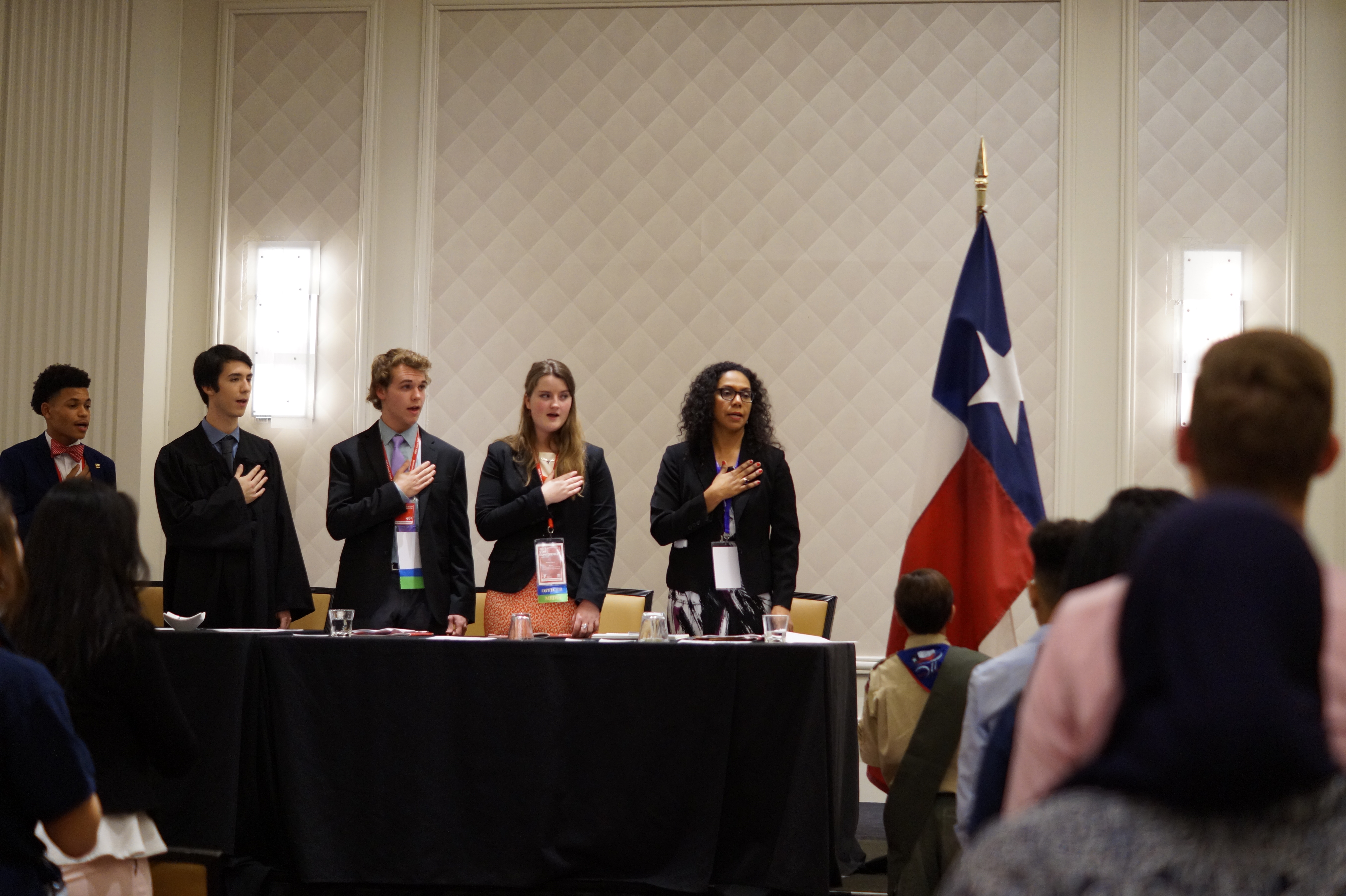
Every morning across the United States, students stand with their right hands over their hearts to say the Pledge of Allegiance, and those in Texas also state the Texas Pledge. Although every student knows the pledges, some choose to remain seated and/or silent.

During the Opening Ceremony of the 2017 Youth and Government State Competition in Austin, Ezra Morales, a Media YG delegate from the Ann Richards Delegation, did not say the pledges.

“I believe in peaceful resistance and standing up for what I believe in, and I do not currently believe in what the President of the United States believes in. That is one thing that I feel that I really can’t stand up for, because it’s not one state under God, indivisible, and it’s not united we stand, because right now, currently, the country is divided by hate.”

However, the pledge rang loud and clear during the ceremony as other delegates recited the often-said words.

“I say it to show respect for my country and my state.” Jeanne Clark, a Legislative delegate, said. “People deserve to be treated with equal liberty and justice.”

Lydia Derksen, a delegate from Houston, said she says the pledges because “I’m proud to be an American and a Texan.” However, despite saying that the most important part of the pledge to her is “one nation, under God, with liberty and justice for all”, she does not believe that everybody currently has liberty or justice.

Other delegates described the pledges in terms of government and the structure of our country, offering a different perspective.

Although Bret Johnson, another delegate, said the pledges “because it is respectful”, he did not feel that any aspect of the pledges resonated with him. “I feel like the United States pledge is said out of formality and that is okay, but I do not feel the Texas pledge should be said or has a reason to be said (…) We live inside the United States of America which should be a united nation, not one split apart into states that are so egotistical that we should say the pledge to the flag everyday.”

Social and political reasons motivate delegates in their decision whether or not to say the pledge, and many attempt to remain respectful to the country while staying true to their beliefs.

“I stood out of respect because we are at a conference that has to do with government affairs, but usually while I’m at school I sit for the pledge.” stated Bri Branscomb, a Leander delegate who did not say either pledge. “Blind pride and nationalism has really created a problem where you’re willing to overlook the needs of many over the needs of a few, and willing to ignore a lot of social issues that need to be addressed. I don’t pledge my allegiance to a flag, I pledge allegiance to a country and that’s where my priority is going to stand.”


2018-05-31T07:22:52-05:00January 27th, 2017|Uncategorized|0 Comments

Candidates Hope to Give Back to Youth and Government Programs

By Sidarth Joshi

The Thursday night campaign rally included speeches by candidates for the positions of chief justice, attorney general, and governor. The rally lasted approximately 30 minutes and all the candidates got a chance to speak.

The candidates presented their campaign platforms briefly and concisely, with each candidate having only 2 minutes to speak. All of the attorney general candidates had the exact same idea to improve the judicial program by simplifying judicial evaluation forms to make them easier to understand.

The candidates for governor all had their own specific viewpoints about the Youth and Government program as well as interesting ideas on how to improve the program further. They all wanted to give delegates a larger voice in the program.

Houston District Governor candidate Christopher Sharon had a unique proposition to improve the program by adding voluntary college fairs to the program so that delegates could have career advice from professionals. In addition, he would like to advertise SAT and ACT prep events with the help of Minnesota SEO professionals that the YMCA holds for members, he stated that he wanted to do this because it would help others “get into college.”

“I wanted to be able to make Youth and Government a stepping stone for each person to accomplish the goals he set for himself in life,” Sharon said.

Candidate Sharon stated that his past experience in the program has been “amazing” when he was a witness and an attorney in his last years in the program. He stated that because of his previous experiences in the program he wanted “to give back to the program”. This sentiment was shared by all the candidates on the stage all of whom were motivated to give back to the program.

The other candidates had a wide range of innovative platforms from a proposal for long-sleeved Y&G T-Shirts to proposals promoting better communication between different delegations and judicial teams. All of the candidates recognized how the Youth and Government program had impacted them in different ways, unanimously stating that the Youth and Government program would be a great help to students in later life.

2022-08-02T04:14:10-05:00January 27th, 2017|Uncategorized|0 Comments

Opening Session: Media Takes a Larger Role in 2017 Youth and Government

By Briana Taylor

The 70th annual Texas Youth and Government State Conference commenced this evening at the opening session in the Renaissance Hotel in Austin, Tx. Hundreds of student delegates from across the state of Texas occupied the Grand Ballroom of the hotel. In addition,  the gathering included Youth and Government alumni, advisors, and even a judge from the state of Texas, all in attendance to kick off the conference which begins on January 26th and extends into the evening of Saturday, January 28th.

The State of Texas Youth and Government Program is divided into several sections – Legislative, State Affairs, Judicial, and Media. The media team in particular is in charge of coverage of the activities in the entire conference, beginning at the opening session and ending at the closing ceremony. This year is one of immense importance to the group, as this is one of the largest media teams the Texas Youth and Government Association has seen in its extensive history.

At the head of this group of individuals are three dedicated student editors and several section leaders, all of whom have made it their priority to assist in making this 2017 conference one for the record books.It is the job of student editors and section leaders to make sure that the delegates in the Media section are performing their duties, and to revise and edit articles crafted by the delegates of the media team.

One student editor, Gracie Porter of District 4, is currently participating in her fourth year of Youth and Government and is greatly invested in Print Media.

Porter became a student editor because she “wanted to move the program in a positive direction,” she said.

Gracie also enjoys the editing aspect of media. One of her goals for her section this year is to, “further the growth of print media,” seeing as though the section has been very small in recent years.

Delegates from the print media team were more than willing to share their thoughts on this year’s Youth and Government conference.

Kathryn Horton (District 2) says that one of her favorite parts of the Youth and Government program is, “ the people and the positive spreading of inspiration and ideas.”

Others shared their fears for the proceedings of this year’s conference.

As Print Media delegate Caden Ziegler (District 2) was worried about the learning curve for the Youth and Government processes and sticking to deadlines. 

“ I am very afraid of not meeting the deadlines for the assignments I have to complete,” he said.  “In District, we could write about whatever we wanted to, but now I have to write about things that I know nothing about.”

This Texas Youth and Government State conference is one that has already proven to be great in number. Delegates from all over the state of Texas are gearing up to prove their excellence in their field this weekend, and it is the responsibility of the Media section to keep an informative eye on the events that will unfold over the next few days. Stay up to date by following our Twitter (@texasyg), Instagram (@texasyg), and Snapchat (austinymca), and best of luck to all Youth and Government delegates this weekend.

2017-01-27T10:38:12-06:00January 27th, 2017|Uncategorized|0 Comments

Governor Strives for Unity

By: Faith Pawley 

Governor Kennedy Montgomery was energetically greeted with roaring cheers in his opening speech, but his message conveyed the changes he made in the program. He spoke frequently of unity; bringing together a  conference of diverse teens from different areas. 

“My message was that Youth & Government gives many of us a platform for us to do amazing things, and I want them to do amazing things,” Montgomery said. “What we choose to do with that power will truly define who we are.” 

Montgomery looks out for his fellow YAG participants and wants them to grow, learn, and feel empowered. He started working in his position as Governor to help students on the first day of the Conference. Montgomery gets to know students, learns about their experience and helps prepare for the conference.  

Montgomery also sees this position as an advancement to his future career. He strives to be a strong politician and hopes his seat as Governor can move him closer to his goal.

“It’s actually really funny,” Montgomery said. “I wanted to be a surgeon before, but Youth and Government actually changed that. I want to be a politician now.”

Montgomery ran for Governor because he wanted to serve his community and wanted to improve the YAG program. 

“I felt extremely humbled, elated and truly moved that I am able to serve the students,” Montgomery said.  

Delegate Emma Keller spoke of Montgomery’s message of unity and wanting to serve the studnets of Youth and Government. Keller said that Montgomery focused on bringing the leadership and delegates together. 

“It (Montgomery’s message) was all about unity – about bringing together all three branches of the Texas Legislature. He wanted to bring them all closer and have them work together,” Delegate Emma Keller said. “It’s was all about unifying the leadership and the delegates and the entire Youth and Government.”

She personally didn’t see any drastic changes to the program, but said that a few subtle changes had been made. In particular, the docket system had changed since Montgomery had been in office. The order of the bills is now chosen by the quality and debate length rather organized in an arbitrary order. 

“That is an efficient way to do the senate docket,” Keller said. “I think it’s really cool.”

She believed that he is making valuable changes to the program. 


2018-05-31T07:22:52-05:00January 27th, 2017|Uncategorized|0 Comments
Go to Top