
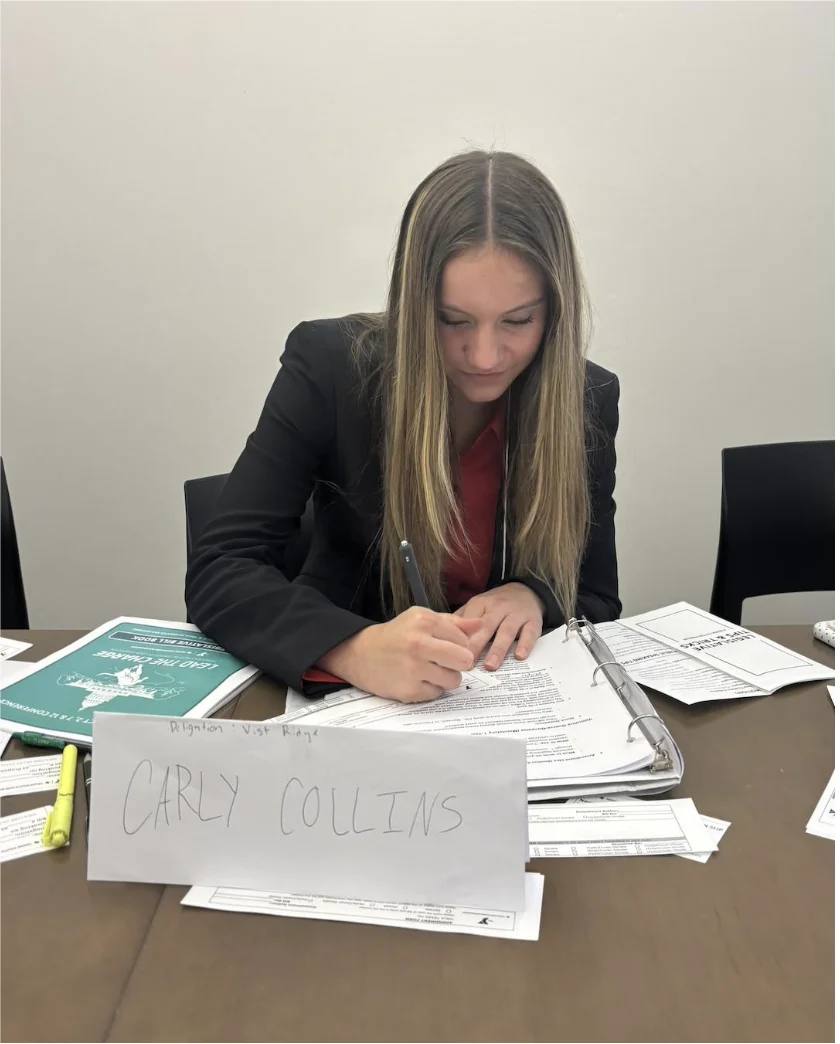
Legislative Delegate Carly Collins
Photo taken by Caydenn Angeles. Legislative delegate Carly Collins prepares to propose and defend HB058, which increases eligible state General Revenue Fund for cancer research.
By: Caydenn Angeles
W.B. Ray High School
It’s not a surprise that cancer is considered the second leading cause of death in Texas; with over 2 million cancer diagnoses each year in America, it is almost inevitable for an American individual to know of someone suffering through cancer, whether it be a loved one or an acquaintance. This is especially a reality for Carly Collins, a high school student from Vista Ridge High School proposing to dedicate 20 percent of eligible state General Revenue Fund to cancer research through HB058.
According to the National Cancer Institute (NIH), 14.7 thousand adolescents—ranging from ages 0 to 19—are diagnosed with cancer each year. When asked about her motivations toward creating this bill, Collins revealed that her cousin was diagnosed with brain cancer at age 7. “I now run a non-profit trying to help get grants for research trials. My cousin is the reason I would like to see this change in the state’s funding,” she explained. Collins’ experience reflects the majority of individuals in America, and she speaks for these people through her role as a Legislative delegate.
One could argue that directing 20 percent of the state General Revenue Fund toward cancer research is excessive, but Collins easily explained her well-thought-out plan regarding the bill. With specific instruments—ranging from $25 million to $40 million in cost—necessary for expediting the process of understanding cancer, and a $4.6 billion surplus of the state left untouched, her reasoning left most delegates in her committee unable to argue against her bill, and she effectively defended herself from those who attempted to oppose it.
Both Collins’ planning behind the bill and the near unanimous vote to pass it reflect her passion that remained present before this conference. Her application of a personal experience to the Legislative section that relates to the widespread issue of cancer represents the true purpose of Youth and Government: to prepare young students for “moral and political leadership in the American democratic process.”