Volunteer with us Today!! We have various dates to choose from Jan 31st | Feb 1st | Feb 27th | Feb 28th | Mar 1st | Sign Up Today!

Texas Youth and Government

About Texas Youth and Government Youth and Government

This author has not yet filled in any details.
So far Texas Youth and Government Youth and Government has created 177 blog entries.

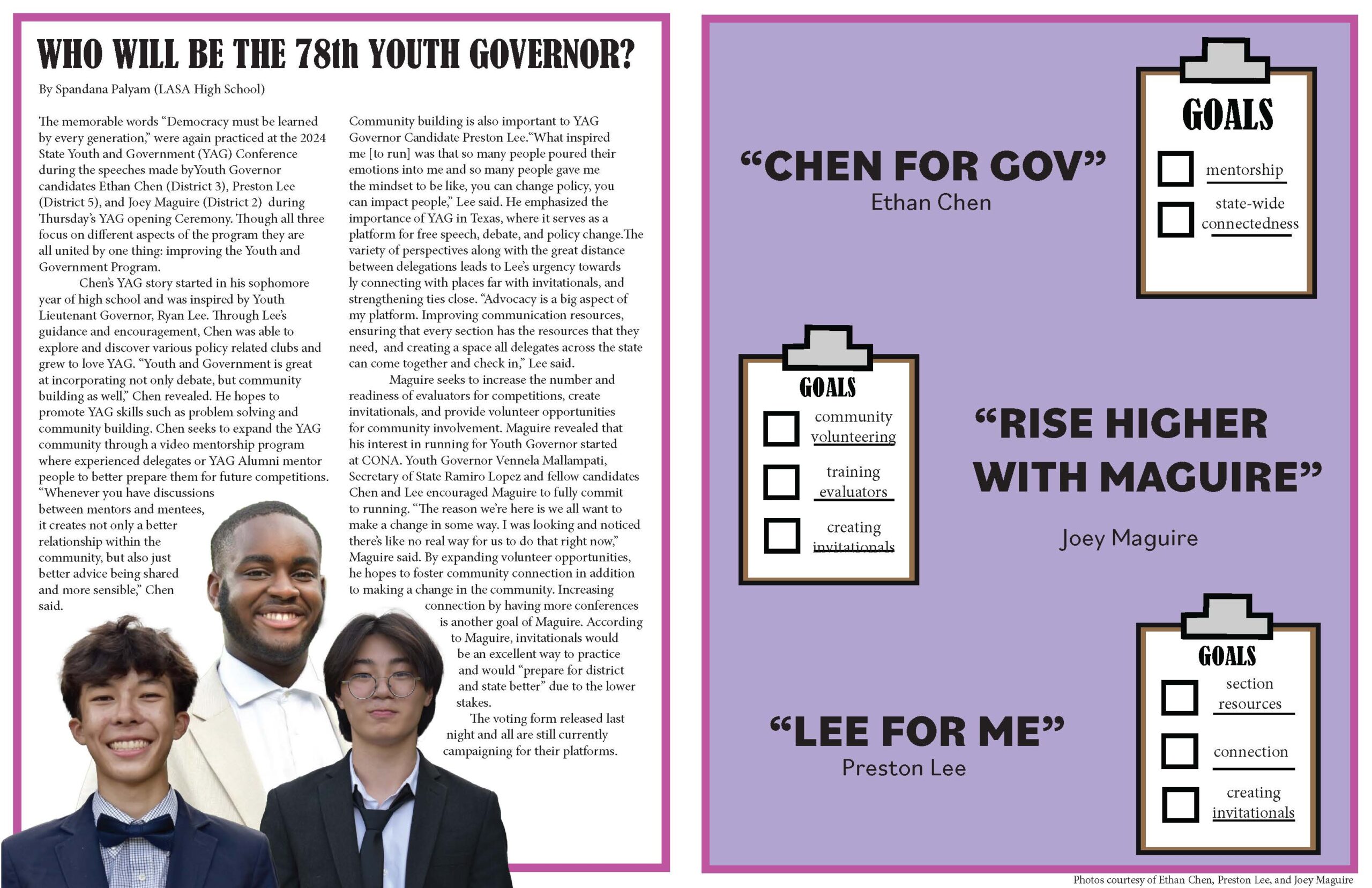
Who Will Be The 78th Youth Governor

The memorable words “Democracy must be learned by every generation,” were again practiced at the
2024 State Youth and Government (YAG) Conference during the speeches made byYouth Governor
candidates Ethan Chen (District 3), Preston Lee (District 5), and Joey Maguire (District 2) during
Thursday’s YAG opening Ceremony. Though all three focus on different aspects of the program they are
all united by one thing: improving the Youth and Government Program.

Chen’s YAG story started in his sophomore year of high school and was inspired by Youth Lieutenant
Governor, Ryan Lee. Through Lee’s guidance and encouragement, Chen was able to explore and discover
various policy related clubs and grew to love YAG. “Youth and Government is great at incorporating not
only debate, but community building as well,” Chen revealed. He hopes to promote YAG skills such as
problem solving and community building. Chen seeks to expand the YAG community through a video
mentorship program where experienced delegates or YAG Alumni mentor people to better prepare them
for future competitions. “Whenever you have discussions between mentors and mentees, it creates not
only a better relationship within the community, but also just better advice being shared and more
sensible,” Chen said.

Community building is also important to YAG Governor Candidate Preston Lee.“What inspired me [to
run] was that so many people poured their emotions into me and so many people gave me the mindset to
be like, you can change policy, you can impact people,” Lee said. He emphasized the importance of YAG
in Texas, where it serves as a platform for free speech, debate, and policy change.The variety of
perspectives along with the great distance between delegations leads to Lee’s urgency towards ly
connecting with places far with invitationals, and strengthening ties close. “Advocacy is a big aspect of
my platform. Improving communication resources, ensuring that every section has the resources that they
need, and creating a space all delegates across the state can come together and check in,” Lee said.


Maguire seeks to increase the number and readiness of evaluators for competitions, create invitationals,
and provide volunteer opportunities for community involvement. Maguire revealed that his interest in
running for Youth Governor started at CONA. Youth Governor Vennela Mallampati, Secretary of State
Ramiro Lopez and fellow candidates Chen and Lee encouraged Maguire to fully commit to running. “The
reason we’re here is we all want to make a change in some way. I was looking and noticed there’s like no
real way for us to do that right now,” Maguire said. By expanding volunteer opportunities, he hopes to
foster community connection in addition to making a change in the community. Increasing connection by
having more conferences is another goal of Maguire. According to Maguire, invitationals would be an
excellent way to practice and would “prepare for district and state better” due to the lower stakes.
The voting form released last night and all are still currently campaigning for their platforms.
Written by: Spandana Palyam, LASA High School

Kenneth Pham Story

The YMCA Youth and Government (YG) program provides the new generation with an enriching and hands-on activity that promotes civic engagement within the political state of contemporary society. Although YG is broken down into four different sections, in my opinion, the legislative branch is one of the most beneficial sections for students looking to improve their overall understanding of how bills are written into law. The legislative branch is broken up into two groups, the House of Representatives, and the Senate; however, I will be specifically focusing on members of the House, in which most legislative delegates will be debating. Within the House, many procedures carried out by these committees reflect the actualities of modern government. For example, YG legislative practices consists of submitted bills by its members in which fellow delegates will debate during the question-and-answer, amendment, and proponent opponent periods. These processes closely follow the responsibilities of legislators in positions of government which will be beneficial because it keeps the youth informed on societal issues and how they can use their own voice to advocate for what they believe is right. For instance, one bill advocating for a ban on the purchase of electrical vehicles as it damages the Texas power grids, especially in times of harsh weather. “I like how Youth and Government addresses a variety of issues and continues to keep the youth educated on how laws are implemented within their communities,” said Kyle Villinueva, YG House of Representatives delegate. It is especially important that the younger generation continues to stay informed on current issues within their community and that they are comfortable in standing up for their beliefs through proposing legislature and voting for the favorable passage of them. The legislative branch, specifically the House of Representatives, is a crucial section of the Youth and Government program as it mirrors how bills eventually evolve into law. Younger generations are the future of our society and it is crucial that they are educated and are aware of the functions within their government.

Sources: – Bill Book –

Interview with Kyle Villinueva

Proposal For Blood Donations

Inside the Legislative House and Senate session, many representatives are presenting their bills. Along with this, each representative is defending their proposals. Throughout the day, bills are either being approved or disapproved. Today in this session, we have Jason Choi and his proposal to resolve the statewide need for blood donations and him declaring an emergency. Choi begins his proposal by supporting real- world situations.

Small businesses are defined as business entities with an annual revenue of $1 million or less employing 50 employees. Choi states that communities with higher incomes, such as the American Red Cross, can assist with this problem. It is recognized that giving blood donations can help support millions. With these donations, small, struggling businesses will receive a 10% tax rebate based on the total operation costs incurred for each blood drive. Choi also states that blood drives raise a revenue of $ 5,000. Not only would this support small businesses financially, but it would also display public awareness of this situation. Though this situation may depend on public awareness, Choi believes this bill should be enforced, with the right to audit.

In this session, other representatives questioned whether this proposal would actually work. Many of them question, “How do we know for sure?” After listening to many of these questions, Choi reassures them of the higher chance of the bill assisting others and the lower chance of the bill not helping. After giving many supporting ideas, Choi begins stating the underlying possibilities of the bill not working. Though possibilities such as, there not being enough blood donations could lead to various problems, like fraud and not being held accountable. Before Choi finishes his proposal, he confirms that the representatives will fully trust him. As he finishes, he thoroughly explains that the main goal is to “pass on the gift of life without any lives, lost in vain.” With this bill, many lives could be saved in shambles. After much thought and no objections, the senator decided to pass the bill and agree with Jason Choi’s proposal for blood donations.

Written by Emma Hoang, Glenda Dawson High School

The Future of YG

TXYG 78TH CHIEF OF JUSTICE CANDIDATE JASMINE JOHN DISCUSSES HER PLANS FOR THE FUTURE OF VG

by Eliza Pepito

Coming from District 5, Garland High School Junior Jasmine John is proving herself to be THE Chief of Justice candidate to keep your eye out for. Garnering over 5 years of experience as a YG delegate, John has been putting her best step forward ever since her first year in the program. After being placed into Appellate Court (a section within YG’s Judicial Branch) during her Sophomore year, John conveys her initial feelings of inexperience and uncertainty due to not having been familiar with how the section functions. John recalls the time when she had relied on “YouTube videos” to help her navigate the new and unfamiliar territory. Therefore, through her campaign for TXYG’s 78th Chief Justice, John aims to “expand” the Appellate section by helping it accumulate more recognition as well as make it easier for others to join the section by “[providing more] resources.” With experience as both an “attorney [and) justice” at NJC (National Judicial Competition) as well as winning “number one attorney in the country”, John truly believes her deep involvement and immense accomplishments in Appellate have aided in her better understanding of the section as a “close-knit” family. Although many, such as Delegate Kaavya Sampath from Greenhill School, have been appreciating John and her campaign due to her confession of having joined YG for the “hot men”, thus revealing a “gutsy” as well as “hilarious and energetic” aspect unique to John’s campaign, John believes her platform concerning “Professional Development” is especially important in creating change within YG. John states that a delegate’s succession “should continue on past YG”. Thus, she aims to make opportunities such as “[networking], internships, [and) scholarships” more accessible to YG students since they are the “best candidates” for those positions. Although John’s campaign has received much attention due to her unique declaration of loving hot men, John has also possessed qualities within her campaign that truly harbor the potential to bring genuine change to the YG program, which can only help better the program. For that reason and in the words of a potential future leader in the TXYG program, “You want something cine? Jasmine John is the One!”

Blood Donation

Blood donations have become crucial to those in need, determining their final fate. As stated by representative Jason Choi, there is an opportunity for more people to be helped and assisted with blood donation within their community. As part of the bill, a collaboration was put forward to allow this bill to thrive further. One promoter mentioned in Choi’s speech was the Comptroller’s office, who would then promote blood donation and raise public awareness along with well open blood drives. Several ways to be part of helping others are by donating blood yourself, spreading the word, and/or becoming members of organizations that involve communication.

If small businesses were to disobey the guidelines of this bill, penalties would be given, and further consequences would be sentenced. Businesses would engage in fraud or even demotion from participating in programs or civil issues. Though helping is always a good deed, some are unable to. So, what does this bill mean to those individuals? Diseases, along with many other possibilities, could be highly transmitted through given blood, which would decrease those who can donate, but does not wanting to by choice make you a bad person? Not everyone may agree with this bill because of the possibility of failure. Even though small businesses and people may benefit from this act, persuading everyone to donate may not be possible. Many may disagree with the taxes or business requirements that include higher than an average income and descriptive eligibility. When watching the arguments in action, the room felt a rising tension, but Jason’s words were well said, and with a firm tone, he got as much of his bill into the audience. As the final discussion approaches, Jason Choi is faced with many questions in which the court’s final decisions lead to the decline of his bill.

Written by Isabella Martinez

Catherine Masey: A Profile on the LASA Delegation’s Co-President

By Delia Rune,

Liberal Arts and Science Academy

Catherine Masey has done Youth and Government (YAG) for the last three years. She
used to mock trial but, this year, she has transitioned to judging in order to balance her role at
YAG with her role as a delegation president. Masey wants to be a lawyer, so being in the
judicial branch was a no-brainer for her. “I chose to be a judge because it was something still in the judicial branch but with less commitment than mock trial,” Masey said. “I knew I wasn’t going to be able to give my all to a
team this year while also being co-president of a delegation and balancing college applications.”

Masey explained that judging has presented unique challenges, but that being a co-president is even more difficult. Organizing and managing a team of students has proven to be a complicated task that requires strong leadership skills. “The biggest challenge of judging is just dealing with people who are completely wrong but think they are completely right,” Masey said. “But being the co-president of a delegation is really a whole lot of work. It’s honestly challenging just to try to get people to check the Remind, check their emails, and text me back.”

Still, despite the challenges, Masey loves her role as co-president. According to Masey,
her co-president Will Bolduc has helped a lot, and even veteran YAG attendees can help to manage the team and explain what is going on to newer YAG students. “I really really love being co-resident of my delegation,” Masey said. “And Will is such a great co-president, he’s wonderful.”

Masey is glad she chose to do YAG and says that she will continue to encourage
younger students to join the organization. Masey loves YAG because of the friends she has met
through the club, as well as the real-world skills she has developed. “I think that it’s important for students to do YAG because it is important to be an informed citizen – and YAG definitely fosters that,” Masey said. “All the different branches of Youth and Government teach kids about how the real world works and give them skills they can use as adults.”

Governor Hopeful Believes Preparation for YAG Leads to Success

By Alanis Rodriguez,
Chisolm Trail High School

Students spend hours preparing for the Youth and Government State Conference. These moments are spent practicing, seeking advice, and considering endless possibilities in court or on the floor. While some go to the conference to hang out with friends and see the sights, others want to impress evaluators so that they can the most points. Whatever the reason might be, the delegates and candidates must prepare for the four-day conference in a variety of ways.

In the Judicial branch, witnesses are played and studied by students, which are then polished with the help of the attorneys. “I like to say we can’t have good attorneys if we don’t have good witnesses,” says Danika Maddox, who defended Arlo Key in the windshield murderer case. “We like to, at least once a practice, take our witnesses and either run through their questions or talk about how they’re going to answer them,” she said. By working in tandem, the witnesses and attorneys can create an effective argument that can get the defendant out of years of imprisonment. Meanwhile, the students who play as these witnesses have to understand their characters and research any other information that might come up in court.
Gavin Brooks, who played the medical examiner in the windshield murderer case, says, “you also have to have a lot of background knowledge on the scientific terms that are used,” and that you have to “understand them so then you don’t get frozen” on the witness stand. These two groups must work together to appeal to the judge and eventually reach the verdict that they worked hard for.

Along with the delegates, candidates running for next year’s positions must prepare their platforms and hone their campaigning skills to get the attention of students. Ryan Lee, a junior running for Governor, says that he has been “consulting other states and other governors” and “brainstorming, asking other delegates” to assist in creating his platforms. He has three platforms: 1) More Youth and Government events for practice opportunities; 2) A peer group system to give personalized feedback, and 3) To localize the Youth Advocate Program so that it is accessible to more students.

“I’ve already consulted other places like Washington, DC, and California, and they already have this thing in place, and all I’m going to do is reflect their own process and put it on to Texas,” said Lee when asked about the localization of the last program. As someone who is running for governor, Lee will need to talk to many students in the program in order to get their votes. “Since district, every weekend I’ve been setting at least three to four hours, developing speeches, developing ideas, and reaching out to other people,” he explained when asked about how long he has been preparing for his campaign. As seen above, candidates like Lee have spent hours of dedication to perfect their skills and platforms to hopefully get the votes of their fellow peers.

Emily White’s Bill

By Piper Watson

North Central Texas Academy

First-time Youth and Government delegate Emily White has been chosen to speak on the floor in the senate today because she has written an outstanding and debatable bill. She is confident in her research and information and knows the subject well. Emily’s bill is about restricting the use of long-barrel firearms within a city with a population exceeding 250,000 people. She wants to assist in declining the number of deaths caused by these hazardous guns. Emory Miramontes believes that “it will accomplish a safer Texas because gun ownership is already something that is heavily prevalent in Texas. Restricting that to not include deadly and injury-prone weapons can really help make the streets of Texas safer and make us in society feel safer.”

Emily’s bill has incredible, thought-through points about how if these guns are restricted they can be used for their original purpose so Texans can feel safer when going out. Some of the con speakers addressed points such as how it violates the second amendment, that people have the right to bear arms, which is simply not true. She is not depriving anyone of their rights because guns are intended for self-defense and hunting, not shooting innocent and unlucky bystanders who are just trying to enjoy their day. Emory decided that she agreed with Emily and wanted to support her by speaking for her bill during the pro and con section. She “really believes in gun ownership laws that make sure that the people who are owning guns are supposed to be owning guns. Gun ownership should be restricted to those who need to own guns because frankly, not everyone on the streets should own a gun. She believes that Emily’s bill will really help Texas restrict that in a way that she feels does not violate the second amendment or the rights of the people.” Overall Emily did an extraordinary job at presenting and passing her bill in committee, so let’s hope that she does the same today on the floor in Senate.


Food Is Life

By Maryfer Garcia,

Chisholm Trail High School

There is an expression that goes “food is life” which means that food is something vital that we need to survive. Food is what fuels us and to some, it is used as a reward after a hard day of work. Many people use food to recognize big accomplishments like at parties where important events are celebrated. A special treat should be recognized for going to compete at state for Youth and Government. Participating at state is not something that can be done leisurely are it requires much time to prepare and has many challenges, for that reason competing is an important event that should be commemorated.

Some students are looking forward to the banquet because it is their first time at such an event. The banquet is a place to dress to impress but still have a good time enjoying the new environment established. From the fashion to the aesthetic, to the food there is something to look forward to. Some first-years are looking forward to “I’m expecting this loud dinner party, nothing much” First-year Emma Bojnoch said. ”I’m expecting casual like no one’s really going to care.” Likewise, many first-years are in the dark about the banquet and have high expectations for the food. “I hope there’s good food.” Gabriel Lawrence said. “Because I’m hungry.”

Second years who have been exposed to the banquet food have not had such high expectations about the food. It has had a mixed review from some people saying the food did not live up to the expectations to others saying they appreciated the taste. “First year we had some sort of chicken bake.” Second-year Hannah Coleman said. ”And I kinda just picked at it.” The different accommodations have made some people favor the food more. “I think it was really nice.” Third-year Andrew Quinones said “I mean there’s a lot of accommodations for different religions, different food sensitivities, vegans. I myself would know because I’m religious, but yea the cheesecakes were really good.”


Texas Capitol Adds Rich History to YAG Experience

By Piper Watson,
North Central Texas Academy

The story of Texas’s State Capitol started long ago when it was established in 1839. The second president of the Republic of Texas, Mirabeau Lamar, wanted to make the town of Waterloo the Capitol of Texas. After the Texas Congress had approved the spot, the name was changed to Austin to honor Stephen F. Austin.

As time went on, Austin began to change and grow. The Capitol building started as a log cabin that had two larger and two smaller meeting rooms with an eight-foot stockade fence that aided in protection from Indian raids. In 1853, the Capitol had been improved into a limestone building located at Capitol Square, the current spot of the Confederate Soldiers’ monument. It was nicknamed an “architectural monstrosity” due to its lack of architectural refinement. When the Constitution of 1876 was created, they authorized 3 million acres of public land in the Texas Panhandle to be used to pay to build a new Capitol. A group from Chicago paid to construct our present-day Capitol in exchange for all of the land that eventually became the famous XIT ranch. 

In 1880, Texas officials announced a reward of $1,700, which is worth $49,861.67 now, to whomever won the nationwide competition with the best design for the new Capitol. Architect Elijah E. Myers made the design that was approved by Texas officials. Before the Capitol’s construction could begin, there was a fire that almost burned the plans on November 9, 1881. While the limestone Capitol was on fire, the Capitol Board had been in a meeting inside. Limestone from south Austin began being used to construct the foundation for the Capitol by contractors in 1881.

Sadly, they discovered that when exposed to the atmosphere, the limestone began to become discolored. They began looking for other options and found that Texas Sunset Red Granite would be the perfect building material. Then the owners of Granite Mountain in the nearby county of Burnet constructed a railroad especially for workers to transport the donated 188,518 cubic feet of the special granite that was needed. Numerous civic and government dignitaries attended the ceremony when the cornerstone was laid by Texans on March 2, 1885. Inside the 12,000-pound stone was a little zinc box inside a carved niche that held mementos that had been collected. Massive stones from railcars were hoisted up to any parts of the outside walls of the Capitol by ten derricks. When the Capitol building was completed it had 392 rooms, 404 doors, and 924 windows. In 1887, iron braces and wrought iron framework were imported from Belgium to make a dome that was then painted to match the Capitol’s granite. 

The year 1888 had a lot of accomplishments for our Capitol. In February, the Goddess of Liberty was created by metal contractors by welding 80 zinc pieces into the torso, two arms, and head. Each section was hoisted to the top of the dome and put in place by large screws. In May, over 20,000 people attended a week of celebrations at the new Capitol. The festivities included fireworks, band concerts, drill team competitions, and military displays. There were special streetcar lines that would bring large groups of people from an encampment a mile outside of town into the city. Crowds filled the Capitol grounds and lined Congress Avenue to view the dedication to the Capitol. The youngest son of Sam Houston, Senator Temple Houston, accepted the building on behalf of the state while expressing the pride that Texans felt in the building. “This building fires the heart and excites reflections in the minds of all… the architecture of a civilization is its most enduring feature, and by this structure shall Texas transmit herself to posterity” (Temple Houston). 

Today in 2023, the Capitol is an extremely popular tourist spot for those wanting to learn about our history, and just to tour or look around. Having the esteemed opportunity to visit here and look at all of the extraordinary architecture and detail is certainly something that should reside on your bucket list. There are numerous artifacts and information all over the halls. The Capitol building in Austin, Texas is a fascinating, historical sight to see.

In 1947, the YMCA of Texas organized the first Youth and Government Conference. 76 years later we have the option to all travel to meet at the government Capitol of Texas. Delegates that put in the hard work get the opportunity to visit our Capitol to get to debate bills in the Senate and House for Legislative, propose solutions to our biggest problems in State Affairs, and see the entire capitol to document and interview in media. We are blessed to be able to get come to our Capitol to be able to learn and show the valuable skills that Youth and Government has taught us.

Go to Top