Your Voice Matters! The November 3 General Election is here! Get informed, explore what's on the ballot, and learn how to participate. Find Your Ballot, Candidates & Voting Information

Monthly Archives: November 2026

DRESS FOR SUCCESS

THE EVOLUTION OF PROFFESIONAL ATTRIE

By: Dorcas Owala

John Marshall Law and Medical services magnet highschool

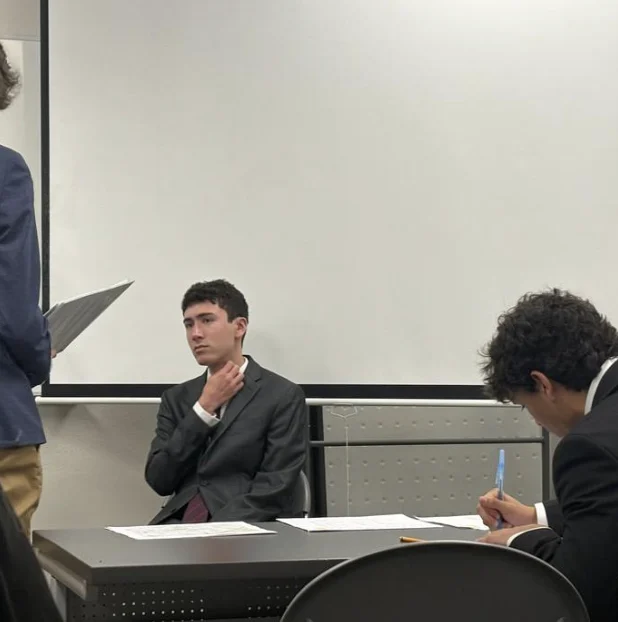
Austin, TX – Delegates arrived from Texas districts 2, 7, and 12 had arrived at the 2026 District conference. As the gym filled the room with students, their outfits helped create a professional atmosphere intended for law. Over the years professional dressing has changed as the Eras progressed. From the 1950’s to the 1980’s, law professionals were expected to wear very formal clothing almost every day, such as dark colored suits, white dress shirts, Pantyhose or stockings, conservative ties, and polished dress shoes. From the 1990’s to 2000’s,  Dress  code  remained professional but became slightly more flexible with the addition of different color, as well as less rigid styles that business attire became a replacement for the expectation of formal attire.. Today courtrooms still expect professional and conservative attire yet comfort, diversity and individual style are more accepted as long as the appearance remains professional. Similar to the real legal world, District conference participants follow a code to instill a proffesional environment.

Trial court delegate Avelina Sanchez says, “Last year for disctirct conference I had fell in love with wearing skirts! So now whenever I figure out my outfits it has to be paired with a skirt. As for my shirt I just liked how it fit on me.” Delegates showed care for their dressing with many choosing clothing that not only made them look good but also feel comfortable. An evaluator says, “Beingcomfortablee in the first start to a well articulated trial court delegate.

Throughout the conferences are being encouraged to dress professionally because it illustrates respect for the event and the people attending it. Madilyn Garcia an evaluator says, “It’s important to dress the part when presenting an argument. Presentation is everything from tone of voice to how wrinkled your slacks are.” Professional attire helps participants make strong first impressions and prepares them for future careers where appearance and professionalism are important.

As fashion continues to evolve, one thing remains clear: dressing professionally is about more than just clothing. It is a way for delegates to represent themselves in their future apirations. The addition of colors, different blouces, suits, allow delegates to invoke a sense of creativity as well as the values depicting in their sense of respect for professional attire. Delegates let their attire connect to their performance

As district conferences continue to bring together future leaders, the tradition of proffesional dress remains an important part of the experience. Fahsion trends will continue to change, but proffesionalism, respect and confidence will always be in style.
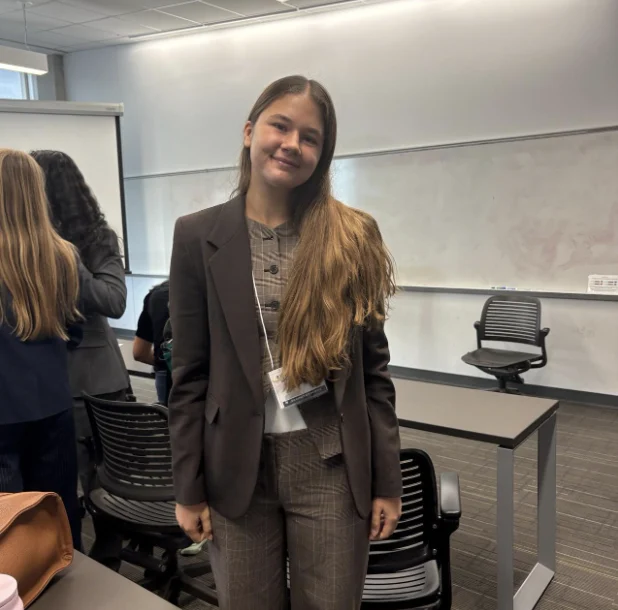
Professional dress

remains an important tradition of District Conference, reflecting the same values of responsibility and professionalism found in law careers. Trial court delegate chooses brown in order to show color and comfortability in her performance.
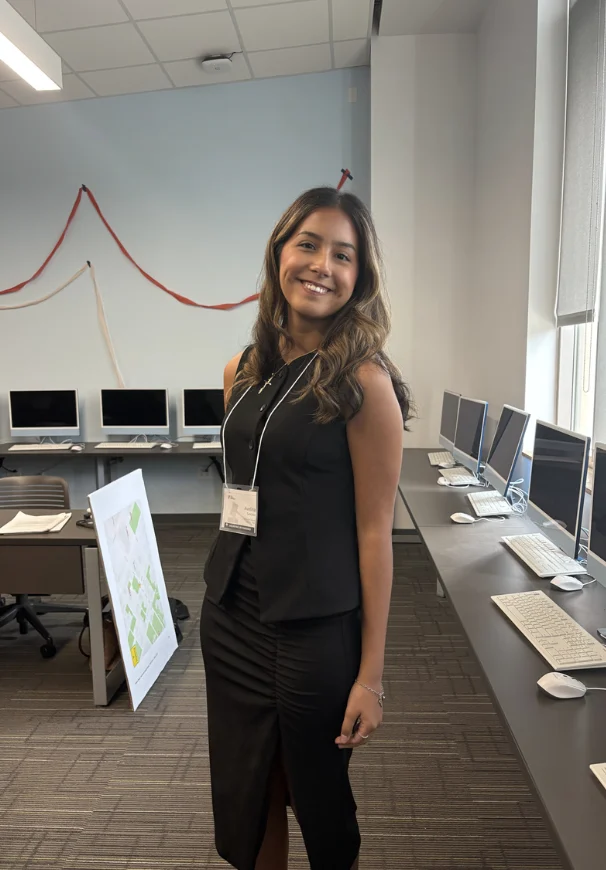
Avelina Sanchez

a trial court delegate decides to follow the skirt trend she has fallen in love with. Modern proffessional attire allows for personal style while continuing to meet the expectations of the District Conference dress code.
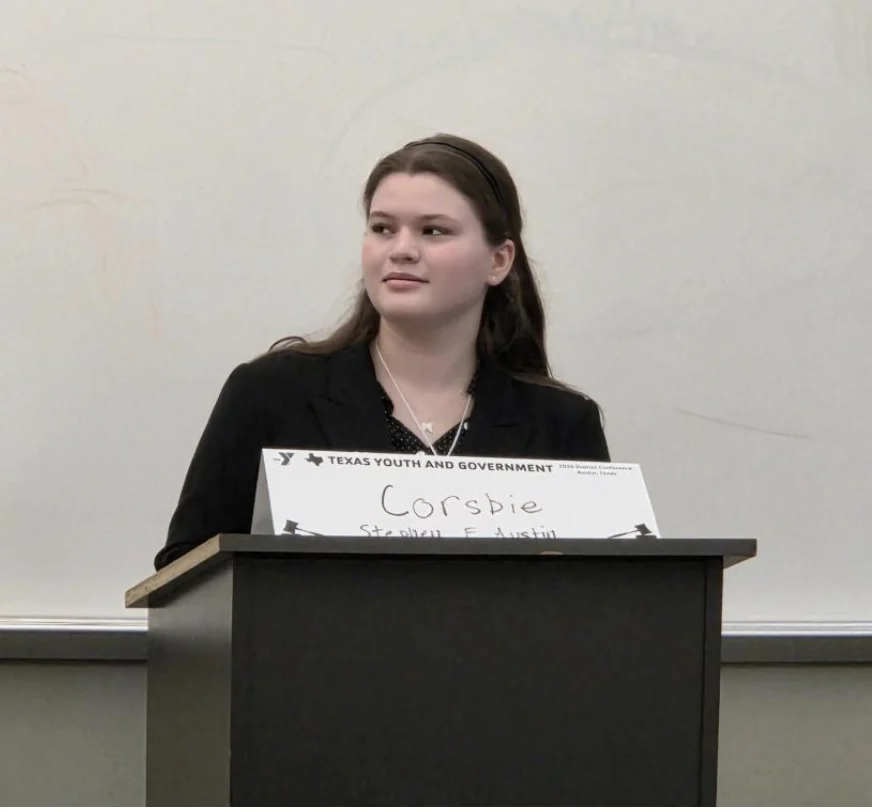
Facilitating Women: Elisabeth Corsbie’s Proposal

By Dakota DiTullio

Elisabeth Corsbie is a veteran State Affairs delegate from District Two, with proposals tackling major concerns such as gerrymandering and workplace wages. At this year’s District Conference, she shifted her focus to a surprisingly simple topic: women’s restrooms. Though a requirement is already in place for permanent facilities to provide waste disposals, Corsbie noted that portable and unisex restrooms are not. “Women’s menstrual cycles cannot be easily timed or regulated,” she argued, “And a lack of proper facilities in these spaces leads to unsafe and unsanitary situations.”

Corsbie’s demand is simple: provide facilities with adequate waste disposals, regardless of permanence. She claims that the addition of disposals will create a safer and healthier environment, promoting women’s comfort and preventing littering. Speaking in favor of Corsbie’s proposal, delegate DiTullio pointed out that the establishment of women’s facilities is a necessary step to ensure women’s safety and comfort. 

Other delegates believe this is not a foolproof approach.  In an amendment, delegate King argued that “Certain organizations could get away by just changing their bathrooms to be ‘male’ while still allowing females to enter,” negating the positive effects of the proposal. In response, Corsbie accepted King’s amendment to her proposal, extending the implementation of disposal facilities to all bathrooms. She noted that there would be an added grace period before the implementation of this requirement, so that portable facilities would have time to make necessary adjustments. 

In her closing summation, delegate Corsbie reiterated the importance of her proposal, stating that “it does not call for the large expense to be placed on companies nor does it call for complicated remodeling. All it asks for are simple covered waste disposals that are emptied regularly. Because public health shouldn’t depend on what bathroom you enter. Everyone deserves clean, sanitary, and dignified facilities.”

PRESENCE UNDER PRESSURE

WHAT SEPARATES A GOOD ATTORNEY FROM A GREAT ONE

By Kavya Gupta

Austin, TX – Before a single objection is raised or an exhibit is entered into evidence, an opening statement must be made.

The bailiff calls the room to order. All rise as the judge enters and takes the bench. Immediately, the evaluator begins to take notes, eyes darting across the well to observe microexpressions-even from participants who are not currently speaking.

“Does the prosecution wish to make an opening statement?”

This is the moment of truth. The attorney pushes her chair back, careful not to stumble over the scattered array of tote bags and binders at her feet. She takes a deep breath, straightens her lapel, and checks her notes one last time before setting them down. The script can’t save her now.

“Good morning, ma’am—apologies, Your Honour.”

Her knees shake. She nearly forgot how to address the judge. Looking out at the gallery of parents, co-counsel, and Youth and Government media members, the pressure of the room is palpable.

In YAG Mock Trial, legal knowledge is only half the struggle.

Evaluators score heavily on courtroom presence, which includes posture, vocal projection, and the ability to recover smoothly from mistakes. It’s true that a stumbled word does not ruin an entire round, but losing composure certainly can.

“What really helped me was knowing that judges and evaluators aren’t looking for a seasoned attorney who never makes mistakes. I’m confident during my openings, but being aware that there is room to have character and be authentic makes the courtroom environment even more lively,” said Akwaeno Udosen, an attorney from LASA.

The fact of the matter is-staying grounded under pressure separates good teams from state finalists. Whether this refers to delivering a passionate closing argument or simply listening quietly at the counsel table, every movement, every footfall, and every intonation adds to the case. “We’re looking for poise under pressure. When you stumble over a word, take a breath, own the space, and keep going,” noted Bryan Page, a Judge hailing from LASA.

At the end of the day, confidence in the courtroom isn’t about being fearless or vehemently confident. It’s about standing tall, owning the floor, and keeping your poise when all eyes are on you.

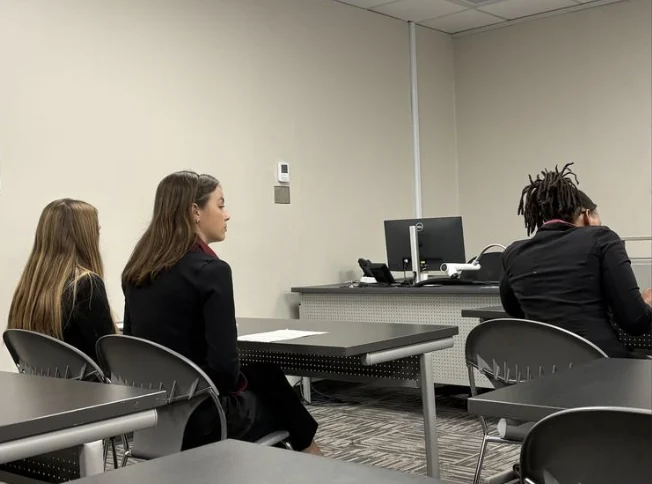
Austin High’s YAG team

competes against LASA’s Team

FIRST IMPRESSIONS OR FINAL WORDS?

AN EXPLORATION OF WHETHER OPENING OR CLOSING STATEMENTS HOLD MORE INFLUENCE OVER THE SUCCESS OF MOCK TRIAL

By: Apollo Dahmus

Liberal Arts and Science Academy

Austin, TX – In the courtroom, the judge’s perception begins with the opening statement and ends with the closing. Oftentimes a strong, confident opening or closing statement may be the deciding factor that sways the judge’s decision in  favor  of  one  team  over another. Knowing this, these statements are usually sculpted into assertive, convincing arguments pored over well before the trial even begins.

It can be difficult to devote an equal amount of time and effort to both statements for prosecution and defense. Some teams value one over the other.

ASA team L234 underwent rigorous closing statement preparations to be completely ready for conference day.

“We tried to have team meetings weekly leading up to the district conference,” Attorney Maria Sirbu said. “At those meetings, we practiced time management and coming up with rebuttals on the spot.” In such closing moments where some of the most passionate courtroom debate occur, with designated time for rebuttal and teams laying out all they have presented, tensions can be high. It can be difficult to compose a rebuttal with extremely limited time.

“We usually end up with around a minute or so to attack the other teams’ points. I’m glad we practiced under pressure beforehand.” Sirbu said.

While opening statements are the judge’s first presentation to the case, the scriptedness of them can take away from the natural confidence of a team’s unpolished response in the heat of the moment.

Even though they’re stressful, I really like doing closing,” Attorney Akwaeno Udosen said. “I get to show how prepared we are, and that we successfully checked all the boxes we said we would.”

“Both closing and opening statements are staples of mock trial, rituals embedded in the court. Lawyers roam the well and speak uninterrupted, laying out all the details of their preparatory work. Without these displays, mock trial would not have become what it has come to be today.

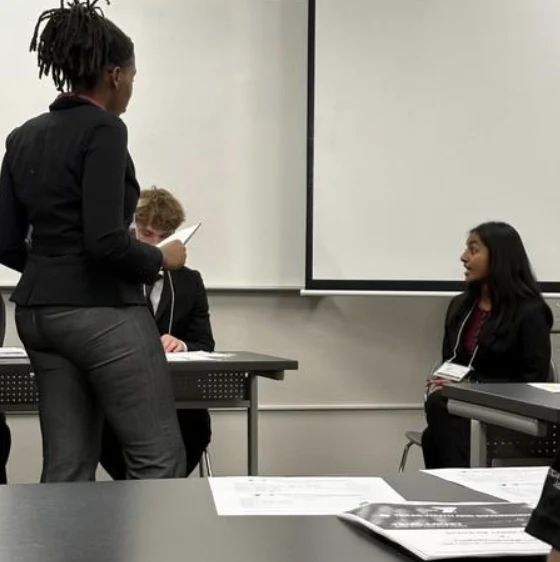
LASA Attorney Maria Sirbu

prepares to conduct her opening statement. It is her first trial of the day and she is representing the defense.

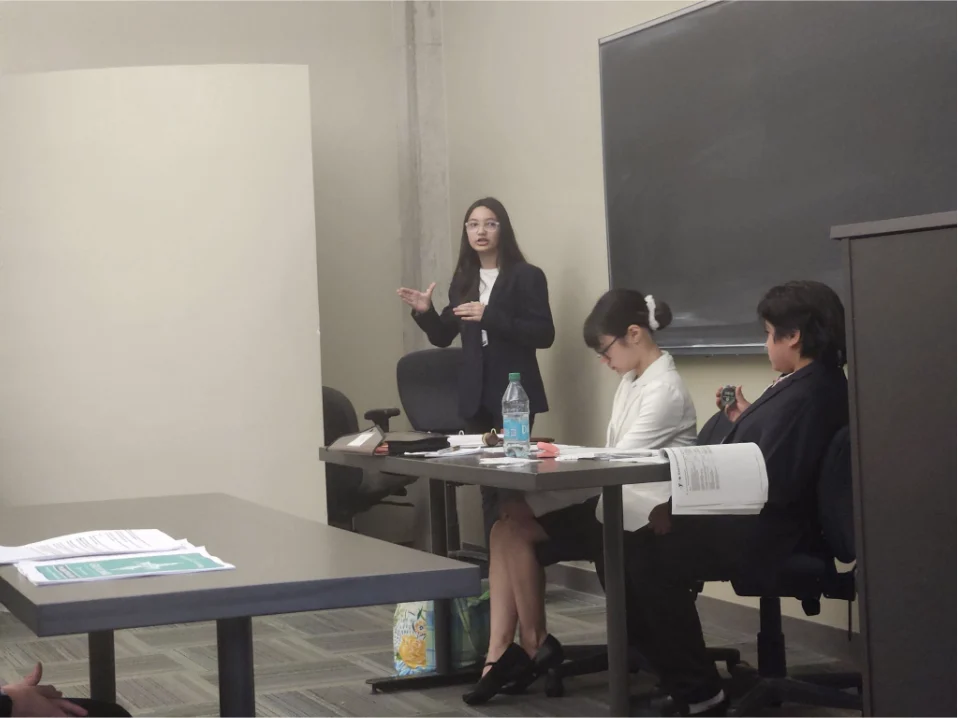
LASA attorney Akwaeno Udosen

presents her closing argument for the defense.

Bill 42: Fighting the 10 Commandments

By Marin Patterson

On the morning of November 14, 2026, several United States delegates gathered to discuss different bills that each had a proposal prepared for. Bill number 42 happened to be one of the more controversial ones. Proposed by Delegate Nidhi Abraham in committee four, this called for an act prohibiting the display of the 10 Commandments in public school classrooms and declaring an emergency. Delegate Abraham started her opening state with pure facts. She stated that 4600 public Texas high schools have 16×20 inch posters in every classroom. SHe then brought up Nathan versus Alamo Heights, a lawsuit in 2025 that challenged Texas Senate Bill 10. In Delegate Abraham’s words, she quoted, “Congress shall make no law prohibiting the free exercise of religion,” which she stated was directly violated by this S.B. 10 bill.

The Q&A period brought up several interesting points, which were all handled very efficiently. One of the more memorable questions asked what benefits would be caused by this bill passing. Delegate Abraham responded by saying Nathan versus Alamo Heights shows us that children felt pressured about their religion. Her hope is that students feel welcome to discover religion on their own and have the freedom to do so in their own environment.

The proponents brought up several points that pushed the need for this bill further. Both proponents clearly agreed that the separation of church and state is a fundamental constitutional right which is being violated by S.B. 10, and that forcing public schools to put up the ten commandments is clear favoritism of Christianity over other religions. There was only one opponent for this bill, with a weaker point. He stated, “The ten commandments are not just biblical words, they are key advice to take, such as don’t lie, and don’t steal.”

The amendment period went by quickly. The proposal was that an addition be made to the bill which did have high schools teach the 10 Commandments, but teach other religions as well, such as a theology class. However, the bill author opposed this amendment, and so did the other delegates, so it was not passed. Delegate Abraham’s closing statement was quick and concise, stating that her ultimate goal is for students to feel welcomed in a place meant to promote creative thinking and freedom. The bill was passed for favorable recommendation for the house in senate action.

Delegate Nidhi Abraham

Delegate Nidhi Abraham

Proposed Bill 42

Becoming the Character: How Witnesses Prepare To Be Questioned on the Stand, and Stay Composed Under Pressure.

By: Riley Rodin

District 2 Leander Co-op

As I sat in on a mock trial, I was impressed by how professional one student, a senior named Isabel Menga, was. Here at St. Edwards University students from across Texas compete in a youth and government sponsored by the YMCA in a conference for district 2 and 7. 

When I interviewed the student, she described her preparation to be on the stand. “After I feel like I have it memorized, I’ll hand my questions over to my friends…and they’ll ask me questions until I feel like I have it memorized.” I was also informed that it took doing it over and over. After all, “practice is the only way to get better” (Aurelian Victor Cotuna, 2019).

The skill Menga answered each question from the defense and prosecution was remarkable. She was an expert witness, meaning she is required to have expertise in the profession she was acting as. To give some background, the case is about a protester who gets run over by a man on grounds of necessity. In this particular case, she was being questioned as a doctor. I watched her being asked countless questions from the prosecution, most in an intimidating or accusatory tone, but instead of folding under the pressure, Menga answered each question with such integrity and ease that I began to believe she had prior medical knowledge. 

I ended the interview by how long  she has been doing Youth And Government. I was told that she has been participating and competing for 3 years, and has been a witness before. My final question was if Menga has advice for delegates who are interested in being witnesses, but struggle with stage fright or performance anxiety. “Dont be scared to get it into your character…take a deep breath and think about your answer.”

SAVE OUR SCHOOLS – WHO RULES OUR SCHOOLS?!

By: Aubrey Rey

Stephen F Austin HIgh

November 14, 2026 at 12:00 p.m. CST

Austin, TX – At a Youth and Government Conference on Saturday, November 14th 2026, Proposal 4, made and read by SAF member Kahlo DiTullio. Who rules our schools? The TEA, short for Texas Education Agency, is a state agency that oversees the activities and programs of public schools all over Texas. The head of the TEA is called the Commissioner of Education and is elected by the Governor at the time. The Commissioner of Education is backed by a hierarchy of staff who are chosen directly by the TEA Commissioner themselves. The TEA works closely with two other organizations called SBOE (short for State Board of Education), and SBEC (State Board for Educator Certification).

Unlike the TEA, the State Board of Education consists of 15 members elected and representing different regions of the state, the Governor then from the 15 elected members chooses a chair of board.

Kahlo DiTullio, Austin High Delegation made a proposal to change this overpowering election of officials.

Kahlo DiTullio argued “The focus of TEA is not to improve our education at all, but to further the political regimes of whoever happens to be in power”. This proposal is suggesting that the TEA Commissioner of Education should be voted on by the regionally elected State Board of Education using a two-thirds majority, instead of being chosen by the Governor alone.

This change is made in hopes that the wants and needs of the people are the main focus, rather than the Governor’s interests. SAF members worry that the State Board of Education is just as politically aligned as the Governor may be and will struggle to vote on the TEA Commissioner using the two-thirds majority rule. This is due to the fact that the State Board of Education are elected by regions that may radically differ in political alignments. This is addressed to be “Highly unlikely” and the State Board of Education is said to be more prone to compromise and less prone to be driven by political agendas because of their educational teaching backgrounds. According to Kahlo DiTullio “They are teachers, they are from education… they are a lot less polarized than the Governor”.

Other SAF members argue that this proposal is vital to ensure that our education system should be directed to benefit children’s creativity and learning rather than be completely overpowered by political subtext.

Now I must ask again, who rules our schools? Do you believe that our public schools need to be saved, or do you believe that they should be left alone?

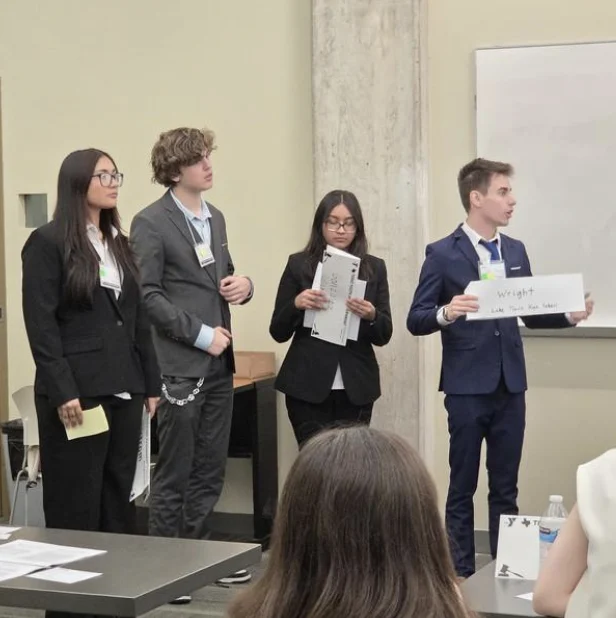
Committee room 1
Committee Room 1 during Proposal speech 4

Kahlo DiTullio

Committee Room 1 during Proposal speech 4

Pro speech for Proposal 4 in committee room 1

Advocating for the Introverts: The Proposal For a Bill to Help Students Become More Socially Aware

Written by: Addie Pfannenstiel

Should schools have business classes and teach students to be socially aware? Many kids around the world today lack the social skills to talk to others today, which is exactly what Areeya sought out to fix. Areeya Chhom-jans, a seventh grader in the Legislature, proposed a bill stating that both middle schoolers and high schoolers in the state of Texas should be required to take classes that teach them more social cues, have interpersonal skills, etc. Funding would come from fundraisers, parents paying for their kids, at school fairs having the food marker up by 20%, and even cutting some of the teachers salary. As well as fining districts up to $1000 if they didn’t do this with a 10% increase per quarter if they didn’t pay the fee. When asked why she wanted to make this bill, she said, “I feel some people at my school do not know how to talk to people, and I feel sad seeing them sit alone, so I want to help.” 

However, while her bill seemed good in theory, one of the candidates had other thoughts. Opponent, Gabriel from the Austin Co-op asked Areeya, “Who would teach these classes? How would they be qualified?” When responding, she said that teachers would have a license to teach and be prepared if any students needed accommodations. Gabriel urged others to not side with the bill and argued that in the bill there was not enough specifics about what the classes would entail as well what the guidelines overall would be, and where the funding exactly would come from.

And, even after Areeya tried to answer the questions when given the time to, ultimately the bill was not passed. When asked what she would do differently next year she stated, “Next year I would try to have more specific details in my bill about how the bill would work and where the funding would go.” And while this year she might have not been able to be successful in her attempt, she plans to come back next year ready and even stronger.

Youth & Governments’ Unseen Heroes

The Elipsy Foundation working together at St Edwards Univesity to fulfill a goal to support their aimed community.

Volunteers

The Epilepsy Foundation working together at St Edwards University to fulfill a goal to support their aimed community.

The Impact of Volunteering in Youth and Government

By Allisson Miron November 14th, 2026 Collegiate Highschool

Every year, the Youth and Government program continues to grow with new members as we know it— but what about those who are supporting our community? Who are they and what do they do for Youth and Government? Well, they’re various people from Texas who come for several different reasons, they’re volunteers and they share one common goal: To guide our community to success.

You might have unknowingly asked for their help on your way here at St Edward’s University as it reaches over 150+ acres or even have been evaluated by them! Volunteers help the program competition flow as smoothly as possible by maintaining jobs such as judging or simply showing the way to your room. However, the question stands, why do they do it and what is their impact?

Well, Youth and Government has been organized since 1946 and members who once competed within the program have begun to work in Texas courts. For example, Gabby, a former competitor in Youth in Government who now works as an attorney, continues to attend the program as a volunteer. She believes that voices are able to be made heard thanks to the program and believes that volunteering can continue to support the future for our members. She stated, “Ultimately, I continue to volunteer because this program invested in my future, and I believe it’s my responsibility and privilege to invest in theirs.”

Community is crucial within the program, we are surrounded by those who share similar dreams as us and we’re able to share and learn new perspectives thanks to one another. Many who I’ve interviewed shared the same vision about community, “family”.

Volunteers strengthen the community, not only are they working here but they’re here to watch us grow. They make competition possible.

Kimberly Martin, another volunteer for a community working here at the University stated that: “Community sparks hope.”

Celebrating the 80th

By Elijah DeBusk

This year marks the 80th year of the YMCA’s Youth and Government program in Texas. What started in 1936 in New York and then later moved into Texas in 1946 is an organization that gives schools and students a way for them to express themselves and lets them advocate for themselves. To start with, the only section that could be picked was legislative, which followed the same theme set in place by the founding group in New York. But as the organization grew, there was a need to expand the available delegations. In 1960, Texas started the judicial section, which gave students more opportunity to learn more than just about bills. It gave students the knowledge that lawyers have and need to be successful. In the time since then, media has been added, which lets students get experience in telling stories and painting a picture of what’s going on, and middle school integration was added, giving younger students the ability to grow their knowledge.

A big milestone in the organization’s history was the year 2000, when the American Bar Association began endorsing and supporting Youth and Government and even came up with policies that are designed to educate students interested in that field. With a supporter like this, it showed how important Youth and Government is and secured the idea of how necessary it is.

This year, in 2026, during the 80th anniversary, district conferences are underway and as fun as ever. This year, Saint Edward’s University in Austin, Texas, is letting Districts 2 and 7 have their conference there, letting the delegates have the ability to see and use such a beautiful campus, really showing how far the organization has come that a university in the capital of Texas has donated its space to be used. Eighty years old is a lot, but with the way that Youth and Government is looking, I don’t see it stopping anytime soon.

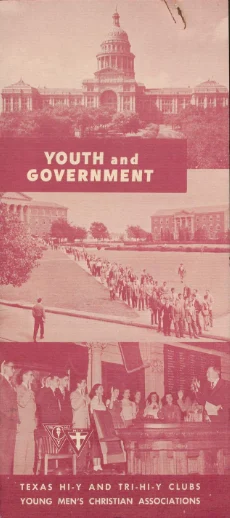
An old pamphlet from the 1950s getting the word out about Youth & Government, showing their ideas and how it benefits youth

1950s Youth & Government

An old pamphlet from the 1950s getting the word out about Youth & Government, showing their ideas and how it benefits youth

Go to Top