Volunteer with us Today!! We have various dates to choose from Jan 31st | Feb 1st | Feb 27th | Feb 28th | Mar 1st | Sign Up Today!

Monthly Archives: November 2025

Difference In the Districts: How Corpus Christi and Austin Prepare for a Mock Trial Against One Another
By: Caydenn Angeles
W.B. Ray High School

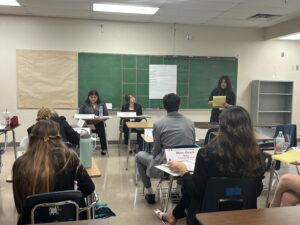
Austin, TX – When hosting the District Conference for Texas Youth and Government, the districts of Texas are divided into four separate conferences. In Texas’s state capital, Austin, one of these conferences is held between Austin itself and Corpus Christi, along with other cities.

The verdict of Harper Lin, a 31-year-old woman accused of murder, criminal conspiracy, and criminal solicitation against Cody Maddox, depended on Veterans Memorial High School from Corpus Christi, Texas, which stood as the prosecution, and Liberal Arts and Science Academy High School from Austin, Texas, which defended the accused woman. Through the observation of this specific mock trial, a question arose: Do different districts of Texas prepare and perform using different strategies?

The final verdict for this court trial was decided by the judge as not guilty. There  were many factors that contributed to the verdict of this woman, but Liberal Arts and Science Academy High School stood out to me when defending their client. During the trial, the defense provided objections to the judge a significant amount more than the prosecution. Veterans Memorial made a great attempt to prosecute Lin but was unable to ask sufficient questions to witnesses in this trial overall. This is because, while the prosecution would try to ask a question towards the witnesses in this trial, the defense would continuously state, “Objection!” which would typically later be sustained by the judge.

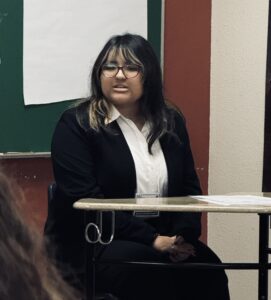
After the verdict was announced, I proposed an interview with Diya Darshan, the lead attorney of this court case who has participated in this event for three years, with the intention to discover if these consecutive objections were a planned tactic or if it was a a happy coincidence that contributed to their success. “That wasn’t specifically planned, as there were many instances of a foundation not being laid properly for the witness to be questioned about that topic. This gave us an upper hand as they weren’t able to enter evidence for specific witnesses and receive crucial feedback,” Darshan responds. It was interesting to view the mindset lawyers must have when performing in a trial, as it seems like a nerve-racking job to possess. Darshan helped me formulate a clearer understanding of her process, as her “biggest strategy was to look at the judge and solely convince them only as it is their courtroom despite the pressure,” ignoring any sort of self- consciousness that would impact her performance.

Despite Harper Lin being found not guilty, Veterans Memorial High School still provided an exceptional performance that impressed me. Keane Wood, a witness for the prosecution, stated that it was Veterans Memorial High School’s “first time attending a conference of Youth and Government.” This was a factor of the trial I was unaware of during the observation oftheir mock trial, so discovering this unknown fact contributed to my curiosity within their methods of preparation. “Understanding the trial and making questions that would defend our accusations was our main focus in preparation,” Wood stated, “but we weren’t able to fully defend our points because the defense’s objections to our questions kept getting sustained.” Because the defense seemed very relaxed with their case, I then asked Wood if their confidence intimidated him to the point of affecting his performance. “Their confidence, along with their constant objections, was definitely intimidating for me, and it was hard to stay collected when I was under pressure as a witness.”

The differences between each school from the towns of Corpus Christi, Texas, and Austin, Texas within their level of preparation, expertise, and performance was profound. Liberal Arts and Science Academy High School maintained preparation, as they were experienced and knew how to format and defend their evidence. On the other hand, Veterans Memorial High School were not as confident within their abilities because of their low experience level and inability to ask questions that were necessary to succeed. Though, one thing schools had in common from both Corpus Christi, Texas, and Austin, Texas, was pressure. Acting as any member of a trial, whether you’re a lead attorney or witness, is required for your whole team to succeed. There is no doubt that even if certain districts have more expertise within mock trials, the pressure each Youth and Government member feels proves the care they have for this organization.

The Issue of Plasma Donation and Its Effects on Lower-Class Communities

By Naden Ramirez
B. Ray High School

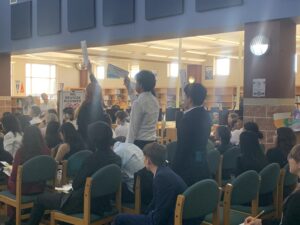
We should prohibit the wearing of socks with sandals. This is HB005, written by Alexandra Harper, and an example of one of several “joke bills” that took place at Committee 6 at the district meet for Districts 2 & 7. A large variety of bills were proposed, some relating to issues involving schools, while others were about lighthearted issues where they took a strong stance on issues like whether or not we should allow for Texas schools to teach that the Earth is flat. One bill that showed a genuine compassion for the issue it was discussing was HB088, which argued for an act to regulate paid plasma donation practices. The bill author, Sofia Torres, spoke on the issue with such passion during a casual 10-minute recess, and her passion was highlighted even more when she officially proposed her bill. 

The main components of her bill included provisions such as “The Texas Department of State Health Services (DSHS) shall regulate plasma donation practices statewide. Individuals may donate plasma no more than once every fourteen days, with payments capped at sixty dollars per donation.” This bill is meant to address the real-world issue of the connection between blood plasma donation and poverty in the United States. Americans with low incomes use these donations as a way to “add a few hundred dollars a month to household income, an important source of economic support for low-income families” as stated in “The Interlinkage Between Blood Plasma Donation and Poverty in the United States” by Western Michigan University. Although this can add on several hundred bucks a month to a person’s income, the detrimental effects of this on a person’s body are too severe. This is why Torres capped plasma donation to “no more than once every fourteen days” to ensure those who are donating plasma, mainly those in the lower class, have time to recover as much as possible. The negative effects of donating too much plasma are extensive, as it can lead to things such as dehydration, fatigue, vein damage, iron deficiency, infection, and many more. 

Placing regulations on an issue as serious as this in a sort of mock legislation reflects the real-world actions we should be taking towards regulating health-related issues such as this. Torres’s bill not only shows an incredible amount of passion towards a real-world issue, but it also reflects the positive effects of organizations such as Youth and Government. These sorts of organizations allow students to participate in real issues even if it is in a “fake” setting, allowing them to share their voice and inform people on real-world issues. As stated on the Youth and Government website, “Democracy must be learned by each generation.”

Being Lieutenant Governor as a Woman of Color: The Good, Bad, and Ugly

By: David Lee
W.B. Ray High School

“A lot of guys and even evaluators won’t take you seriously as a woman, I’ve had sexist comments said to me, but to be honest, I just laughed at them”, Spandana Palyam expressed. 

Spandana Palyam is the 79th Lieutenant Governor of district two and seven, and has shared her experience as a leader in youth and government, the good, the bad, and the ugly. Spandana Palyam is a devoted leader of district two and seven, with the experience and determination to back it up. Spandana started her youth and government career as a freshman, winning Distinguished Delegate in media, and advancing to state. Palyam also became the youngest ever media co-editor of the state, attended the conference on national affairs, and the Youth Advocates Program in D.C. on National Advocacy day. However, her journey didn’t start with perfection. Spandana found that she struggled with insecurity and imposter syndrome. She struggled with the experience of being seen differently because of her identity, and found that she wasn’t taken as seriously because she was a woman. However, Megan Dern and Missy Garcia, female leaders of Austin pushed her to stay committed to her journey of civic duty. When asked how she responded when discriminated against, Palyam gave me a steadfast answer, “To be honest, I just laughed at them. My brain just translated that experience into, “It’s not about me, they’ve got their own things, and if they truly believe that, then that’s just because they haven’t seen anything differently”. As a queer person of color myself, I found that this answer was deeply inspiring. There are moments when I struggle with a marginalized identity, but it was heartwarming to see such a successful leader like Palyam devoted to civic duty. 

Palyam also expressed more advice for leaders that struggle with being treated differently. “focus on what matters to you, don’t ever try to abandon what you value, just to cater to other people just to make them like you more.” Palyam also found that these experiences were essential to her growth, allowing for her to mature into the leader that she is today. Palyam found that Youth and Government pushed her to be more confident, to assert herself no matter what challenged her. “No matter where you go, there will always be haters”, Palyam expressed. 

Spandana Palyam is a visionary leader and inspiring heroine for anyone that struggles with their journey in leadership, showing that anything is possible. Through the challenges she faced in YAG and YMCA, Palyam was able to build her confidence, self security, and above all else; her commitment to civic leadership.

79th Lieutenant Governor
Spandana Palyam

AI Accumulating All the Energy

By Wangmin Estes
Liberal Arts Science Academy

In the afternoon, session 3 of State of Affairs was going on. A proposal about limiting the energy usage of AI in the State of Affairs room. Delegates Wright and King started out by stating that AI data centers consumed so much energy that it was causing black outs for people in the state. To fix this problem Wright and King propose to limit the energy use for AI data systems to 8% for the entire state and 10% for the county. They say that these limitations will allow AI to grow without harming the people.

The idea is that when the state is using 8% of the energy for AI data centers, no more data centers can be built unless the state or country supplies their own energy. Another delegate asked about how the companies will know how much energy they have left, and the answer was that there would be a tracker to ensure that the state knows how much energy they have left.

In the closing statement made by delegates Wright and King, they made several more strong points. They mentioned that the “energy consumption will double by 2030” which would make the power outages and blackouts even morecommon (Wright). In the end the authors of the proposal defended their proposal so well that it passed unanimously.

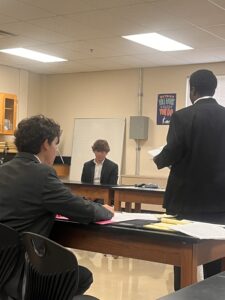
The State of Texas Versus Harper Lynn

(Above) Zane Torres on the witness stand in the court room,
photo taken by Marin Patterson

By Marin Patterson
W.B. Ray High School

This is the case of, ‘Local politics, old enemies, and deadly explosion,’ as written by Hon. C. Tyler Atkinson and Judge Denton from the Municipal Court for this 2025-2026 court case. I was actually able to sit in on this court case, and get exclusive information and photographs that would not be made available to the public for a year. So without further ado, this article presents an overview of the case, what happened, who did what, and the outcome. 

The cas began like any other, the prosecution and the defendant teams decided how they wanted their time spent and witnesses proclaimed the oath and affirmation. And then the prosecution immediately went into their opening statement, which can be summarized by their final quote stating, “Cody Maddox was killed in a bomb explosion made by Harper Lyn. She committed the offense of murder, criminal solicitation, and criminal conspiracy. We intend to testify to the court so that the defendant is found guilty of all charges, your honor.” 

After these words, the defendant decided to remain silent, so the prosecution went ahead and called their first witness, Jordan Reeves. Jordan Reeves stated that he was a detective, who’d gone to Sam Houston University. He is also currently working on this case, proving to be an expert witness in criminal justice. The prosecution’s questions permitted around the first piece of evidence, lawn fertilizer. Jordan answered that the lawn fertilizer had a “key component” called ammonium nitrate, which was confirmed to have been used in the bomb device. This exact kind of fertilizer was also found in Harper’s garage. 

It was then the defense’s turn to cross-examine the witness, asking several short questions to make it known to the court that this is not evidence that can prove Harper to be 100 percent guilty. The defense managed to prove that this fertilizer was quite popular, and stated that, “This circumstantial evidence should not be the proof of all these crimes.” 

After Jordan Reeves left the witness stand, the prosecution wasted no time or words before calling up Jamie Ternian, their second witness. Jamie Ternian was a friend of mister Maddox and miss Lynn, and she was called to the stand to testify as to why Harper was acting suspicious towards Cody weeks before the explosion. The prosecution’s first question was about Harper’s behavior, how she was acting, and what words may have been said. Ms. Ternian’s answer to this was, “I remember Harper saying to Cody a few weeks ago at a party, that one day he will push somebody too far.” The defendant then went on to ask about personal interactions and words exchanged between Ms. Tiernan and Ms. Lynn. According to Mr. Reeves, about a week ago, Harper had asked him if he’d seen Cody’s car, to which he replied that he had not, and Harper was speculating if Cody was sleeping IN his car, which marked the point of the conversation where Ms. Tiernan grew confused. Harper then proceeded to laugh and end the conversation. 

The defense had little cross-examining to do it seemed, as many of their questions speculated why or how Harper might be innocent, before they sat back down. After a few more witnesses (Riley Knox, Harper Lynn, and Gloria Parker), all of which provided only substantial evidence to the court, with Harper stating that she is fully innocent of all charges, the defense called their last witness. 

The witness’s name is Zane Torres, an expert in digital forensics and cybersecurity analysis, who was involved in the investigation due to her personal and professional view on the evidence exhibited on Harper Lynn’s laptop and burner phone. Mr. Torres stated that his takes from the evidence consisted of, “geolocation pings and pings in the area of Cody’s house.” However, Mr. Torres also explained that the location pings were not the most accurate due to the triangulation on the pings, triangulation meaning that

it sets the phone’s location into a certain mile radius, not giving the precise location. The prosecution questioned the man first, asking about the time and precise location. Mr. Torres answered the best he could, which brought the prosecution to their final statement, stating, “I implore the court to find Harper Lynn guilty of murder, criminal solicitation, and criminal conspiracy.” The defense’s closing statement chose to be a response to this, as both had three minutes. The defense stated, “Why destroy something you already have? Witnesses stated that other witnesses only supplied shaky evidence, the court must take this into account.” After the words of the defense, the prosecution used their last minute to provide a rebuttal, their final statement being, “While certain pieces of the evidence may be shaky, the entire picture proves that Harper Lynn is guilty, without a doubt.” Now, with the defense only having a few more seconds left to speak on, the last few words they managed to get out was stating that Harper Lynn was not in town during the searches of her house and properties. 

Finally, the court went into recess, and everybody waited with baited breaths, silently looking around. I took note that the prosecution looked confident, while the defense was quiet, with downfallen expressions of someone who believed they would not succeed. When the judge returned, she announced that the defendant, Harper Lynn, was found guilty of all charges, the prosecution had won. 

In conclusion, this case was a series of ups and downs. Experts were brought in, friends were brought in, and ultimately all of it resulted in the prosecution of Harper Lynn. When everybody was exiting the court room, I managed to get ahold of the judge for just a few words, even though she clearly was not eager to talk to a journalist at the moment. I asked, “Do you truly believe that Harper Lynn is guilty, with the evidence presented to you by both sides?” I waited silently for an answer before the judge responded quietly and curtly, “Yes. Harper Lynn is truly guilty of all charges.”

Behind the Scenes: Unseen Aspects of the Youth And Government District Conference

By: Dorcas Owala
John Marshall Law and Medical Services

Austin, TX – Before any competition or important event, we all tend to become nervous and prepare endlessly for the moment. Dreading for the day to come, we become doubtful and stress out over the little things. The only thing we want is for the day to be perfect, just perfect. Well the same can be said for many youth and government delegates. Nerves flying through the building as delegates walk in. There’s lots of hard work and training put into it that most judges and evaluators don’t get to see. Behind the Scenes work is the most important factor to prepare them for the District Conference. All delegates hope the outcome is a spot for the State Conference.

Preparation can range from parent support/advice, school training, mental notes, repetition of information, etc. Jose Garza a youth teacher of DMS says, “Students were provided with Bill/Proposal templates and mandatory practices twice a week. We help them navigate through the law world and answer any questions when needed.” Preparation comes from guidance. When needed, delegates watch videos, ask questions, and learn more from their teachers in order to do and be the best.

Shelby Watson an Advisor says, “Humans crave community; community can of course look different for people, but its very important to give them that scene. It’s not fun to be alone to be that support.” In the 2025 District Conference, about 200+ visitors came to watch their fellow friend and or family member compete. As the conference reaches, delegates begin to feel nervous and stressed. Their family members support and team support, helps them calm down and motivate them to be the best and do their best no matter the outcome.

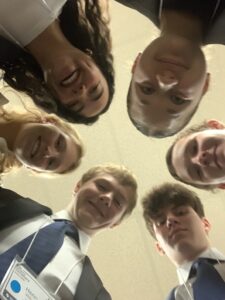
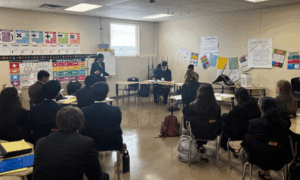
Trial Court Delegates in a group huddle before the start of the trial.
This is in order to calm down nerves and build confidence.

Mock Trial Mentality: What Mock Trial Members Do During Recess

By Caydenn Angeles
W.B. Ray Delegation

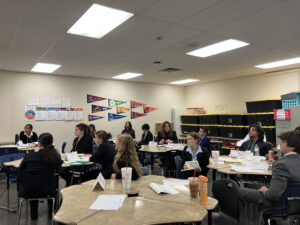
While walking in the hallways of Akins High School for the District 2 & 7 Conference, a group of students were seated in the hallway with paper and folders sprawled out everywhere. Confronting them, students Sebastian Oviedo, Aashna Kosher, Yuktha Gobburu, Catherine Willard, and Dhiya Sundar from both Cedar Park High School and Leander High School clarified that they were in a recess period.

For this District Conference, there are not enough judges available to conduct four mock trials, requiring each school to only achieve three. Because of this, each school is granted recess, which allows for the mock trial members to have a one-hour period of time to do whatever they prefer. I assumed that most members in Youth and Government would spend their time calming down from a suspenseful event, eating lunch, or having a talk with familiar friends, but these mock trial members proved me otherwise. “This is our first meeting, so we’re really nervous,” Kosher stated, “but working together in our mock trials has been more fun than scary.” In preparation for this conference, Kosher explained to me that their mixed mock trial team attended online meetings with each other once a week and in-person meetings every two weeks. 

Though, despite their consistent preparation, it still seemed like they were continuing to study for their upcoming trial. This surprised me, as I assumed they would have been confident in their abilities by now. “Going over the rules of evidence and the trial case itself is important to have our team succeed,” Yuktha Gobburu emphasized. Adding on to this, Catherine Willard expressed, “Reviewing our previous trials is really important for our next mock trial. That’s what we’re doing right now. It helps to see how other trial courts make arguments because we are able to predict and prepare for similar arguments coming up.” 

As a media journalist for this conference, it was surprising to see how members of different events spent their time. Each event has specific requirements in order to succeed, and this was demonstrated through my interview with this group of mock trial students. Realizing the dedication each member of Youth and Government has toward their event was and still is motivating to my overall perspective of the organization itself.


The Age of Student Debt; The Necessity of Financial Literacy

By: David Lee
Ray High School

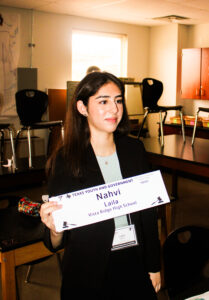
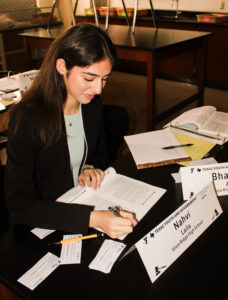
To be a Teenager in America means to collectively shoulder a total of $144.9 billion dollars in college debt. Financial literacy isn’t an additive to preparing high school students for the real world; it’s a necessity. This is why Delegate Laila Nahvi, a senior from Vista Ridge High School has proposed a bill to make financial literacy a course requirement for high school.

Nahvi, a high school senior, understands firsthand the importance of financial literacy. From a family of triplets, her household has to carry the immense financial burden of sending 3 children to college at the same time. Nahvi expresses her sentiments of a lack of financial awareness in her high school community, “most high school students aren’t aware of the intricacies of financial literacy”. Nahvi’s personal experience and numerous extracurricular activities related to financial literacy demonstrates her passion. These include meeting with members of the Bank of America, being a part of the Austin City Counsel, and an internship with the city of Austin.

The facts echo delegate Nahvi’s sentiment. According to the IFAC, Americans collectively lost a total of 330 billion dollars due to financial illiteracy. Another surprising statistic according to NEFE, only 1 in 5 high school students can answer basic financial literacy questions. In the age of predatory loaning, FASFA, scholarships, and the student debt crisis, this is a daunting issue. Nahvi urged her fellow delegates to pass her bill, and a unanimous vote erupted in her favor, showing the relevance of this pressing issue.

Delegate Galvan’s Artificial Intelligence Bill

By William Einhorn
Stephen F Austin High School

One of the sections offered by the YMCA Youth and Government program in Texas is the State Affairs section. In the state affairs section, delegates from certain schools within the conference debate solutions to real-world problems within Texas. They spend months preparing speeches and proposals for the District Conference. Delegates will present their proposal to a committee, then the delegates will question the proposal, and then take a pro or con side of the
debate.

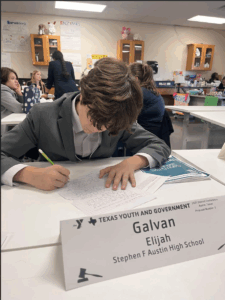
Elijah Galvan, from the Austin High School delegation, proposed his idea on the regulation of artificial intelligence in schools. He proposed to implement stronger punishments for AI usage to prevent it from happening again. Elijah strongly believes that the use of AI on school assignments greatly hinders learning for people in school, as well as lowers productivity and creativity. He said when asked about his personal viewpoint on AI, “I hate when I see my friends using it in school, because it makes me think they aren’t learning.” He also believes that making sure AI is not used in school helps prepare kids for the real world by giving them a
better education as well as a work ethic. He states, “Under these policies, students will grow to be more independent learners and stronger thinkers.” However, Elijah does believe that the use of AI can be helpful in some ways. He believes that using it as a brainstorming tool can be
useful, but it should never be used for an entire assignment.

Sadly, Elijah’s proposal failed to pass in the first meeting because he didn’t have a clear enough solution. However, he now has a second chance in his next meeting, and he plans to have his proposal pass. Elijah truly cares about his proposal and wants it to pass.

Texas Youth and Government, Shaping the Leaders of Tomorrow

By William Einhorn
Stephen F Austin High School

Before kids can even vote, some of them already know how to debate court cases, propose laws, and write articles. YMCA Youth and Government (YAG) is the place where these kids learn these skills. YAG is a club offered at many high schools across the country, one of which is in Texas. Students compete in conferences against other schools in their same district within their state. Students get to compete in mock trials, practice being journalists, propose bills, or propose solutions to current world problems. Students who participate in the conference get excellent experience participating in roles that simulate real-world situations. Some of the sections that are offered are: Legislative, State Affairs, Media, and Judicial. With all of the different sections offered at YAG, there’s room for everyone. Future lawyers may do the Judicial section to get courtroom experience through a mock trial, aspiring journalists would do the media section, and future lawmakers would want to do the Legislative section.

Some of the biggest benefits of YAG are that you get crucial experience for roles in government if that is what you want to pursue in life. YAG also gives you experience speaking in front of a small group of people. More shy people get to go out of their comfort zone and have a good experience publicly speaking. YAG is also very good when you are applying to college, specifically for people going into majors like political science. Doing YAG is what will separate you from the rest of the applicants.

Today, November 15th, 2025, the District 2 and 7 Conference is being held at Akins High School. Districts 2 and 7 represent high schools in Austin, San Antonio, and Corpus Cristi. Young leaders came from all of these places to debate their proposed bills, write articles, and participate in court cases. Excitement is in the air as young leaders from districts 2 and 7 have prepared for months just for today. They wrote their proposed bills, prepared to present solutions to real-world problems, and studied their court cases. I spoke with Gabriel Lara from the Austin High Judicial Delegation and asked him about the benefits of YAG. He said when asked about how he believed he was benefiting, “It’s helping my public speaking skills, and thinking on my feet as a lawyer.”

YAG is an excellent opportunity for the young leaders of the world. Kids get so much experience that is necessary to go into jobs related to politics when they are adults. They get a jump start on their education on the topic while also getting experience doing the tasks that they will be met with when working in the real field. If you are interested in going into politics in your future or you just want to have a good experience, then YAG is definitely the program for you.

Go to Top