
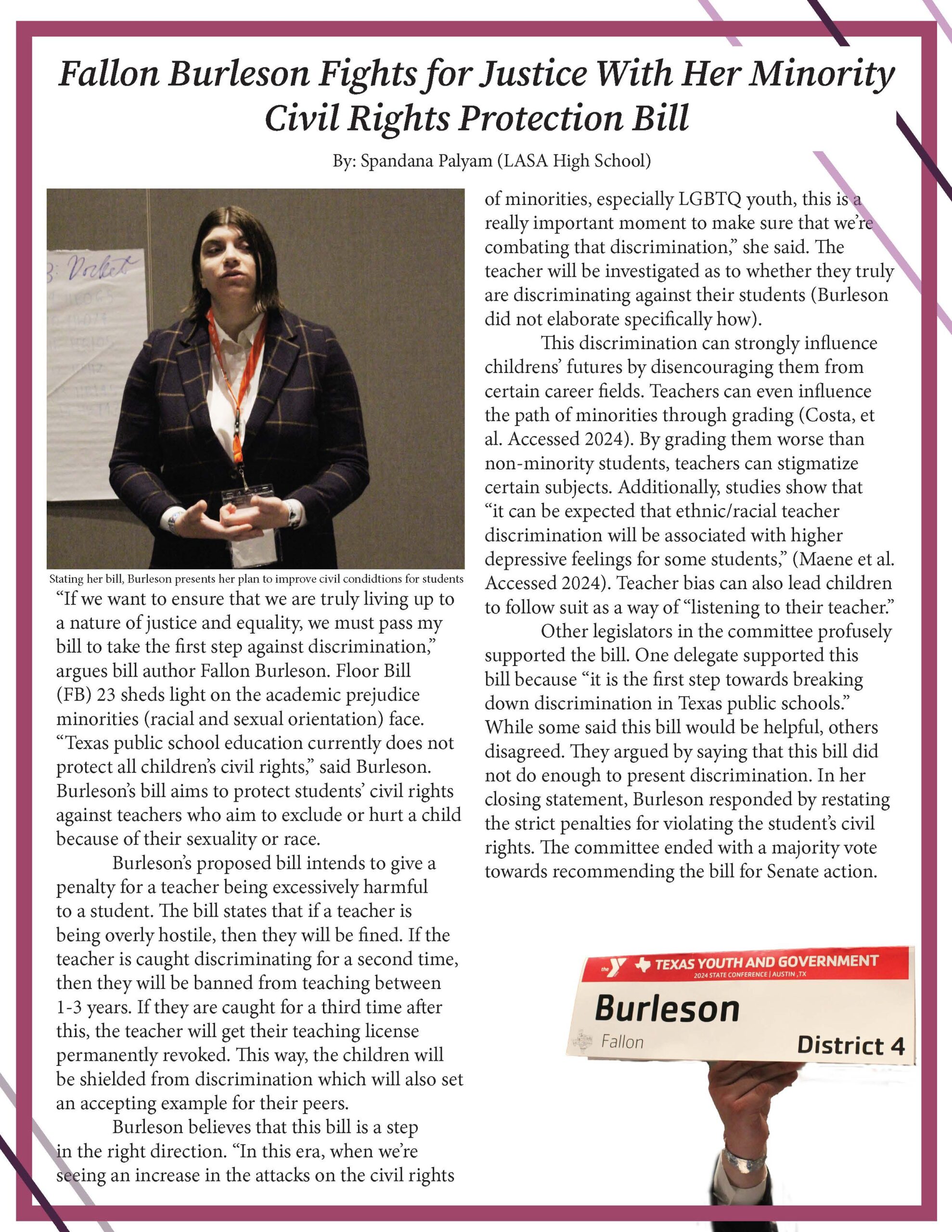
“If we want to ensure that we are truly living up to a nature of justice and equality, we must pass my bill to take the first step against discrimination,” argues bill author Fallon Burleson. Floor Bill (FB) 23 sheds light on the academic prejudice minorities (racial and sexual orientation) face. “Texas public school education currently does not protect all children’s civil rights,” said Burleson. Burleson’s bill aims to protect students’ civil rights against teachers who aim to exclude or hurt a child because of their sexuality or race. Burleson’s proposed bill intends to give a penalty for a teacher being excessively harmful to a student. The bill states that if a teacher is overly hostile, they will not be able to teach for one year. If the teacher is caught discriminating for a second time, then they will be banned from teaching for 3 years. If they are caught for a third time after this, the teacher will get their teaching license permanently revoked. This way, students will be shielded from discrimination, setting an accepting example for their peers.
Burleson believes that this bill is a step in the right direction. “In this era, when we’re seeing an increase in the attacks on the civil rights of minorities, especially LGBTQ youth, this is a really important moment to make sure that we’re combating that discrimination,” she said. The teacher will be investigated as to whether they truly discriminate against their students (Burleson did not elaborate specifically on how). This discrimination can strongly influence children’s futures by discouraging them from certain career fields. Teachers can even influence the path of minorities through grading (Costa, et al. Accessed 2024). By grading them worse than non-minority students, teachers can stigmatize certain subjects. Additionally, studies show that “it can be expected that ethnic/racial teacher discrimination will be associated with higher depressive feelings for some students,” (Maene et al. Accessed 2024). Teacher bias can also lead children to follow suit as a way of “listening to their teacher.”
Other legislators in the committee profusely supported the bill. One delegate endorsed this bill, because “it is the first step towards breaking down discrimination in Texas public schools.” While some said this bill would be helpful, some delegates disagreed. They argued that this bill did not do enough to present discrimination. In her closing statement, Burleson responded by restating the strict penalties for violating the student’s civil rights. The committee ended with a majority vote toward recommending the bill for Senate action.
By Spandana Palyam, Liberal Arts and Science Academy