Volunteer with us Today!! We have various dates to choose from Jan 31st | Feb 1st | Feb 27th | Feb 28th | Mar 1st | Sign Up Today!

Texas Youth and Government

About Texas Youth and Government Youth and Government

This author has not yet filled in any details.
So far Texas Youth and Government Youth and Government has created 177 blog entries.

Optional and Free Standardized Test

A PROPOSAL THAT MAKES THE SAT AND ACT OPTIONAL AND FREE FOR ALL TEXAN STUDENTS

Austin, TX – A proposal by Olivia Hundley and Mariam Oyejide would make the SAT and the ACT completely optional for all students. If students decide to take either test, all study materials and the test itself will be funded by the state. The ACT and SAT are standardized tests that most students in Texas are required to take.

Standardized tests are designed to be interpreted in a specific, standard way to evaluate all testers consistently. Both ACT and SAT scores are used by colleges and scholarship programs. The SAT is offered seven times a year and is an extremely important event in high schools, with many students cramming for multiple months before their test. The SAT and ACT were created to measure students’ ability and readiness for college and to give colleges one standard point of data to compare applicants.

Hundley and Oyejide propose that since the use of ACT and SAT scores are gradually becoming obsolete, it is no longer useful for all high schoolers to take these tests, spend time and resources studying for them and taking them and pay up to hundreds of dollars just for colleges to not use them.

This proposal will make the SAT and ACT optional for all students in Texas. Suppose a student chooses to take either test. In that case, federal funding will be allocated to pay any and all fees the student would need to pay, making everything free.

The SAT requires a registration fee to take the test and many other additional fees for certain services, like a late registration fee and score report fees. International testers must also pay a regional fee. The fees will fluctuate over time, but as of 2022, the registration fee is $60. There are fee waivers available to eligible low-income 11th and 12 graders and cover two SAT registrations, six SAT Subject Test registrations, all score report fees, and waived application fees at colleges.

The ACT no writing test fee is $55, and the ACT test with writing fee is $70. Like the SAT, the ACT also has late registration fees, test date change fees, and test center change fees. The ACT has fee waivers available to all 11th and 12th-grade students to take the test for free.

 Recently, colleges have been putting less and less emphasis on SAT and ACT scores, giving more attention to the GPA of their applicants to gauge their academic ability. The validity of standardized testing has been a very controversial debate for many years. Some say that the tests don’t actually show students’ abilities and that it’s impossible to make a standard test for all testers. In contrast, others argue that standardized testing is the only way to gather consistent student data.

Written by: Edy Wang, LASA
Should Physician Assisted Suicide be Legalized?

Today, a bill was proposed intending to legalize physician-assisted suicide for terminally ill patients. The definitions of this amendment would be that they must be 18 years or older, must be a Texas resident, and capable of communicating health care decisions. An argument that one of the delegates made immediately caught my attention. The delegate stated that many young adults’ minds are not fully developed until their mid-20s.

Without a developed mind, patients might make poor decisions that can greatly affect their families in the future. Another delegate stated that physician-assisted suicide is a fairly controversial topic, and because of this, an issue may come up with a lack of participation from physicians, which, with a lack of supply, prices would increase for the procedure. Another statement from a delegate was that the medical term “terminally ill” is very broad and sometimes doesn’t mean what it may sound like. Terminally ill can mean many different diseases or infections. The delegate speaker was concerned about the gray area in the definition of
terminally ill. Overall, the bill is still very controversial and would need some revisions to be enacted.

Written by: Elan Rodriguez

The Freshman’s Perspective of Navigating YG 2024

A Newbie’s Glimpse into this Year’s Texas YG States Conference

Participating in the Texas Youth and Government State Conference for the first time is an unforgettable experience. Sparked by the sense of intensity during the debates at the House, the breathtaking sight of the pink granite of the state capital, and the sweet taste of success at the awards ceremony. The overall feeling may be intense and exhausting, but the sense of accomplishment and fulfillment makes it undeniably worthwhile. As the years pass, the initial intense emotions gradually become a part of a normal YG experience. The surprise and awe from the first year eventually transform into a sense of familiarity. The state conferences focus on the seniors departing the program and the sophomores and juniors leveling up. However, the freshman experience is incredibly significant. Especially this year with the numerous changes and the brand-new hotel.

For Ella Costabile, a first-time member of Mock Trial, the experience of starting with a new case was overwhelming. She expressed, “Understanding the amount of time it took to learn the ins and outs of a case, even as a witness, was very overwhelming.” However, this sense of being overwhelmed is common among first-time YG participants, regardless of the section they’re involved in. With practice, the initial overwhelming feeling gradually becomes a new normal.

After the first taste of YG at districts, the difficulty at states can come as a surprise. Kaavya Venkat, a first-year mock trial student, shared her experience, saying, “States was quite a change from my district’s experience. At districts, I had an easier witness, but now at states, I have to be an ‘expert level witness’ practically slandered on the cross.” Costabile shared a similar sentiment: “The teams I faced at states were much harder than the ones at districts.” Despite the challenges, the increased difficulty proved beneficial for their growth. Venkat mentioned, “This level of difficulty was actually very helpful. I feel like I’ve become a better witness through it.”

The best change these newbies got to experience this year was the resort. Akash Bose, a first-year legislative student, recalls enjoying the facilities, “I loved all the amenities this hotel had. The waterpark was the best part of it all.” This change added a new dimension to the overall experience, providing participants with a comfortable and enjoyable environment after an exhausting day at the Capitol or Austin Community College. In the end, while the Texas Youth and Government State Conference may be intense and demanding, the memories created and the personal growth achieved by the participants, particularly the freshmen, make it a truly invaluable and unforgettable experience.

By: Medha Rapuri

Media Under Construction

YG Media Makes an Effort to Improve the Section’s Organization and Efficiency

When you hear the words “Youth and Government,” your mind likely jumps to the concept of law and the idea of it being carried out (for example, the Legislative or Judicial Branch). However, YG extends beyond this. The YMCA program encompasses not only the process of law but also the coverage of it.

This is where Media comes in. Media is a section in YG that focuses on accurately providing accounts of events occurring in and around the program. In other words, Media equals journalism. Although still small, the branch has garnered traction despite not being very well-known to participants in YG and those from outside the program.   

For example, Sophomore Medha Rapuri from Greenhill School is, like many others, a first-year Media delegate. Rapuri had made the switch over to Media after having participated in the Legislative branch Freshman year. Rapuri expresses that her motivation to join the section was sparked by the desire to be an “observer rather than a participant.” After having the last media member in her section graduate last year, Rapuri believed this year was the “perfect time to transition.”

Fellow Media delegate and first-year YG member Elaine Engel states that her motivation to join Media was prompted by being a part of her “school’s newspaper staff.” After learning about the YG press corp, Engel started to desire a “taste of what being a journalist in the capital” is like.

Despite the section’s success in carrying out what it had intended, there was still a potential to improve the branch. Therefore, as of the 2024 TXYG State Conference, the department has undergone some small but impactful changes. Due to the overall disorganization and inefficiency of the section last year and the years prior, many (both delegates and adults alike) believe Media has been overdue for some refurbishing.

Rapuri states that the state conference was “quite organized” this year. “I thought the assignments were well explained, and I was able to understand everything,” Rapuri expresses. “This [state conference] was a lot better than my experience at districts as everything was new to me.”

According to Engel, the “independence and creativeness” that Media allows is especially enjoyable. Essentially, the choice to continue the overall free as well as “self-determined and self-driven” nature of Media has been a benefit to, like Engel, many Media delegates.

Although Media has been notoriously under-appreciated and, for the most part, flown under the radar for many, the changes the section has started to recently implement truly harbors the potential to expand Media both as a section and a tool for others.

Written by: Eliza Pepito, Garland High School

Behind the Bench: The Experiences of Trial Court Judges

Inspirational insight into the perspective of trial court judges.

The Texas Youth and Government judicial branch has had immense success over the past couple of years, with Texas consistently being recognized for having the best trial and appellate court teams at the national level. Yet, as the judicial branch gathers in the State Capitol, we often overlook one crucial section of the Youth and Government Trial Court: Judges.

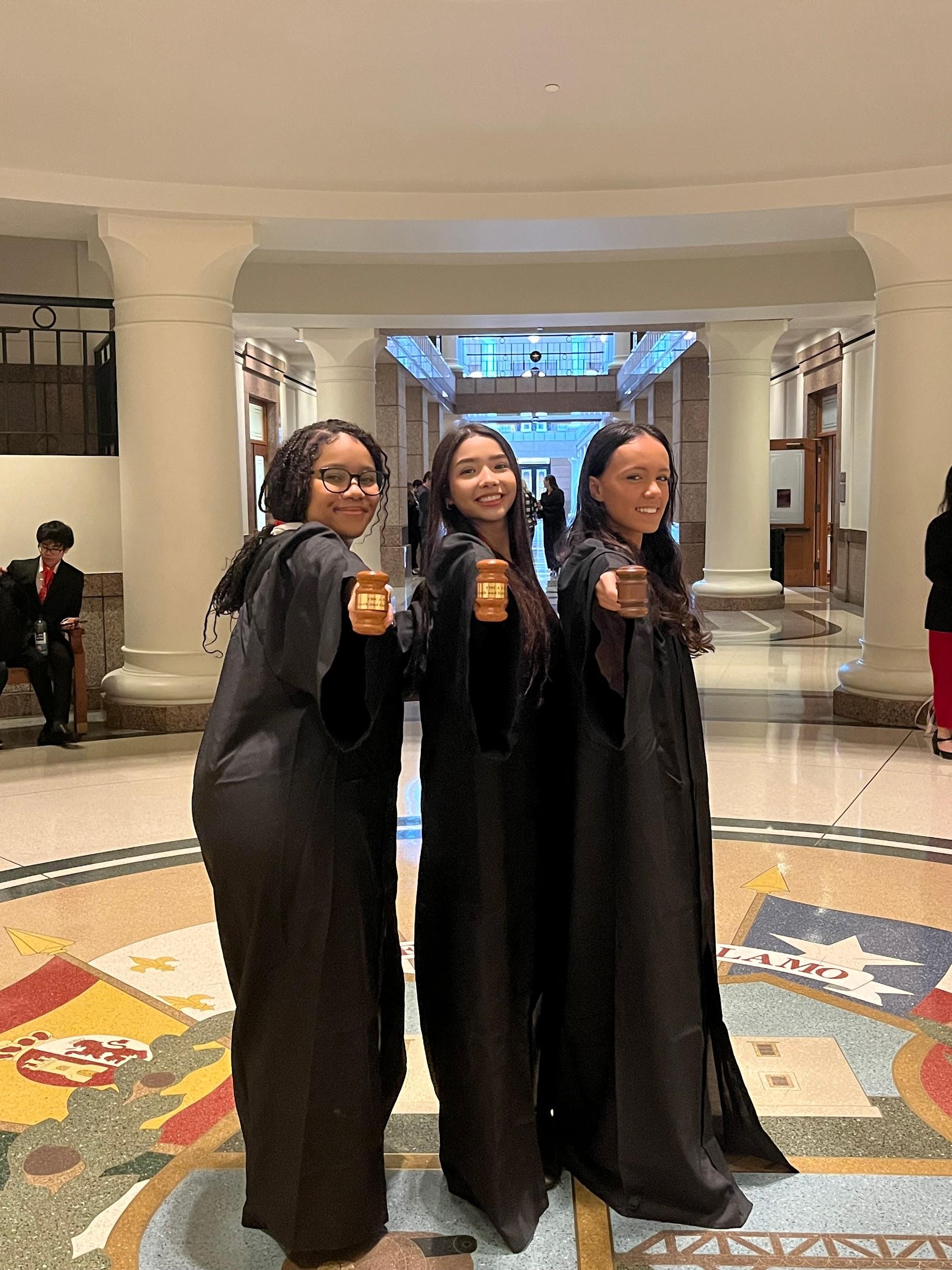
In trial court, a trial would not be complete without the delegates who portray the honorable judge. In the halls of the capitol, the judges prepare their scripts and review the rules of evidence in their heads before each round. They move from trial to trial independently, with no team to debrief with. Watching the judges float through the halls in their robes, you may wonder what it’s like for them. Is it isolating? Is it empowering? What do you get out of being a judge?

Firstly, is being a judge isolating? No, not entirely. According to Anthony Pham, from District 5, “I’ve gained new friends from other teams that I probably would have never met thanks to YG.” Lilia Marshall, a delegate from District 2, looks forward to seeing how teams argue the case. “I’ve really enjoyed seeing all the cases and ideas that people bring to the table and seeing how people have interpreted the case in all different ways and have used the evidence,” she exclaims. Marshall also finds that it’s rewarding to watch trial court rookies, aka freshmen and sophomores, navigate their way through the trial and gain their confidence and skill set, and she’s happy to be a part of that process.

Judges Chloe Hawkins and Alana Arteaga from District 5 hold similar sentiments. The two delegates are competing as judges for the first time, as they were previously nationally recognized trial court attorneys. Hawkins explains that nationals set her up to be a judge and impacted how she sees arguments made in the courtroom, saying, “It was isolating at first because you don’t have that companionship that you have with a team, getting to be on the other side makes up for it as you help teams learn and grow and become better at what they do, but also making sure teams have an equal chance to compete well.” Arteaga feels similarly, stating, “I became a judge because I wanted to see a new perspective of the courtroom, and I really wanted to help teams grow and be a part of their journey.”

While judges may help other teams grow as trial court delegates, they also experience self-growth. Arteaga describes the experience: “You’re just navigating through the capitol by yourself, and you’re having to grow by yourself.” With judging, you experience a type of control and empowerment unique compared to the empowerment you feel as an attorney or witness. Tiffini Edwards, from District 5, accurately compares the role of a judge to a referee in a sports game, saying, “I like being a judge because I like being able to rule on objections. I like knowing that I’m kind of the referee of the game. It’s a fun experience being a judge.”

Written by: Amarys Rodriguez

Delegates Koch, Beitsch Bring Book Bans to Statewide Level

State Affairs Forum delegates Natalie Koch and Mackie Beitsch believe some books should be banned from schools. But, they don’t believe that individual school districts should be the ones to ban books. “Our current education system allows books to be banned by each district,” said the delegates in their proposal. “This allows far too much subjective and based bias against certain topics.”

According to the American Library Association, 2023 brought 695 attempts to censor library materials from Jan. 1 to Aug. 3. These attempts are not evenly dispersed across the country, as Texas is the state with the most attempts at censorship. As an attempt to regulate yet still allow parent-led regulation of school materials, delegates Koch and Beitsch propose a TEA statewide committee to review challenged materials. “The state will form a state review committee within TEA for the purpose of regulating the restriction of books within public school libraries,” said Koch and Beitsch in their proposal. “Individual districts will no longer be allowed to ban a book of their own accord.”

Although on a much larger scale, the banning process would remain similar to what many districts have already implemented. “Parents, students, or faculty may submit books to the committee for a rating to either repeal or institute a ban on a book,” said the proposal. Not only would the state allow or disavow different books, but the committee would also be tasked with rating any book brought before them. “According to their content, books will be rated in a 5-tier system by the TEA said the proposal. “One being the lowest, containing little to no sensitive content, and five being the highest with a great amount of sensitive content.”

Beitsch and Koch aim not to cap school censorship. Instead, their goal is to funnel attempts through a reasonable, regulated source. The delegates state their expected outcome is “an increased amount of liberty of information for students, peace of mind for educators, vendors, and parents.”

Written by: Elaine Carte-Engel

Youth and Government Delegation Profiles

Democracy must be learned by each generation” is the motto of the YMCA Youth and Government Program, which has been around since 1936. To Quote from the YMCA Texas YG website, “Our Mission: To help teenagers become responsible citizens and future leaders of our nation.”(https://ymcatexasyg.org/about/cause/ ). From the outside perspective of Youth and Government, we see just four small sections: Legislative, Judicial, State Affairs Forum, and Media. As we look deeper inside, we see more sections run by teenagers helping form a democracy that will change this world.

At first glance, the legislative section appears to be just delegates debating and writing bills to be passed. But, when speaking to delegate Zakel Warren, he states, “Legislative is way more than that when we are deciding what to write our bill on; it’s subjects that we as delegates are passionate and truly proud of. Having your bill passed is truly an accomplishment as Leg is very competitive, and we get the experience of how our government works!” Legislative allows delegates to express their creative abilities while furthering their writing, research, and debate skills.

Continuing, as we look into Judicial, this section can be kids playing make-believe roles to debate and win, but it’s way more! Speaking with delegate Jordyn Baxter, she explains, “Judicial is a place where I feel close to home. I’m surrounded by many people I consider to be my family/team. Considering I am in theater, Judicial has allowed me to further my theater skills, as when I play my roles, I portray a story that ultimately helps my team, and I win in the end!” Judicial allows delegates to learn how to co-exist with each other while learning the forums of court.

Next, take a look at the State Affairs Forum section. From afar, it seems like delegates are just debating and trying to win over a room, but they do much more! The YMCA website reads, “Delegates are given current events, and as a team or solo, they come up with proposals or solutions to fix those problems. Delegates gain a lot from this section,” learning to think out of the box about certain solutions; they gain a different speaking ability, learning to intelligently and proudly speak about something they created that can fix a problem they are passionate about.” Many delegates also learn to do in-depth research as they have to familiarize themselves with the issue at hand.

Lastly, the Media section from the outside appears to be delegates who just take pictures or record videos. In reality, media delegates gain the experience of being the messenger. Sourced from the YMCA website, “As a section, delegates experience being punctuational, writing and comprehension abilities, and creative sparks.”; taking a look deep inside, delegates learn and gain the experiences of every other section. Without the media, as we see in the government of the United States and the YMCA, it would be harder to gain the perspective of what happening
around us.

Written by: Ajaila Joseph, Duncanville High School

Voting for Lee. Voting for Me.

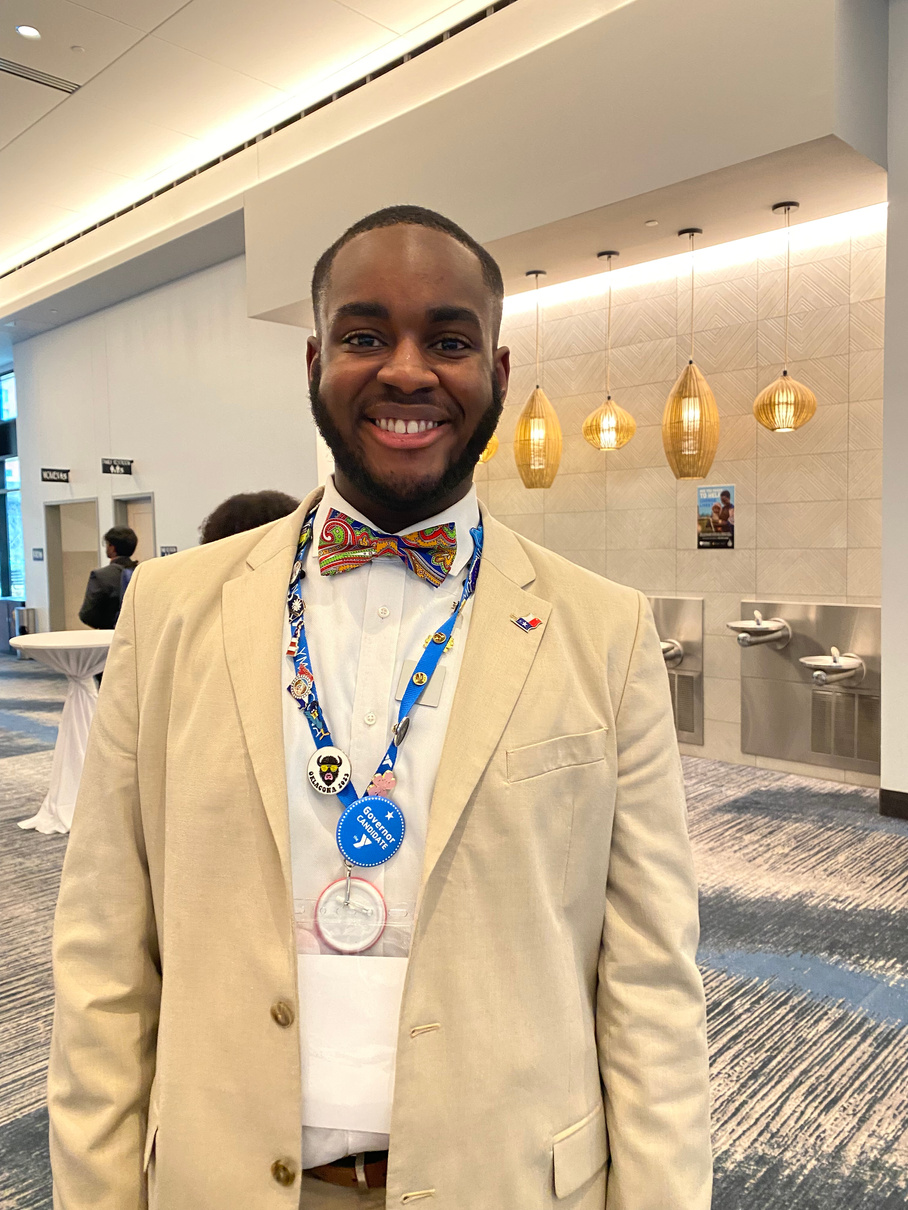
As Texas Youth & Government’s 2024 State Conference reels to a start, swarms of future legislatures, senators, representatives, and various others bring competitive spirit and their best to the Capitol. Among these revolutionary teenagers, Preston Lee, a candidate for Y&G governor, rises above, leading our youth with vigor and promises to be an active voice and force of change. Lee represents the efforts of fellow students to learn and execute democracy while encouraging others to step out of their comfort zones and see failure as a path to success. The young candidate captivates his audience with an engaging yet short speech, not just with mementos and encouragement but feasible ideas for future improvements in communication and connectivity within the organization.

Lee delves deep into plans of connectivity and communication within Youth & Government; his idea consists of creating a network, known as Y-check-ins, allowing all delegations and sections to have representation and an audible voice. The 17-year-old candidate emphasizes, “Because, without your voice and impact, who are we as Texas Youth & Government? The front-facing or the selfies are the most important because it is all about you. A small picture with a big impact. It represents our Y. That’s you, the people of Y&G, your voices and your stories.”

Lee makes it apparent that, if elected as governor, his focus will be on the experiences and relationships the vast participants of Y&G could share and the new perspective all members could gain. He concludes his eloquent speech with a few words of affirmation urging his fellow peers to vote for proper representation, “Imagine this: if a BeReal can bring global effect in 120 milliseconds, imagine the change and purpose each one of you can have by voting for me with just one vote. A vote for Lee, is a vote for me”. The young candidate’s invigorating speech illustrates his innate ability to unify Youth & Government. As a result, he gets 1000 program members to reiterate his slogan: A vote for Lee is a vote for me. During an interview with the governor candidate, Lee identifies his goal as governor to “Advocate and be a representative for the students across Y&G” and explains his focus on communication and connectivity in Y&G as “Those have been the two things that have really stood as a stepping stone through my journey in Y&G. Connection has been something so impactful for me, because when I started the program in 6th grade the ability to connect, the ability to communicate, those two important things have carried me through”.

Although Lee recognizes the ferocity of his competition, the young candidate remains confident in his skill, stating, “The sole thing that distinguishes me from other candidates, respectfully, is my experience.” The young man realizes his involvement within the organization has been six whole years, six state conferences, and six wonderful opportunities to progress, connect, and improve an expanding community.

Written by: Amina Ahmed, Foy H Moody High School

Texas Youth and Government State Conference

By Gael Realivazquez

The Youth and Government program has a series of competitions, starting with District.

District is right before State, and seeing if you make it past District, you get to compete against some of the best teams in the state at the State Conference.

Once you make it to state, for this year’s delegates, State Conference is held at the Kalahari Resort, an African themed waterpark with an arcade and many places to eat, as well as two Starbucks locations. However, this is still not an easy process to get through. There is still competition at the state conference, too. You are going against the best teams and even have a chance to make it to the Conference on National Affairs, or CONA.

Ramiro Lopez, Secretary of State

By Rigoberto Frausto Martinez

“The Secretary of State, appointed by the President with the advice and consent of the Senate, is the President’s chief foreign affairs adviser. The Secretary carries out the President’s foreign policies through the State Department and the Foreign Service of the United States” (US Department of State). With this quote in mind, we can kind of get a vague idea of what a Secretary of State does for one’s community. Ramiro Lopez is a great example of a leader who follows these given guidelines of leadership. I have personally seen him “carry out policies” here at Youth Government. He was early prompted to join Youth Government when a teacher during Covid saw a spark of interest in him for debate. She encouraged him to join and since then, he “hit it off”. After becoming Secretary of State for Youth Government, he fully fulfilled his duties and planned on making a higher voter turnout for our Youth Government candidates. These duties include mentoring other rising candidates for office, making sure all schedules are prepped and ready to go, and any type of help in general regarding Youth Government.

As any great Secretary of State, he is willing to do anything to support and help his community. “I think the job is very important. Election integrity is vital to the democracy in which we live in, while valuing and protecting that democracy is important” (Ramiro Lopez). Given that, we can clearly see that many of the USA’s Secretary of State’s views line up with Ramiro Lopez’s views. Another key factor that impacts and drives Ramiro Lopez’s views is all the poverty that he has experienced and seen first hand. “My school is 92% in poverty… so seeing a lot of kids around me struggle with basic things like finding clothes, basic necessities at home, food. These issues need to be tackled. Having leaders in our community is what’s going to tackle these issues.” (Ramiro Lopez). In conclusion, he is a great example of how a Secretary of State should lead and look like. For example, his favorite quote states, that “Democracy isn’t learned, isn’t just given to the next generation, It’s taught and it’s learned, and cannot be inherited especially in a time of crisis.” (Hawkins, President of the Tossin Teachers College).

Citations:
  • https://drive.google.com/file/d/1SiM4yo1pG0BMMFsN2RotNDOd_pFM0lxa/view?usp=drive_link
  • https://drive.google.com/file/d/1DHpxsf0JhY09wSy6NQYWtaMnK3NTqrPu/view?usp=drive_link
  • U.S. Department of State. (2020, December 1). Duties of the secretary of State – United States Department of State. U.S. Department of State.
    https://www.state.gov/duties-of-the-secretary-of-state/#:~:text=The%20Secretary%20of%20State%2C%20appointed,Service%20of%20the%20United%20States.

    Videos:
Go to Top