
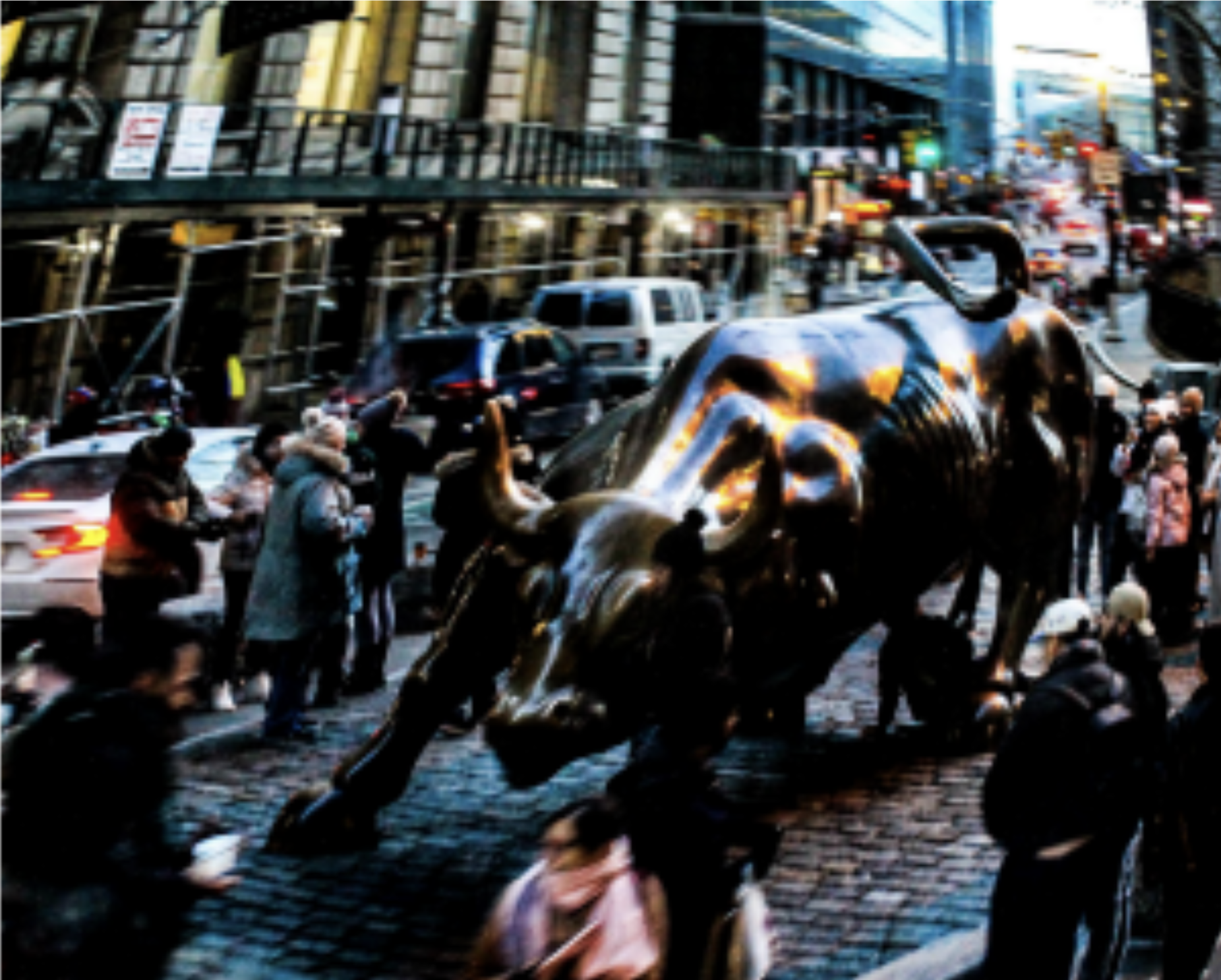
Photo Taken by David Lee, Corpus Christi Texas
Aesthetic values are taken into consideration. The photo was taken in a fast moving automobile, allowing for motion blur to be incorporated into the photo. The motion blur contributes to themes of chaos, with the bull’s passion and defiance being emphasized.
A sleek bronze bull is haunched in attack, charging at its onlookers. With eyebrows furrowed, horns curved, and muscles tense, the bull is filled with ferocity and determination. In the heart of New York City, The Bull’s atmosphere is squirming with tourists and businessmen, swarming the bull close to suffocation, painting a scene of determination in the midst of chaos.
The Charging Bull of New York symbolizes the American dream and the confident enigma of American entrepreneurship that motivates so many. The movement of the bull symbolizes the deep ferocious passion that has inspired so many Americans to actualize their dreams.
As a media delegate for YAG YMCA, I discovered an instance of emotional resonance with this scene. The tense, yet grounded determination that The Bull carries aligned with my experience within Youth and Government. In my district conference, the race to submit media assignments on time and the scurry to interview new faces for new articles made me filled with energy. It was a high pressure environment that still allowed me to be interactive and creative through literature. Training myself as a journalist and media delegate allowed me to gain the quality of adaptability and versatility through fast changing events and trends.
Changing Tides
My experience through Youth and Government has also informed me on the history of journalism, further highlighting its fast-paced, energetic nature. However, within the history of journalism, these changes can have detrimental consequences.
Print is dead, and we have killed it.
According to data from the US News Deserts Project, An estimated 300,000 jobs since 2000 have been lost due to the eventual decline of print, local outlets have been entirely shut down due to lack of interest, and political polarization has increased as a reduction in local community cohesion becomes more apparent. It’s important to humanize these statistics, and to take these shifts into empathetic context. Each job lost is a human being losing their purpose, their livelihood, and their passion. From Carolina Titus, she shared her personal experience with these rapidly shifting cultural and market conditions, “We’re currently cleaning toilets at two Airbnbs at our newspaper office to keep the presses printing. If we decide to shut the doors after 141 years, it’ll take us a year to wind down, we figure. We have to run out people’s subscriptions: can’t afford to give refunds!” Stephen Kaye, another journalist, from Millbrook further explores the nihilistic devastation that this change has inflicted:
“I was the editor and publisher of The Millbrook Independent, which closed its print operation after an eight-year run. We started two weeks after the preceding paper closed, taking local news to a higher plane. We found circulation shrinking and tried migrating to the web, which worked for us but not for readers who didn’t regularly
go to our web pages.
School boards, town and village boards, county news, local news — it all disappeared. We were a check on governments, on endless environmental and zoning hearings, on budgets that we often published in detail, on misdoings and good doings.
There is now a void. No one took up the slack.”
(New York Times, Takenaga)
The devastation that the death of print has caused cannot be understated. Whether it’s submitting assignments on strict deadlines, interviewing candidates, or brainstorming ideas for articles, my experience with youth and government has led me to understand the nature of journalism to be fast paced and constantly evolving. Similar to
The Charging Bull, I found a ground of determination and ambition in the face of chaos.
The Rise of Social Media
With the decline of print came the advent of social media as the primary form of communication and information. News now comes through the lens of flashy thumbnails, 2.5 second hooks to capture the algorithm, and influencers pushing emotional narratives to connect to their audience.
My journey through youth and government has therefore allowed me to combine multiple passions into one field. On my Tiktok account, @davetoearth, I post lifestyle vlogs consistently and was able to cultivate an audience of over 1000 followers. At the State Conference, I continued to post and create vlogs and influencer-formatted content to record my experience at youth and government. The traditional style of influencer content allows for a creator to relate to the viewer on a personal level, speaking casually and cultivating trust with their audience. As a member of Generation Z, I understand that many of my peers consume content through social media, and that cultural atmospheres and public opinion is shaped by the relatable voices we find on our social media feed. The death of print led to the advent of social media, and my experience with Media through Youth and Government allowed me to experience this change firsthand.
The evolution of journalism from print to social media has allowed for the beauty of journalism and literature to continue. Through fast paced graphics, relatable vlogs, and editing, Youth and Government has blessed me to experience this cultural and historical shift through a first hand experience.
Works Cited
Metzger, Zach. “The State of Local News.” Local News Initiative, 23 Oct. 2024,
localnewsinitiative.northwestern.edu/projects/state-of-local-news/2024/report/.
“Vanishing Readers and Journalists -.” The Expanding News Desert, www.usnewsdeserts.com/reports/news-deserts-and-ghost-newspapers-will-local- news-survive/the-news-landscape-in-2020-transformed-and-diminished/vanishing-readers-and-journalists/.
Photo Taken by David Lee, Corpus Christi Texas
Aesthetic values are taken into consideration. The photo was taken in a fast moving automobile, allowing for motion blur to be incorporated into the photo. The motion blur contributes to themes of chaos, with the bull’s passion and defiance being emphasized.
A sleek bronze bull is haunched in attack, charging at its onlookers. With eyebrows furrowed, horns curved, and muscles tense, the bull is filled with ferocity and determination. In the heart of New York City, The Bull’s atmosphere is squirming with tourists and businessmen, swarming the bull close to suffocation, painting a scene of determination in the midst of chaos.
The Charging Bull of New York symbolizes the American dream and the confident enigma of American entrepreneurship that motivates so many. The movement of the bull symbolizes the deep ferocious passion that has inspired so many Americans to actualize their dreams.
As a media delegate for YAG YMCA, I discovered an instance of emotional resonance with this scene. The tense, yet grounded determination that The Bull carries aligned with my experience within Youth and Government. In my district conference, the race to submit media assignments on time and the scurry to interview new faces for new articles made me filled with energy. It was a high pressure environment that still allowed me to be interactive and creative through literature. Training myself as a journalist and media delegate allowed me to gain the quality of adaptability and versatility through fast changing events and trends.
Changing Tides
My experience through Youth and Government has also informed me on the history of journalism, further highlighting its fast-paced, energetic nature. However, within the history of journalism, these changes can have detrimental consequences.
Print is dead, and we have killed it.
According to data from the US News Deserts Project, An estimated 300,000 jobs since 2000 have been lost due to the eventual decline of print, local outlets have been entirely shut down due to lack of interest, and political polarization has increased as a reduction in local community cohesion becomes more apparent. It’s important to humanize these statistics, and to take these shifts into empathetic context. Each job lost is a human being losing their purpose, their livelihood, and their passion. From Carolina Titus, she shared her personal experience with these rapidly shifting cultural and market conditions, “We’re currently cleaning toilets at two Airbnbs at our newspaper office to keep the presses printing. If we decide to shut the doors after 141 years, it’ll take us a year to wind down, we figure. We have to run out people’s subscriptions: can’t afford to give refunds!” Stephen Kaye, another journalist, from Millbrook further explores the nihilistic devastation that this change has inflicted:
“I was the editor and publisher of The Millbrook Independent, which closed its print operation after an eight-year run. We started two weeks after the preceding paper closed, taking local news to a higher plane. We found circulation shrinking and tried migrating to the web, which worked for us but not for readers who didn’t regularly
go to our web pages.
School boards, town and village boards, county news, local news — it all disappeared. We were a check on governments, on endless environmental and zoning hearings, on budgets that we often published in detail, on misdoings and good doings.
There is now a void. No one took up the slack.”
(New York Times, Takenaga)
The devastation that the death of print has caused cannot be understated. Whether it’s submitting assignments on strict deadlines, interviewing candidates, or brainstorming ideas for articles, my experience with youth and government has led me to understand the nature of journalism to be fast paced and constantly evolving. Similar to
The Charging Bull, I found a ground of determination and ambition in the face of chaos.
The Rise of Social Media
With the decline of print came the advent of social media as the primary form of communication and information. News now comes through the lens of flashy thumbnails, 2.5 second hooks to capture the algorithm, and influencers pushing emotional narratives to connect to their audience.
My journey through youth and government has therefore allowed me to combine multiple passions into one field. On my Tiktok account, @davetoearth, I post lifestyle vlogs consistently and was able to cultivate an audience of over 1000 followers. At the State Conference, I continued to post and create vlogs and influencer-formatted content to record my experience at youth and government. The traditional style of influencer content allows for a creator to relate to the viewer on a personal level, speaking casually and cultivating trust with their audience. As a member of Generation Z, I understand that many of my peers consume content through social media, and that cultural atmospheres and public opinion is shaped by the relatable voices we find on our social media feed. The death of print led to the advent of social media, and my experience with Media through Youth and Government allowed me to experience this change firsthand.
The evolution of journalism from print to social media has allowed for the beauty of journalism and literature to continue. Through fast paced graphics, relatable vlogs, and editing, Youth and Government has blessed me to experience this cultural and historical shift through a first hand experience.
Works Cited
Metzger, Zach. “The State of Local News.” Local News Initiative, 23 Oct. 2024,
localnewsinitiative.northwestern.edu/projects/state-of-local-news/2024/report/.
“Vanishing Readers and Journalists -.” The Expanding News Desert, www.usnewsdeserts.com/reports/news-deserts-and-ghost-newspapers-will-local- news-survive/the-news-landscape-in-2020-transformed-and-diminished/vanishing-readers-and-journalists/.