By Naden Ramirez
B. Ray High School
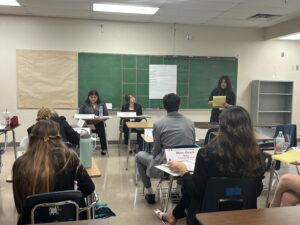
We should prohibit the wearing of socks with sandals. This is HB005, written by Alexandra Harper, and an example of one of several “joke bills” that took place at Committee 6 at the district meet for Districts 2 & 7. A large variety of bills were proposed, some relating to issues involving schools, while others were about lighthearted issues where they took a strong stance on issues like whether or not we should allow for Texas schools to teach that the Earth is flat. One bill that showed a genuine compassion for the issue it was discussing was HB088, which argued for an act to regulate paid plasma donation practices. The bill author, Sofia Torres, spoke on the issue with such passion during a casual 10-minute recess, and her passion was highlighted even more when she officially proposed her bill.
The main components of her bill included provisions such as “The Texas Department of State Health Services (DSHS) shall regulate plasma donation practices statewide. Individuals may donate plasma no more than once every fourteen days, with payments capped at sixty dollars per donation.” This bill is meant to address the real-world issue of the connection between blood plasma donation and poverty in the United States. Americans with low incomes use these donations as a way to “add a few hundred dollars a month to household income, an important source of economic support for low-income families” as stated in “The Interlinkage Between Blood Plasma Donation and Poverty in the United States” by Western Michigan University. Although this can add on several hundred bucks a month to a person’s income, the detrimental effects of this on a person’s body are too severe. This is why Torres capped plasma donation to “no more than once every fourteen days” to ensure those who are donating plasma, mainly those in the lower class, have time to recover as much as possible. The negative effects of donating too much plasma are extensive, as it can lead to things such as dehydration, fatigue, vein damage, iron deficiency, infection, and many more.
Placing regulations on an issue as serious as this in a sort of mock legislation reflects the real-world actions we should be taking towards regulating health-related issues such as this. Torres’s bill not only shows an incredible amount of passion towards a real-world issue, but it also reflects the positive effects of organizations such as Youth and Government. These sorts of organizations allow students to participate in real issues even if it is in a “fake” setting, allowing them to share their voice and inform people on real-world issues. As stated on the Youth and Government website, “Democracy must be learned by each generation.”