Volunteer with us Today!! We have various dates to choose from Jan 31st | Feb 1st | Feb 27th | Feb 28th | Mar 1st | Sign Up Today!

2024

The Media Branch

By Isabella Martinez

Media is often overlooked by an audience, but great experiences and opportunities are brought along the way once you learn more about YMCA Youth and Government media. Some insight on media is developing communication to interact with other delegates and share your ideas within your branch or outside of your branch. The endless possibilities enable a great space and environment for the mind to have the freedom of creativity. When learning to expand your thoughts into paper, interviews, or documents, you share the final product with the public to keep up a good representation of the YMCA.

Reporters also display the status of conferences between legislatives, delegates, and other members of Youth and Government. Media members get a closer view of the depths in court from different perspectives. As the YMCA website describes the different sections and the meaning of media, it mentions the responsibilities of creating original articles with clear details and highlights to emphasize the great work of all the individuals within the YMCA. I believe the YMCA Youth and Government program is a great start if you plan on having a successful future in the media industry because you get the knowledge of submitting assignments by a certain deadline, developing intellectual understanding, and many more skills that would help you benefit from in the best way possible. Plenty of dedication and confidence is required to continue your journey of becoming an experienced media member. While interviewing a current media member, media means to express an individual’s opinions about their career and their current house branch, also collecting information about why they decided to do pursue their current role. Media has so much to offer in both life and personal preferences to evolve and develop as a social member.

YG Members: Information for Rookies

By Ajaila Joseph

Austin, TX – Teams from all over Texas have prepared for this day, the Texas Youth and Government State Conference! Each year the Youth and Government program continues to grow in size gaining new members but losing the old. ” It is a pretty scary but fun experience going to state.” says, Malani McNeil, a first-time Youth and Government member. ” I can’t tell if I feel prepared, over-prepared, or under­prepared! Yes, my advisor and my veteran teammates have told me how it works, but when I’m alone I can’t help but feel a little nervous.”.

Looking around I couldn’t help but sympathize with new members, so I went around gathering evidence to make their first State Conference, a bit easier to navigate. During the opening ceremony Youth Governor, Vannela Mallampati, gave her short speech. “When I first joined Youth and Government I was a shy girl scared to to speak in the room and hiding in the corner. It wasn’t till one day when an advisor told me six words, that I will now tell you guys, ‘Fake it, till you make it!”‘. For the rookies all around let this quote stick with you. The Youth Governor who was once shy, is able now to lead a State Conference, your confidence will get there! As Vannela says “Nobody will remember if you stutter in your opening statement, if you fake it till you make it, eventually you will not be faking it anymore!”. Listening to another delegate, a veteran Esmeralda Rios, give her speech during the opening ceremony, moved me.

I grew up going to school with Esmeralda knowing she was a shy girl. Esmeralda grew in the last year, took a chance, and ran for a state officer position­ and won for that fact! Now seeing her from that shy girl to the confident one I know now, it’s amazing to see that’s what Youth and Government can do! In Esmeralda’s words, ” I would tell rookies to take a chance, I did and look at the outcome! I know it may be scary, but every chance you don’t take is a shot you will a hundred percent miss!” So to all the rookies in YG right now, it’s okay, it may be hard now, but later it will not be!

Feeling Lost? A Guide for First Time Y&G Delegates at State

Speaking from personal experience, my first time at the state youth and government conference, I felt like a lost puppy who didn’t have a clue in the world on where to begin. From working on my first media assignment to meeting some lifelong friends, I have made countless memories here, and I am forever grateful that I decided to immerse myself within the program. I have been in Youth and Government for three years now, so I have seen my fair share, but even if you are in media, state affairs, legislative, or even mock trial, my advice for anyone would be to just have fun.

This program is a great opportunity and tool for you to expand your knowledge and meet new people you may reconnect with in the future. Do not stress, worry, or overwork yourself, thinking you will mess up. Instead, go into this conference with the mindset that “ Hey, I am here for a reason, I have the opportunity to be here, so let’s make the best of it!”

According to the official website of the YMCA Youth & Government, a multitude of resources are provided from an eight-lesson curriculum available to study and prepare yourself to many other great resources on managing your chapter. The website shows different manuals and templates regardless of what subdivision you’re competing in, there is a lot of information and resources available to delegates to further help them prepare for the state conference.

My advice for anyone at the state conference for the first time is to talk to different people and not be afraid to speak up. Enjoy every minute of the time spent at the conference, and most importantly, remember to have fun! The Youth and Government community is a family of students with the same passions as you do. Even if it is not easy, make sure to step out of your comfort zone.

Written by: Benjamin Cisneros, Veterans Memorial/Austin Delegation

Advice For Rookies

By Marley Nervais

For rookies coming into youth and government is a new experience. It may not be what they might have expected. For anyone, this could be the case.

No matter what age or grade as a newcomer it’s a very different environment. Although it can be nerve-wracking many people are here to help the rookies.

“I would probably say to have confidence. Your case could suck but if you go up there and just talk with some mediocre level of confidence you’ll be fine. I wish someone would’ve told me that every case is different and the way you have your case set up the way you have your witnesses to talk, the way you have your opening, your introduction, and your pretrial is going to be different than everyone else’s and that is fine. It’s normal and nothing to worry about.”  Delegate Izy Black said.

For another viewpoint student Anna Kate Beck “A piece of advice I would give someone coming in would be to listen to all your evaluators and judges. The reason you’re there is to learn new stuff. If you listen to all their critics it will definitely improve your first to last round.”

“Something I wish someone told me was to not be afraid to object because even if your objection is wrong it still proves that what you know and that you can attempt it.”

Aaron Esquivel and Syed Humaide give a very popular piece of advice by both saying

“Fake it till you make it”

This advice seems to have paid off due to this team winning their first round of prosecution.

“Fake it till you make it and act confident in whatever you have prepared because basically you only succeed in this when you’re confident in yourself and I believe that especially in public speaking confidence is key. Syed Humaide said.

Innocent or Guilty

On February 2, 2024, the court trial over the death of a woman at the hands of a police officer took place. Prosecutors Addison Hobbs and Haley Hillhouse gave their evidence on why they believe the officer to be guilty and used their share of witnesses to further prove their point.

The prosecutors institute legal proceedings against the defendant. (Oxford).

The trial had a couple of memorable moments, which eased some of the stress that our delegates were experiencing. Eleven-year-old Sage Alexander, the young nephew of the woman murdered, gave his testimony on how he witnessed the scene. After a while of arguing whether he made burnt fish sticks or cookies that night, the defense grew a bit impatient with the witnesses, giving the prosecutors an advantage in the trial. After the prosecutors asked a question to a witness about their feelings in the matter, the defense interrupted with an objection. A relevance objection is based on the argument that the evidence is not relevant to the case (Robinson). After being overruled, the witness gave touching insight into their personal feelings on the matter. As the defense’s witness gave their testimony, the Judge decided that their arguments were just not strong enough. With the prosecutor’s following witness being a forensic pathologist with knowledge on the wounds of the deceased, the outcome of this trial had come to an end. The Judge declared the police officer to be guilty of murder, and the prosecution was declared victorious.

Written by: Andrea Jimenez

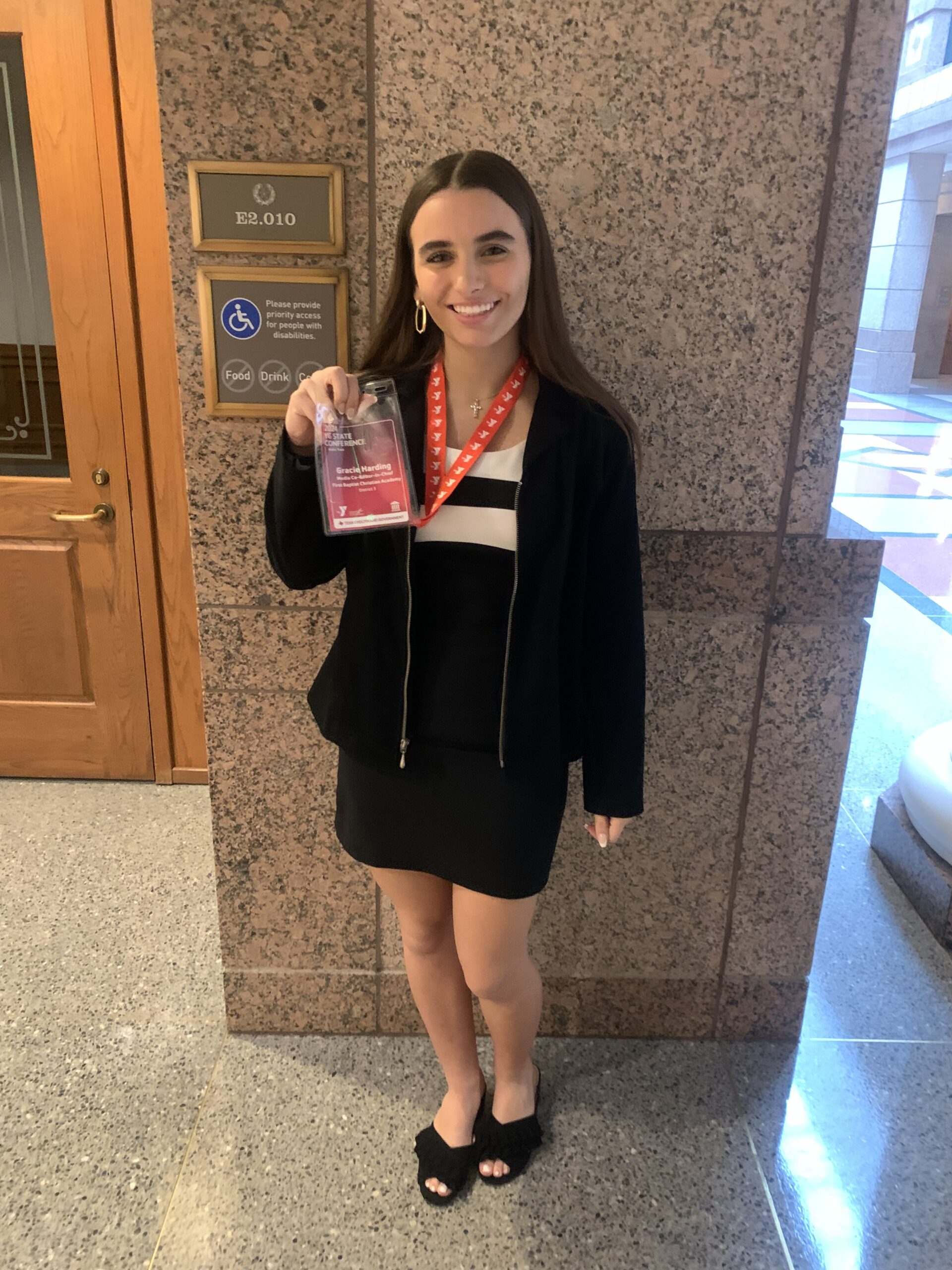
A Day in the Life of Media and Co-Editor Chief Gracie Harding

In a recent interview, 18-year-old Gracie Harding, the Media and Co-Editor Chief of Youth and Government, shared key metrics for using social media to engage with other young media participants in Youth and Government activities. According to Gracie Harding, the most effective way to accomplish this is to create relatable and engaging content that the youth can relate to. Harding highlights the importance of relatability by stating, “Focus on content that the audience wants to see rather than what the organizers want to showcase. It’s about giving them something relatable that they can engage with.” She also suggests to include humor to better engage the audience. “Add funny metrics while still maintaining connection to the primary sources. This not only entertains but also leads the way to more substantial information.”

She then told me about her most successful media campaign which was broadcast videos. Harding explained, “Last year, we made broadcast videos sent to all participants through newsletters. The visual appeal and entertainment value ensured that participants not only received information but also enjoyed the process. When asked what strategies are used to ensure diverse representation in the media produced for the youth and government programs, Harding elaborated on the fact that she dedicates specific days to covering different branches of government programs. This systematic approach contributes to more inclusive and representative coverage of media.

For aspiring media students interested in Youth and Government, Harding commented, “Be open to meeting new people, making connections, and having a few ideas in advance. Getting involved in relevant groups or activities provides experience for skills in media.” Since then, Gracie has looked forward to seeing where the Media section of YG lies in the future.

Written by: Tyler Tran

Did Alex Green Do It?

By Lynette Huang

The county court’s Mock Trial case on February 2, 2024, was Bill R Johnson CTE against First Baptist Christian Academy, with the accused, Alex Green, facing charges for the alleged murder of an innocent victim. The prosecution was led by attorneys Hillhouse and Hobbs representing First Baptist Christian Academy, while attorneys Abraham and Lincoln defended Alex Green on behalf of Bill R Johnson CTE. The prosecution built a strong case, presenting a trio of compelling witnesses. Sage Alexander, the victim’s nephew, provided emotional insight into the impact of the alleged crime. Latin Shield, a coworker of Alex Green, offered perspectives on the suspect’s behavior, and an expert pathologist meticulously detailed the fatal bullet wounds, establishing a narrative of intentional harm. On the defense side, attorneys Abraham and Lincoln called forth witnesses to counter the prosecution’s claims. Alex Green took the stand to testify in his defense, providing his perspective on the events leading up to the tragic incident. Additionally, a contract expert was brought in to challenge the prosecution’s interpretation of the evidence. The prosecution strategically presented physical evidence to strengthen their case, notably the forensic analysis of the bullet wounds. The pathologist’s testimony revealed multiple gunshot wounds, crucial in establishing a narrative of premeditated murder. Despite the victim having a firearm, the prosecution effectively argued that it was solely for self-defense and was not discharged during the altercation. The trial unfolded, with each side making their arguments. The judge, after careful consideration of the evidence and legal arguments, delivered a verdict of guilty for Alex Green. This marked the conclusion of a comprehensive and thought-provoking mock trial, underscoring the complexities of legal proceedings and the importance of a thorough presentation of evidence in reaching a just conclusion. Following the trial, Delegate Haley Hillhouse expressed feeling nervous during the proceedings and shared a sense of relief upon winning the verdict.

The First Bill

By Gabriel Iara

The first bill that was introduced at the 77th Youth and Government Legislative Senate Committee was presented by Elliot Copeland. Delegate Copeland introduced his bill (FS21) an act increasing the safety of laborers in extreme heat workplaces. This bill would provide workers with protection against the hot Texas weather. The first provision included a requirement for employers to install thermometers in work sites to keep track of the temperature outside. The second provision mandates workers are provided with 8 ounces of water every 20 minutes and workers are mandated to take breaks. Many delegates were skeptical about the provision as they believed 8 ounces was “too small” or “unrealistic” as some said. The penalties in this bill included a class c misdemeanor (500$ fine). Delegate Copeland ended his speech by stating: “A vote in favor of this bill is a vote in favor of the life of a fellow Texan”. The debate that ensued after Delegate Copeland’s presentation was lively and engaging. Some delegates voiced concerns about the practicality of enforcing the provisions, especially in smaller businesses or rural areas where resources might be limited. Others argued passionately for the necessity of such measures, citing instances of heat-related illnesses and fatalities among workers in Texas.

Several delegates proposed amendments to the bill, suggesting modifications to the water provision quantities or proposing alternative methods to ensure worker safety in extreme heat conditions. These discussions led to a deeper exploration of the challenges faced by laborers in various industries across the state. Eventually, the committee decided on amendments including, The bill shall only be in place in areas hotter than 90 degrees Fahrenheit. Although the delegates were mostly in unison over the amendments often mostly ye or mostly ne. The most controversial amendment was one that introduced shaded areas and air-conditioned vehicles. Many delegates were against this because of the economic downside. Many family-owned and rural businesses may not be able to meet the requirements.

At the end of deliberations, Delegate Copeland Reminded the committee that ” we should not put money over the lives of real people”.

A.I. Regulations

By Naomi Alexander

The use and abuse of deep fakes.

Austin, TX – Living in the 21st century, we can use advanced technology to make everyday life easier. Year by year technology improves unlocking new ways we can use it. In 2024, one of the most popular forms of technology is social media. And the main concern in this article is the use of social media, particularly sharing A.I. Artificial intelligence has been taking the world by storm with 77%of devices in use featuring some form of A.I. (Fact by AuthorityHacker January 10, 2024.) Its use isn’t just shared on social media but also in businesses, health care facilities, film production, and many other areas. 81.6% of digital marketers think content writer’s jobs are at risk because of A.I. Today in first committees, a State Affairs proposal presented in Committee 5 spoke on this very issue. Delegate Gali and Delegate Iyengar presented their proposal concerning deep-fake regulations. Their major area is affecting the general population of Texas and social media companies operating in Texas.

In summary from the proposal book, they proposed that the Texas legislature will be enforcing social media corporations including, but not limited to Twitter, Instagram, Facebook, and YouTube, to ban all deep-fake content concerning real-world individuals or events with the intent to harm the general public. All major social media companies and search engines would have to implement this policy regardless of their status and inform their viewers/ subscribers of these changes before the policies take effect.

Adding on, to platforms that have sections for children 14 and younger, all deepfakes will be banned irrespective of their content or intent. These policies will not ban or restrict comedy because these are forms of free speech and artistic expression. These policies would also have consequences ranging from account cancellation to legal prosecution. This proposal sparked debates on the advantages and negative effects of deep-fake A.I. on the real world. Regardless, current data suggests that A.I. adoption will keep rising faster as technology keeps improving. It is up to jobs and platforms to see how they’re going to regulate it in regard to human rights and dignity.

The Puzzling Pursuit of a Confused Cop: Guilty or Not Guilt

By Amarys Rodriguez

On February 2nd, 2024, the case of the State of Texas vs. Alex Greene was brought to trial. The prosecution, consisting of attorneys from District 5, Alli Mitchell and Jake Kleinjan brought forth evidence that the defendant, Officer Alex Greene, should be found guilty of felony murder in the first and second degree. To prove their case they called forth three witnesses, Sage Alexander, the nephew of the victim Kamari Jenkins, Leighton Shields, a fellow police officer of Alex Greene, and Breslin Barajas, a forensic pathologist that examined the body of Kamari Jenkins. Through each witness they built their case brick by brick, that the “reckless actions” of Alex Greene should be the reason for his conviction, because as attorney Alli Mitchell emphasized in her opening statement, “Kamari Jenkins was simply trying to protect her castle”.

In contrast, the defense attorneys, Keri Collins and Adelaide Cowden from District 2, argued that Officer Greene had to make a “split-second decision, in a life or death situation”. Through the testimony of their three witnesses Ferrin Glass, Officer Alex Greene, and Bellamy Fraye, they emphasized that Officer Greene acted in accordance with his department policies in taking the shot against Kamari Jenkins that resulted in her death.

As each side defended their case, in an effort to prove or disprove the burden of the prosecution, in the end with the two bangs of a gavel, the “Prosecution has not met their burden on count one, felony murder, but has met their burden on count two, they will be charged for count 2, felony murder.” This was ultimately a trial of responsibility, in a case like this how does one hold an officer accountable for defending his life, yet ending the life of another?

Go to Top