Volunteer with us Today!! We have various dates to choose from Jan 31st | Feb 1st | Feb 27th | Feb 28th | Mar 1st | Sign Up Today!

2024

Delegates Koch, Beitsch Bring Book Bans to Statewide Level

State Affairs Forum delegates Natalie Koch and Mackie Beitsch believe some books should be banned from schools. But, they don’t believe that individual school districts should be the ones to ban books. “Our current education system allows books to be banned by each district,” said the delegates in their proposal. “This allows far too much subjective and based bias against certain topics.”

According to the American Library Association, 2023 brought 695 attempts to censor library materials from Jan. 1 to Aug. 3. These attempts are not evenly dispersed across the country, as Texas is the state with the most attempts at censorship. As an attempt to regulate yet still allow parent-led regulation of school materials, delegates Koch and Beitsch propose a TEA statewide committee to review challenged materials. “The state will form a state review committee within TEA for the purpose of regulating the restriction of books within public school libraries,” said Koch and Beitsch in their proposal. “Individual districts will no longer be allowed to ban a book of their own accord.”

Although on a much larger scale, the banning process would remain similar to what many districts have already implemented. “Parents, students, or faculty may submit books to the committee for a rating to either repeal or institute a ban on a book,” said the proposal. Not only would the state allow or disavow different books, but the committee would also be tasked with rating any book brought before them. “According to their content, books will be rated in a 5-tier system by the TEA said the proposal. “One being the lowest, containing little to no sensitive content, and five being the highest with a great amount of sensitive content.”

Beitsch and Koch aim not to cap school censorship. Instead, their goal is to funnel attempts through a reasonable, regulated source. The delegates state their expected outcome is “an increased amount of liberty of information for students, peace of mind for educators, vendors, and parents.”

Written by: Elaine Carte-Engel
Youth and Government Delegation Profiles

Democracy must be learned by each generation” is the motto of the YMCA Youth and Government Program, which has been around since 1936. To Quote from the YMCA Texas YG website, “Our Mission: To help teenagers become responsible citizens and future leaders of our nation.”(https://ymcatexasyg.org/about/cause/ ). From the outside perspective of Youth and Government, we see just four small sections: Legislative, Judicial, State Affairs Forum, and Media. As we look deeper inside, we see more sections run by teenagers helping form a democracy that will change this world.

At first glance, the legislative section appears to be just delegates debating and writing bills to be passed. But, when speaking to delegate Zakel Warren, he states, “Legislative is way more than that when we are deciding what to write our bill on; it’s subjects that we as delegates are passionate and truly proud of. Having your bill passed is truly an accomplishment as Leg is very competitive, and we get the experience of how our government works!” Legislative allows delegates to express their creative abilities while furthering their writing, research, and debate skills.

Continuing, as we look into Judicial, this section can be kids playing make-believe roles to debate and win, but it’s way more! Speaking with delegate Jordyn Baxter, she explains, “Judicial is a place where I feel close to home. I’m surrounded by many people I consider to be my family/team. Considering I am in theater, Judicial has allowed me to further my theater skills, as when I play my roles, I portray a story that ultimately helps my team, and I win in the end!” Judicial allows delegates to learn how to co-exist with each other while learning the forums of court.

Next, take a look at the State Affairs Forum section. From afar, it seems like delegates are just debating and trying to win over a room, but they do much more! The YMCA website reads, “Delegates are given current events, and as a team or solo, they come up with proposals or solutions to fix those problems. Delegates gain a lot from this section,” learning to think out of the box about certain solutions; they gain a different speaking ability, learning to intelligently and proudly speak about something they created that can fix a problem they are passionate about.” Many delegates also learn to do in-depth research as they have to familiarize themselves with the issue at hand.

Lastly, the Media section from the outside appears to be delegates who just take pictures or record videos. In reality, media delegates gain the experience of being the messenger. Sourced from the YMCA website, “As a section, delegates experience being punctuational, writing and comprehension abilities, and creative sparks.”; taking a look deep inside, delegates learn and gain the experiences of every other section. Without the media, as we see in the government of the United States and the YMCA, it would be harder to gain the perspective of what happening
around us.

Written by: Ajaila Joseph, Duncanville High School

Voting for Lee. Voting for Me.

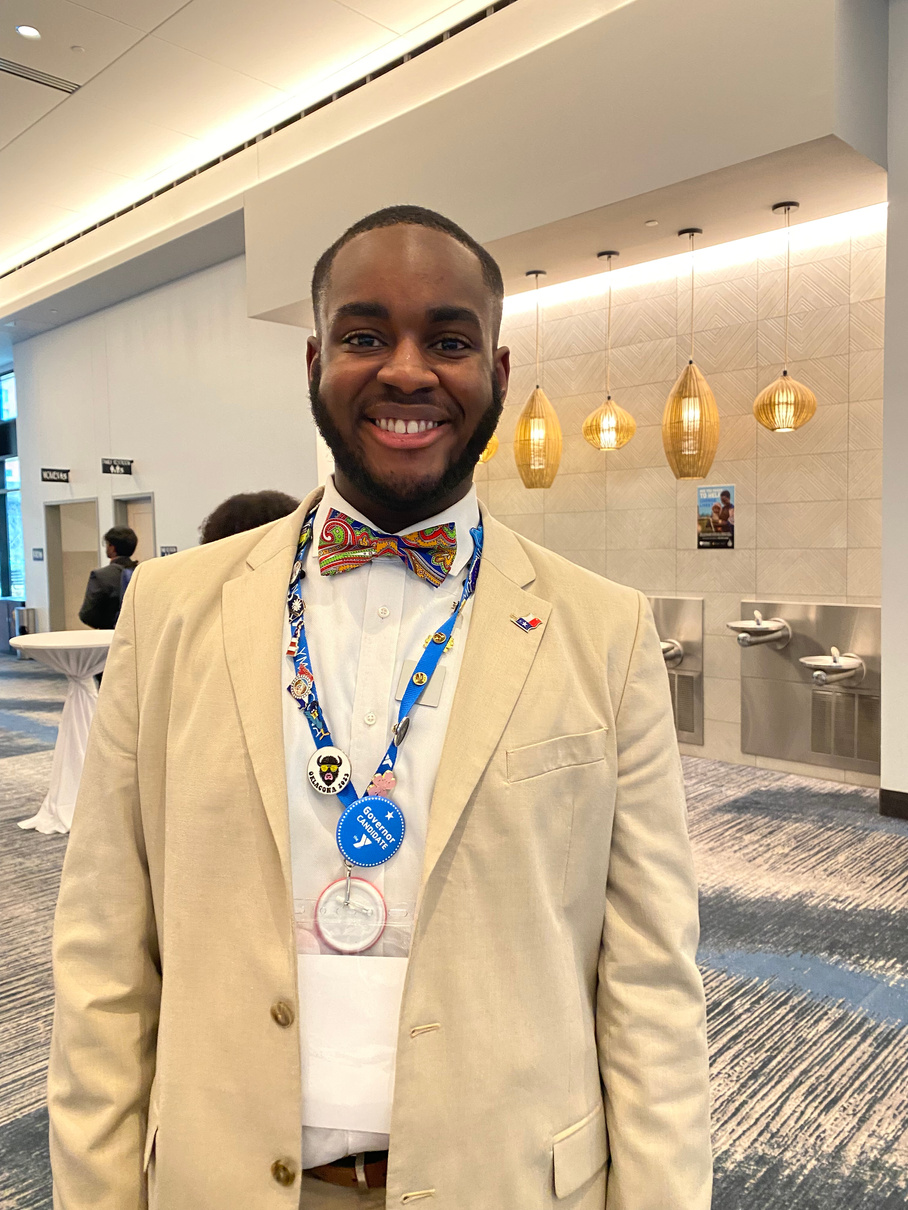
As Texas Youth & Government’s 2024 State Conference reels to a start, swarms of future legislatures, senators, representatives, and various others bring competitive spirit and their best to the Capitol. Among these revolutionary teenagers, Preston Lee, a candidate for Y&G governor, rises above, leading our youth with vigor and promises to be an active voice and force of change. Lee represents the efforts of fellow students to learn and execute democracy while encouraging others to step out of their comfort zones and see failure as a path to success. The young candidate captivates his audience with an engaging yet short speech, not just with mementos and encouragement but feasible ideas for future improvements in communication and connectivity within the organization.

Lee delves deep into plans of connectivity and communication within Youth & Government; his idea consists of creating a network, known as Y-check-ins, allowing all delegations and sections to have representation and an audible voice. The 17-year-old candidate emphasizes, “Because, without your voice and impact, who are we as Texas Youth & Government? The front-facing or the selfies are the most important because it is all about you. A small picture with a big impact. It represents our Y. That’s you, the people of Y&G, your voices and your stories.”

Lee makes it apparent that, if elected as governor, his focus will be on the experiences and relationships the vast participants of Y&G could share and the new perspective all members could gain. He concludes his eloquent speech with a few words of affirmation urging his fellow peers to vote for proper representation, “Imagine this: if a BeReal can bring global effect in 120 milliseconds, imagine the change and purpose each one of you can have by voting for me with just one vote. A vote for Lee, is a vote for me”. The young candidate’s invigorating speech illustrates his innate ability to unify Youth & Government. As a result, he gets 1000 program members to reiterate his slogan: A vote for Lee is a vote for me. During an interview with the governor candidate, Lee identifies his goal as governor to “Advocate and be a representative for the students across Y&G” and explains his focus on communication and connectivity in Y&G as “Those have been the two things that have really stood as a stepping stone through my journey in Y&G. Connection has been something so impactful for me, because when I started the program in 6th grade the ability to connect, the ability to communicate, those two important things have carried me through”.

Although Lee recognizes the ferocity of his competition, the young candidate remains confident in his skill, stating, “The sole thing that distinguishes me from other candidates, respectfully, is my experience.” The young man realizes his involvement within the organization has been six whole years, six state conferences, and six wonderful opportunities to progress, connect, and improve an expanding community.

Written by: Amina Ahmed, Foy H Moody High School

Ramiro Lopez, Secretary of State

By Rigoberto Frausto Martinez

“The Secretary of State, appointed by the President with the advice and consent of the Senate, is the President’s chief foreign affairs adviser. The Secretary carries out the President’s foreign policies through the State Department and the Foreign Service of the United States” (US Department of State). With this quote in mind, we can kind of get a vague idea of what a Secretary of State does for one’s community. Ramiro Lopez is a great example of a leader who follows these given guidelines of leadership. I have personally seen him “carry out policies” here at Youth Government. He was early prompted to join Youth Government when a teacher during Covid saw a spark of interest in him for debate. She encouraged him to join and since then, he “hit it off”. After becoming Secretary of State for Youth Government, he fully fulfilled his duties and planned on making a higher voter turnout for our Youth Government candidates. These duties include mentoring other rising candidates for office, making sure all schedules are prepped and ready to go, and any type of help in general regarding Youth Government.

As any great Secretary of State, he is willing to do anything to support and help his community. “I think the job is very important. Election integrity is vital to the democracy in which we live in, while valuing and protecting that democracy is important” (Ramiro Lopez). Given that, we can clearly see that many of the USA’s Secretary of State’s views line up with Ramiro Lopez’s views. Another key factor that impacts and drives Ramiro Lopez’s views is all the poverty that he has experienced and seen first hand. “My school is 92% in poverty… so seeing a lot of kids around me struggle with basic things like finding clothes, basic necessities at home, food. These issues need to be tackled. Having leaders in our community is what’s going to tackle these issues.” (Ramiro Lopez). In conclusion, he is a great example of how a Secretary of State should lead and look like. For example, his favorite quote states, that “Democracy isn’t learned, isn’t just given to the next generation, It’s taught and it’s learned, and cannot be inherited especially in a time of crisis.” (Hawkins, President of the Tossin Teachers College).

Citations:
  • https://drive.google.com/file/d/1SiM4yo1pG0BMMFsN2RotNDOd_pFM0lxa/view?usp=drive_link
  • https://drive.google.com/file/d/1DHpxsf0JhY09wSy6NQYWtaMnK3NTqrPu/view?usp=drive_link
  • U.S. Department of State. (2020, December 1). Duties of the secretary of State – United States Department of State. U.S. Department of State.
    https://www.state.gov/duties-of-the-secretary-of-state/#:~:text=The%20Secretary%20of%20State%2C%20appointed,Service%20of%20the%20United%20States.

    Videos:

The Case is Wide Open

By Benjamin Cisneros

The Big Case at the Y&G Conference

Austin, TX – The big case this year that mock trial delegates will debate on is the case of “the confused cop”. On the night of November 25th, 2022 Officer Alex Greene responded to a high-priority call to the residence of Kamari Jenkins. He ended up shooting her and she ended up passing away, the prosecution looks to indict Officer Greene for the murder of Kamari Jenkins. The sequence of events on that night is as follows. The Mustang police department received a call about a possible burglary by a concerned neighbor.

Officer Alex Greene took the lead and responded to the call, he was joined by fellow officer Leighton Shields. They both scan the perimeter of the property and Officer Alex Greene ends up in a very dark backyard where he frantically spots Ms. Jenkins through a window and proceeds to fire his firearm in “self-defense” and she collapses on the ground. Officer Greene enters the home through the front door as he sees that it is cracked open. Once he enters the home he notices that the house is all out of sorts as if it had just been burglarized. He finds Ms. Jenkins on the ground with a firearm in her hand, officer Greene begins chest compressions but as it is too late she unfortunately passes away. The witnesses for the defense (Alex Greene) are as follows, Alex Greene, the defendant. Dr. Bellamy Frey, a police training expert.

Finally, Ferrin Glass, the next-door neighbor who made the call to the police worried for Ms. Jenkins. The witnesses for the prosecution (the state of Texas) are Sage Alexander, the eleven-year-old niece of Kamari Jenkins who witnessed her aunt being shot. Leighton Shields, the officer who went to back up Officer Greene. The last witness is Dr. Breslin Barajas, the medical examiner. Delegates debated deliberately and have made cases for both sides. In the case I witnessed, the two teams were at a standoff. In the end, the State won with a count of serious bodily injury to the victim, the defendant was found guilty. The trial was intense and full of arguments, questioning, and intricate investigation.

Delegates of ‘24

The Perspective of the New and the Vets

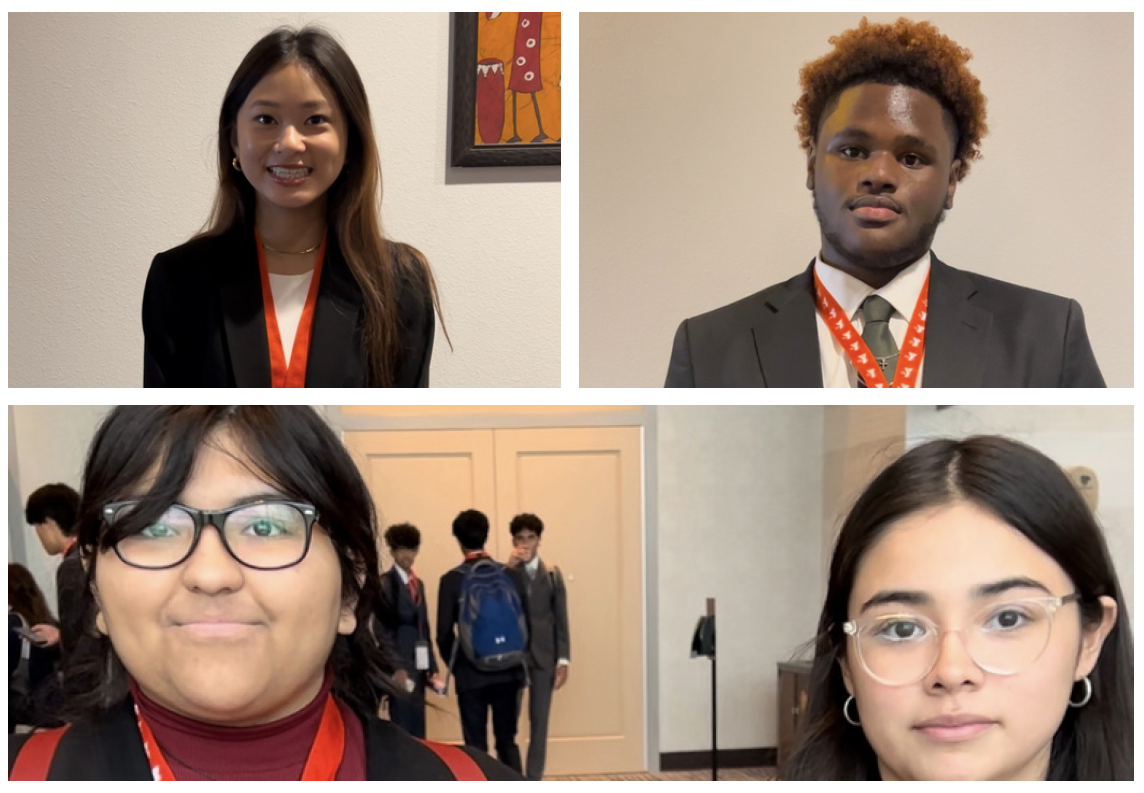
Youth and Government has people of all grades and experience levels. In State Affairs, we have a couple of new and experienced perspectives. On the bottom, we have two first-year delegates, Delegate Castillo and Delegate Lopez. Delegate Castillo’s proposal is about discrimination in the army against women, mainly women who are facing harassment/sexual harassment. Delegate Lopez proposes increasing the janitor’s wages to 15 per hour. Castillo is interested in YAG because she likes the idea of picking a topic you feel strongly about. Delegate Lopez was interested because she attended a law camp and gained a strong interest in mock trials. Both of their experiences have been meeting new people, and they both want to learn more details about different SAF topics.

The top left corner is Delegate Tran, a first-year YAG member. Her proposal is about increasing the minimum wage in Texas. Her experience so far has been great, and she doesn’t feel stage fright, but debating is where she finds challenges. Delegate Tran wants to learn how to motion and yield time to others more effectively to understand the debating process more. Finally, we have Delegate Wiltz, a 3-year veteran, in the top right corner. His proposal is about deep fake regulation affecting social media sites and users. Over the years, Delegate Wiltz said that his favorite experiences are debating new topics because he loves discussing new things. Delegate Wiltz says that YAG helped him develop his future because he is considering majoring in public affairs in college. One thing he says he wished he would’ve known his first year is how hectic competing and experiencing the conference could get! From these many perspectives and viewpoints, we see what the state is like for many different levels of delegates. One thing they all have in common is that they all enjoy and love going through this experience and making new memories.

Written By: Naomi Alexander, Duncanville High school/Oak Cliff Delegation

What is Media, Really?

A Need-to-Know Basis of the Youth and Government’s Media Section

At a typical Texas Youth and Government State Conference, one can find students in legislative, state affairs, judicial, and less commonly known media. This section only takes 50 students from all districts to the state conference. Despite being one of four sections, not many people know about the section or what it does. In the real world, however, the media plays a huge role in connecting people to the government. An aspect that the Youth and Government attempt to model.

According to Ishmael Behrhorst, the senior director for marketing at the YMCA, media was the last section to be added to YG after it was founded. He states in an interview that media “is the balance to be able to tell stories of everything that’s happening at the conference while also replicating what happens every day in real life.” Activities include writing news-report-like stories, creating social media posts, and photographing delegates. Students have the freedom to “use their creativity, art, video skills, and even their human to be able to tell the stories that really matter and affect us daily.”

The media section has transformed throughout the years. Assignments from the previous year’s state conference differ significantly from the current ones. Esmerelda Rios, a media co-editor-in-chief, says, “Social media used to be a newer concept that not everyone was sure about. But with time, we have come to see how integrated media is in our society and politics and how it can help inform audiences. This is definitely reflected in the changes made to the YG media section because it is now reflecting real-world media to actively engage and inform people.” As the world undergoes constant change, the Youth and Government media section stands ready to adapt.

This section has done a lot for its students. For Gracie Harding, a media co-editor-in-chief, media has “helped her photography skills tremendously.” For Rios, it is a “tool to help her reach her goals.” As much as media changes based on the world’s evolving trends, the section should also cater to the needs of its students. Harding expresses discontent on the section’s news articles, she says she “would like to make it more visual based and interactive. When the target audience is our generation and our participants, let’s be honest, after a long day of trials and submitting bills, students would rather skim an article than read it.” Every year, the media section enhances the YG experience, ensuring it stays informative and engaging for all generations. It’s always keeping on track to meet the evolving world and its student needs, offering a truly immersive journey.

By: Medha Rapuri

A day at YG

By Benjamin Wise

My name is Benjamin Wise and I will be writing about the bills that I heard about in court today. Today, I went to the Texas State Capitol in Austin, Texas. Inside the Capitol, there are many different places. The place I went to is in the Senate chamber where they pass bills. When I first got here, to the Senate chamber in the Capitol, they were talking about a bill they wanted to pass for people who work outside to keep them from overheating. One of the main things about this bill is that they wanted thermometers on the job site to measure the heat and also to have water on the site just to keep people from overheating and mandatory breaks for work to keep them from overheating and if workers don’t get this then the company will be fined with a class C misdemeanor. They also wanted small cups of water for the workers to drink whenever they got too hot. Also, they said that they could get water bottles but right now they get small cups for their mandatory break. The person passing the bill wanted a 20-minute break for the workers because that was enough time for them to cool down and drink some water. The author of the bill said that above 90 degrees is considered extreme heat and that that’s enough to take a break. However, someone countered him and said that they think 90 degrees isn’t too much and that workers can still overheat at around 80°. When they voted for the bill it did not pass the first time but Second vote when they did a recount the bill passed.

The second bill they talked about was about circumcision. The author of the bill said that Jewish babies should be allowed to be circumcised. Many people did not agree with him. They said that being circumcised can lead to many sexual diseases and normal diseases as well. However, the author said that being circumcised gives you benefits. Another argument they had is that babies can’t give consent to have circumcisions and they said that once you turn 18 you should be able to choose if you want to get circumcised. The bill did not pass.

For the third and final bill, the author proposed that all private and public school teachers must be first aid and CPR certified. One of their arguments was that when professionals arrive to try and save a student who has something wrong with them it could be too late for that child and a teacher who is first aid or CPR satisfied could save peoples lives. They said that it is a situation you would not want to be in but if it does happen it’s always good to be prepared. The bill didn’t pass.

Prosecution Attorney Brooke Desir

A Look Into a Texas YG Attorney’s Life

What is a prosecution attorney, and what do they do? Cornell Law defines this as “an attorney elected or appointed by local government officials to represent the state in a criminal case brought in a judicial district or designated county.” Prosecution attorneys are the people who go against the person who has been charged with violating the law. Brooke Desir is a student at Saginaw High School in Texas and a prosecuting attorney in the Judicial section of the YMCA Texas Youth and Government program. This year’s case is about a police officer who shot and killed a woman who he mistook for an armed burglar while investigating her house with his partner. The prosecution had to prove that the officer had the intent to kill.

The prosecution has to meet the burden of proof, which Desir describes as “proof beyond any reasonable doubt.” She says this is the hardest part of being a prosecuting attorney “because you can have all this emotion and stuff, but if you can’t actually meet the law, that’s kind of where the law in mock trial plays in.”

Mock trial involves a lot of teamwork with your fellow attorneys and your witnesses. Being able to work together with people and cooperating with your team is a must if you want to do well during the trial.

Brooke Desir and her team work amazingly together, and, according to Desir, they are always trying to come up with new ways to prove [their] case.” Desir first looks at the law, and based off of the law, she sees what she can use to make it work in her favor. She specifically loves using figurative language to make their case more emotional and compelling, appealing to people’s emotions to sway them to her side. In the days leading up to the trial, Desir and her team ran through the entirety of their case at least once a day, every day. The team’s attorneys and witnesses must memorize everything about the case and what they have to do and say. Whether someone wins or loses their trial isn’t a big deal in the Judicial section, as everyone is criticized and praised by both the judge and evaluator. In the end, though, Desir says, “When you like what you do, it’s really easy to do it.”

Written By: Edy Wang, LASA

Exploring the Intersection of Law: The Mock Trial Program

By Eliana Balderas

In the dynamic world of Youth and Government, one program stands out for its unique blend of legal education, advocacy, and public speaking prowess- the Mock Trial Program. Designed to stimulate real courtroom proceedings, this immersive experience offers participants a firsthand glimpse into the intricacies of the legal system. There is a captivating realm of mock trials within the Youth and Government framework. “Honestly Mock Trial serves as a great outlet to be with my friends, not only this but challenges my thinking and helps me gain skills toward speaking, all the way to being argumentative,” Valentino Ortiz said. Through rigorous preparation, compelling arguments, and spirited courtroom debates, these young advocates emerge not only as champions of justice but also as empowered leaders. “Mock trial means family to me, not only am I able to portray the role as an attorney that has allowed me and my family to get a glimpse of my future career but it has given me a family of my own. Within the past months, I have spent more time with my team than with my actual family. Although there came times of stress and arguments we all had a clear goal which was to strive higher than any other team,” Leslie Contreras said. From mastering the art of case preparation to honing cross-examination techniques, the transformative impact of the mock trial program and invaluable skills instill the perfect skills for young leaders. “I joined a mock trial to fulfill my dreams of being in a courtroom as an attorney representing and defending victims. Although everything is simply a re-enactment of a real court case, it shows me what I will one day be looking at when I am facing a real trial,” Leslie Contreras said.

Go to Top