
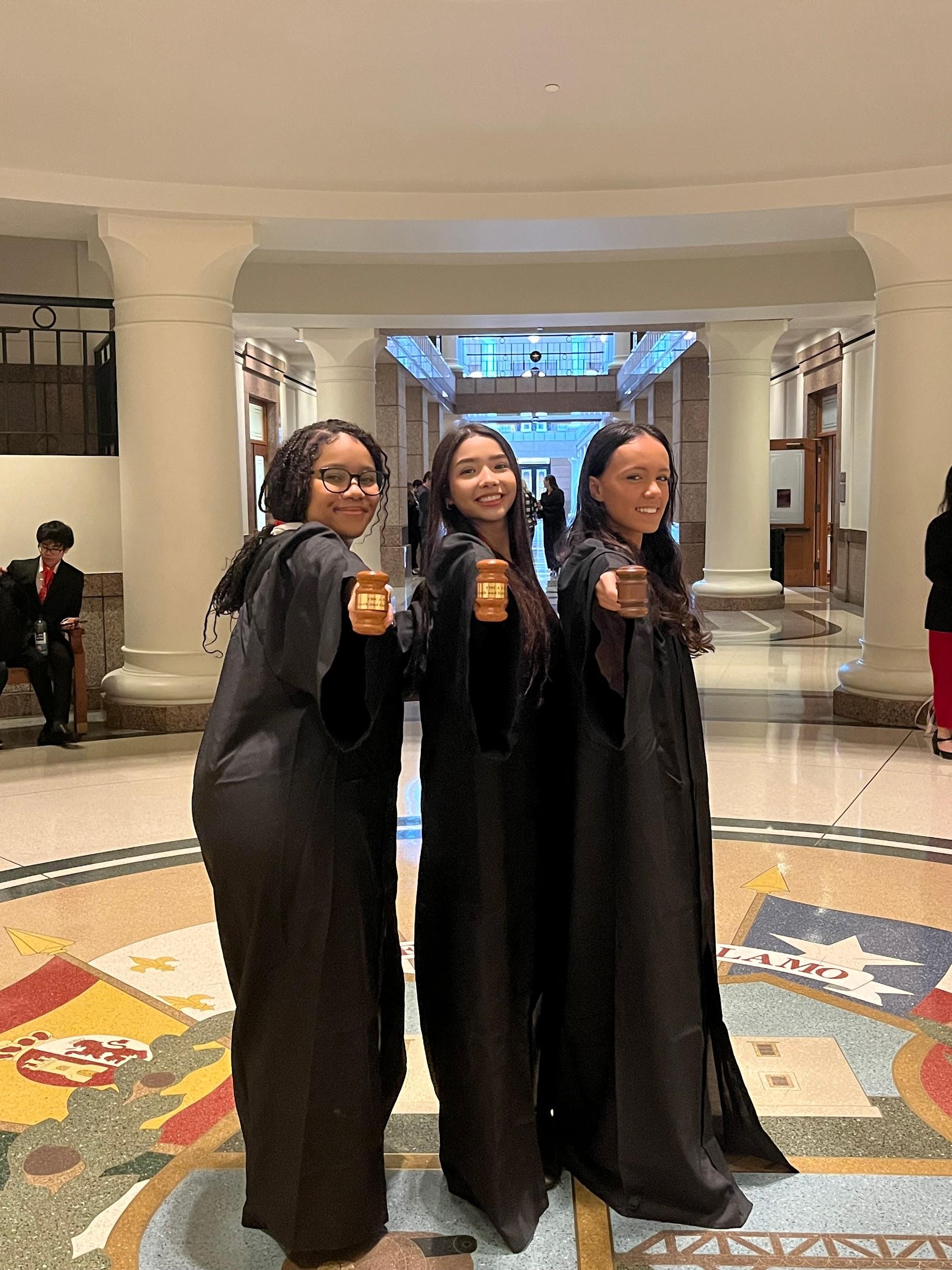
Inspirational insight into the perspective of trial court judges.
The Texas Youth and Government judicial branch has had immense success over the past couple of years, with Texas consistently being recognized for having the best trial and appellate court teams at the national level. Yet, as the judicial branch gathers in the State Capitol, we often overlook one crucial section of the Youth and Government Trial Court: Judges.
In trial court, a trial would not be complete without the delegates who portray the honorable judge. In the halls of the capitol, the judges prepare their scripts and review the rules of evidence in their heads before each round. They move from trial to trial independently, with no team to debrief with. Watching the judges float through the halls in their robes, you may wonder what it’s like for them. Is it isolating? Is it empowering? What do you get out of being a judge?
Firstly, is being a judge isolating? No, not entirely. According to Anthony Pham, from District 5, “I’ve gained new friends from other teams that I probably would have never met thanks to YG.” Lilia Marshall, a delegate from District 2, looks forward to seeing how teams argue the case. “I’ve really enjoyed seeing all the cases and ideas that people bring to the table and seeing how people have interpreted the case in all different ways and have used the evidence,” she exclaims. Marshall also finds that it’s rewarding to watch trial court rookies, aka freshmen and sophomores, navigate their way through the trial and gain their confidence and skill set, and she’s happy to be a part of that process.
Judges Chloe Hawkins and Alana Arteaga from District 5 hold similar sentiments. The two delegates are competing as judges for the first time, as they were previously nationally recognized trial court attorneys. Hawkins explains that nationals set her up to be a judge and impacted how she sees arguments made in the courtroom, saying, “It was isolating at first because you don’t have that companionship that you have with a team, getting to be on the other side makes up for it as you help teams learn and grow and become better at what they do, but also making sure teams have an equal chance to compete well.” Arteaga feels similarly, stating, “I became a judge because I wanted to see a new perspective of the courtroom, and I really wanted to help teams grow and be a part of their journey.”
While judges may help other teams grow as trial court delegates, they also experience self-growth. Arteaga describes the experience: “You’re just navigating through the capitol by yourself, and you’re having to grow by yourself.” With judging, you experience a type of control and empowerment unique compared to the empowerment you feel as an attorney or witness. Tiffini Edwards, from District 5, accurately compares the role of a judge to a referee in a sports game, saying, “I like being a judge because I like being able to rule on objections. I like knowing that I’m kind of the referee of the game. It’s a fun experience being a judge.”
Written by: Amarys Rodriguez